
中年小鼠长期使用地西泮治疗后认知功能受损及海马体变化
Impaired Cognitive Function and Hippocampal Changes Following Chronic Diazepam Treatment in Middle-Aged Mice.
作者信息
Furukawa Tomonori, Nikaido Yoshikazu, Shimoyama Shuji, Masuyama Nozomu, Notoya Ayaka, Ueno Shinya
机构信息
Department of Neurophysiology, Hirosaki University Graduate School of Medicine, Hirosaki, Japan.
Department of Frailty Research and Prevention, Hirosaki University Graduate School of Medicine, Hirosaki, Japan.
出版信息
Front Aging Neurosci. 2021 Nov 26;13:777404. doi: 10.3389/fnagi.2021.777404. eCollection 2021.
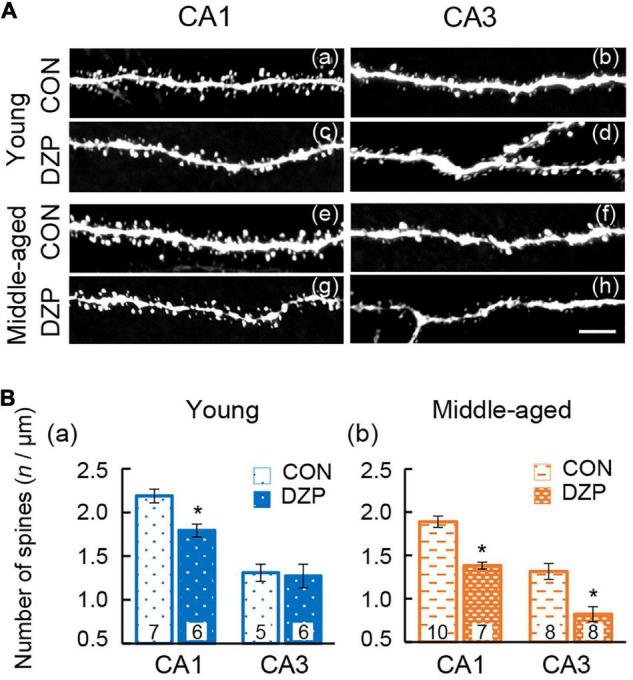
Gamma-aminobutyric acid (GABA) type A receptors are positively allosterically modulated by benzodiazepine binding, leading to a potentiated response to GABA. Diazepam (DZP, a benzodiazepine) is widely prescribed for anxiety, epileptic discharge, and insomnia, and is also used as a muscle relaxant and anti-convulsant. However, some adverse effects - such as tolerance, dependence, withdrawal effects, and impairments in cognition and learning - are elicited by the long-term use of DZP. Clinical studies have reported that chronic DZP treatment increases the risk of dementia in older adults. Furthermore, several studies have reported that chronic DZP administration may affect neuronal activity in the hippocampus, dendritic spine structure, and cognitive performance. However, the effects of chronic DZP administration on cognitive function in aged mice is not yet completely understood. A behavioral test, immunohistochemical analysis of neurogenic and apoptotic markers, dendritic spine density analysis, and long-term potentiation (LTP) assay of the hippocampal CA1 and CA3 were performed in both young (8 weeks old) and middle-aged (12 months old) mice to investigate the effects of chronic DZP administration on cognitive function. The chronic intraperitoneal administration of DZP was performed by implanting an osmotic minipump. To assess spatial learning and memory ability, the Morris water maze test was performed. Dendritic spines were visualized using Lucifer yellow injection into the soma of hippocampal neurons, and spine density was analyzed. Moreover, the effects of exercise on DZP-induced changes in spine density and LTP in the hippocampus were assessed. Learning performance was impaired by chronic DZP administration in middle-aged mice but not in young mice. LTP was attenuated by DZP administration in the CA1 of young mice and the CA3 of middle-aged mice. The spine density of hippocampal neurons was decreased by chronic DZP administration in the CA1 of both young and middle-aged mice as well as in the CA3 of middle-aged mice. Neither neurogenesis nor apoptosis in the hippocampus was affected by chronic DZP administration. The results of this study suggest that the effects of chronic DZP are different between young and middle-aged mice. The chronic DZP-induced memory retrieval performance impairment in middle-aged mice can likely be attributed to decreased LTP and dendritic spine density in hippocampal neurons in the CA3. Notably, prophylactic exercise suppressed the adverse effects of chronic DZP on LTP and spine maintenance in middle-aged mice.
γ-氨基丁酸(GABA)A型受体可被苯二氮䓬类药物结合进行正性变构调节,从而增强对GABA的反应。地西泮(DZP,一种苯二氮䓬类药物)被广泛用于治疗焦虑、癫痫发作和失眠,还用作肌肉松弛剂和抗惊厥药。然而,长期使用DZP会引发一些不良反应,如耐受性、依赖性、戒断反应以及认知和学习障碍。临床研究报告称,长期使用DZP会增加老年人患痴呆症的风险。此外,多项研究报告称,长期给予DZP可能会影响海马体中的神经元活动、树突棘结构和认知能力。然而,长期给予DZP对老年小鼠认知功能的影响尚未完全明确。在年轻(8周龄)和中年(12月龄)小鼠中进行了行为测试、神经发生和凋亡标志物的免疫组织化学分析、树突棘密度分析以及海马体CA1和CA3的长时程增强(LTP)测定,以研究长期给予DZP对认知功能的影响。通过植入渗透微型泵进行DZP的长期腹腔注射。为评估空间学习和记忆能力,进行了莫里斯水迷宫测试。通过向海马神经元胞体注射路西法黄使树突棘可视化,并分析棘密度。此外,评估了运动对DZP诱导的海马体棘密度和LTP变化的影响。长期给予DZP会损害中年小鼠的学习能力,但不会损害年轻小鼠的学习能力。给予DZP会减弱年轻小鼠CA1区和中年小鼠CA3区的LTP。长期给予DZP会降低年轻和中年小鼠CA1区以及中年小鼠CA3区海马神经元的棘密度。长期给予DZP对海马体中的神经发生和凋亡均无影响。本研究结果表明,长期给予DZP对年轻和中年小鼠的影响不同。长期给予DZP导致中年小鼠记忆检索能力受损,这可能归因于CA3区海马神经元的LTP和树突棘密度降低。值得注意的是,预防性运动可抑制长期给予DZP对中年小鼠LTP和棘维持的不良影响。



 Zotero 插件