Division of Infectious Diseases, Department of Internal Medicine, Keimyung University Dongsan Hospital, Keimyung University School of Medicine, Daegu, South Korea.
Department of Internal Medicine, Seoul Red Cross Hospital, Seoul, South Korea.
Front Immunol. 2021 Nov 23;12:772320. doi: 10.3389/fimmu.2021.772320. eCollection 2021.
To evaluate clinical effectiveness of regdanvimab, a monoclonal antibody agent for treating coronavirus 2019 (COVID-19).
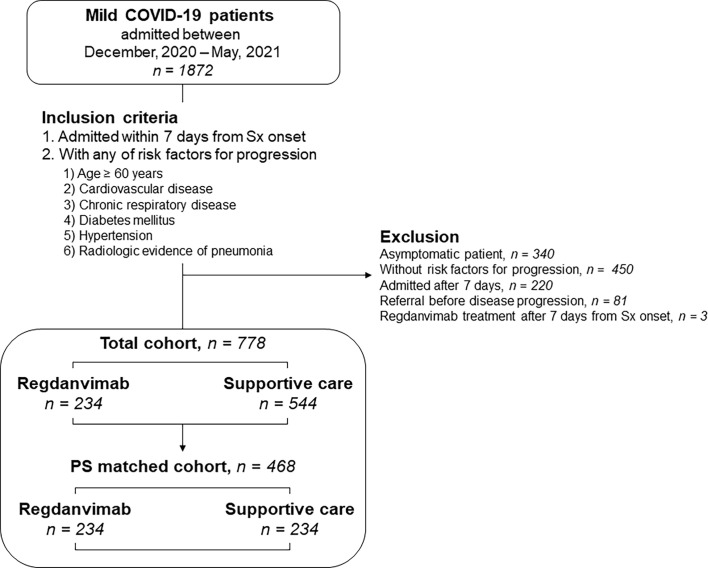
A retrospective cohort study was conducted at two general hospitals during the study period of December 2020 to May 2021. Mild COVID-19 patients with risk factors for disease progression admitted to the hospitals within seven days of symptom onset were enrolled and followed until discharge or referral. Multivariate analyses for disease progression were conducted in the total and propensity score (PS)-matched cohorts.
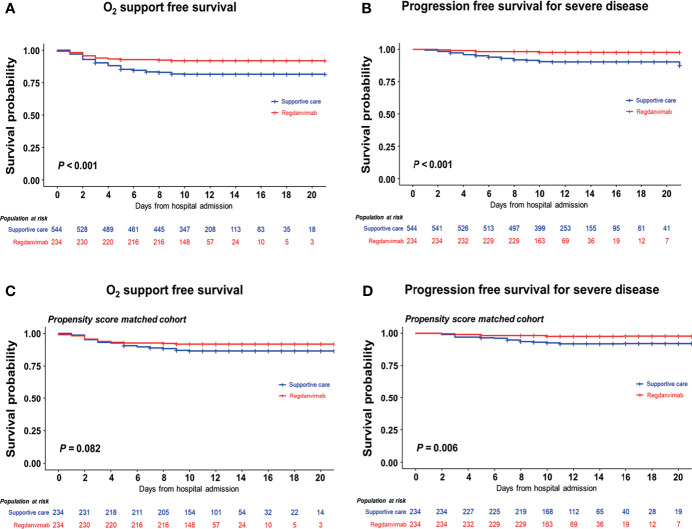
A total of 778 mild COVID-19 patients were included and classified as the regdanvimab (n = 234) and supportive care (n = 544) groups. Significantly fewer patients required O supplementation nasal prong in the regdanvimab group (8.1%) than in the supportive care group (18.4%, < 0.001). The decreased risk for O support by regdanvimab treatment was noticed in the multivariate analysis of the total cohort (HR 0.570, 95% CI 0.343-0.946, = 0.030), but it was not statistically significant in the PS-matched cohort ( = 0.057). Progression to severe disease was also significantly lower in the regdanvimab group (2.1%) than in the supportive care group (9.6%, < 0.001). The significantly reduced risk for progression to severe disease by regdanvimab treatment was observed in the analysis of both the total cohort (HR 0.262, 95% CI 0.103-0.667, = 0.005) and PS-matched cohort (HR 0.176, 95% CI 0.060-0.516, = 0.002). Potential risk factors for progression were investigated in the supportive care group and SpO < 97% and CRP elevation >1.5 mg/dL were common risk factors for O support and progression to severe disease. Among the patients with any of these factors, regdanvimab treatment was associated with decreased risk for progression to severe disease with slightly lower HR (HR 0.202, 95% CI 0.062-0.657, = 0.008) than that of the total cohort.
Regdanvimab treatment was associated with a decreased risk of progression to severe disease.
评估单克隆抗体药物 Regdanvimab 治疗 2019 年冠状病毒病(COVID-19)的临床疗效。
本研究采用回顾性队列研究,在 2020 年 12 月至 2021 年 5 月期间在两家综合医院进行。对发病后 7 天内入院的有疾病进展风险的轻症 COVID-19 患者进行登记,并进行随访直至出院或转科。在总人群和倾向评分(PS)匹配队列中进行疾病进展的多变量分析。
共纳入 778 例轻症 COVID-19 患者,分为 Regdanvimab 组(n=234)和支持治疗组(n=544)。Regdanvimab 组需要补充氧气鼻管的患者比例(8.1%)明显低于支持治疗组(18.4%,<0.001)。多变量分析显示,Regdanvimab 治疗可降低发生氧气支持的风险(HR 0.570,95%CI 0.343-0.946,=0.030),但在 PS 匹配队列中无统计学意义(=0.057)。Regdanvimab 组进展为重症的比例(2.1%)也明显低于支持治疗组(9.6%,<0.001)。多变量分析显示,Regdanvimab 治疗可降低进展为重症的风险(HR 0.262,95%CI 0.103-0.667,=0.005),在 PS 匹配队列中也有类似结果(HR 0.176,95%CI 0.060-0.516,=0.002)。在支持治疗组中对进展的潜在危险因素进行了调查,SpO2<97%和 CRP 升高>1.5mg/dL 是需要氧气支持和进展为重症的常见危险因素。在有这些因素之一的患者中,Regdanvimab 治疗与进展为重症的风险降低相关,风险比(HR)略低(HR 0.202,95%CI 0.062-0.657,=0.008)。
Regdanvimab 治疗与进展为重症的风险降低相关。