Miller Katharine K, Atkinson Patrick, Mendoza Kyssia Ruth, Ó Maoiléidigh Dáibhid, Grillet Nicolas
Department of Otolaryngology-Head and Neck Surgery, School of Medicine, Stanford University, Stanford, CA, United States.
Front Cell Dev Biol. 2021 Nov 25;9:742529. doi: 10.3389/fcell.2021.742529. eCollection 2021.
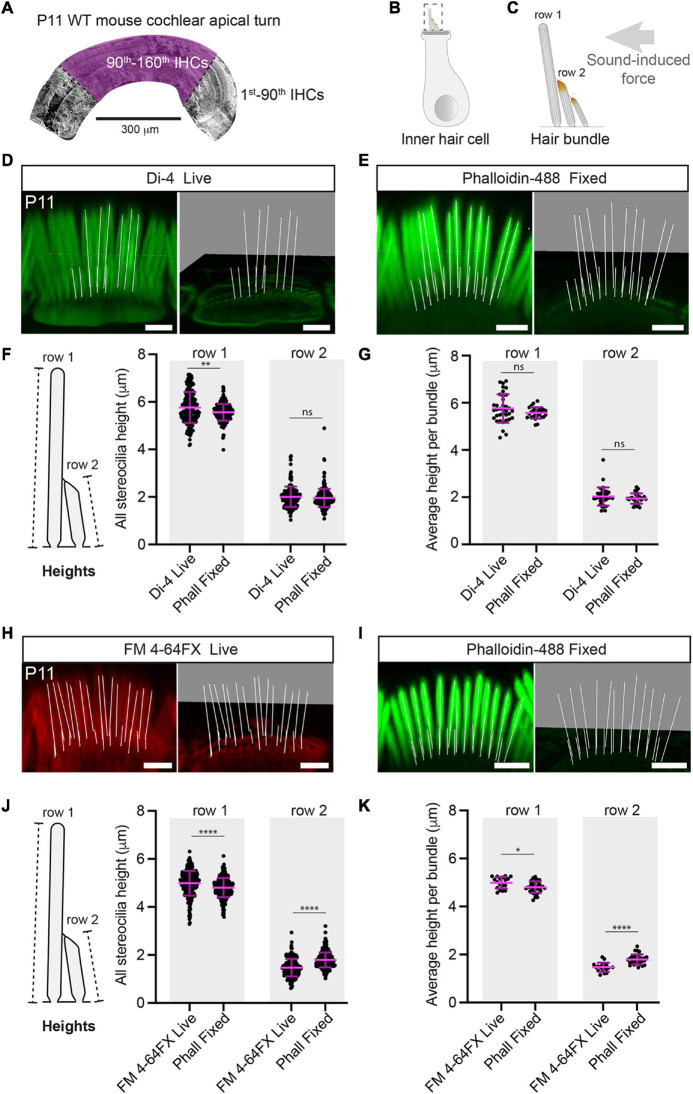
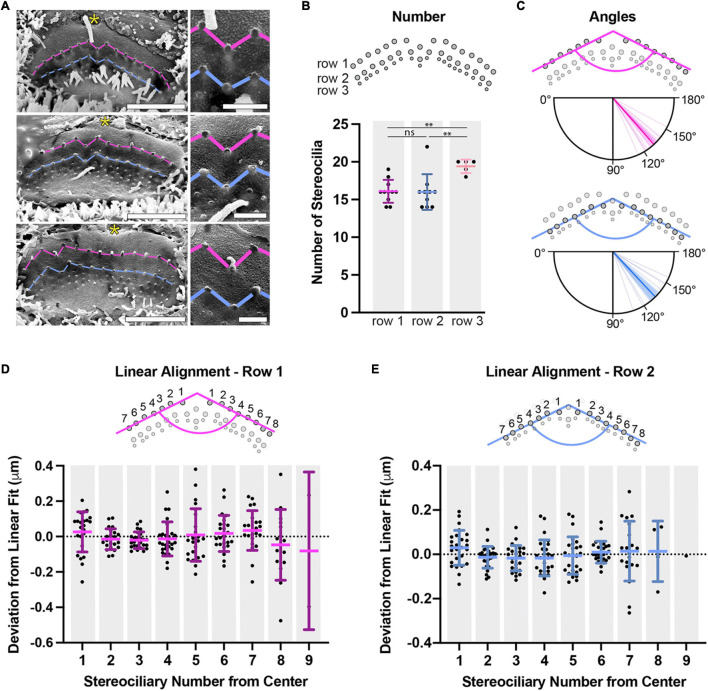
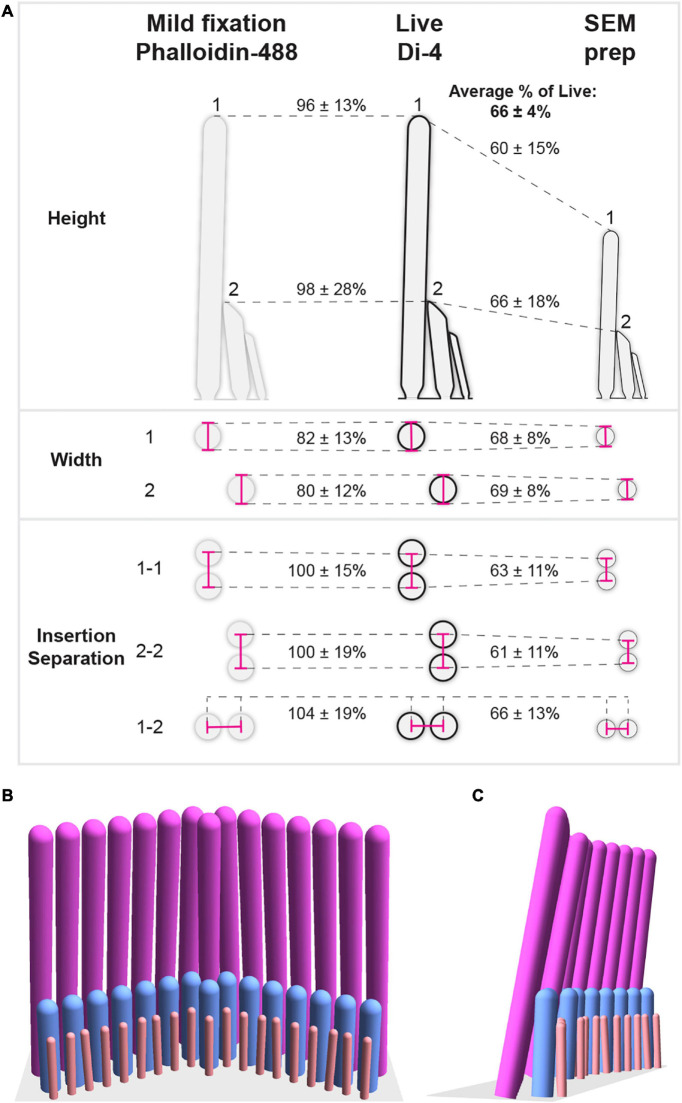
The hair bundle is the mechanosensory organelle of hair cells that detects mechanical stimuli caused by sounds, head motions, and fluid flows. Each hair bundle is an assembly of cellular-protrusions called stereocilia, which differ in height to form a staircase. Stereocilia have different heights, widths, and separations in different species, sensory organs, positions within an organ, hair-cell types, and even within a single hair bundle. The dimensions of the stereociliary assembly dictate how the hair bundle responds to stimuli. These hair-bundle properties have been measured previously only to a limited degree. In particular, mammalian data are either incomplete, lack control for age or position within an organ, or have artifacts owing to fixation or dehydration. Here, we provide a complete set of measurements for postnatal day (P) 11 C57BL/6J mouse apical inner hair cells (IHCs) obtained from living tissue, tissue mildly-fixed for fluorescent imaging, or tissue strongly fixed and dehydrated for scanning electronic microscopy (SEM). We found that hair bundles mildly-fixed for fluorescence had the same dimensions as living hair bundles, whereas SEM-prepared hair bundles shrank uniformly in stereociliary heights, widths, and separations. By determining the shrinkage factors, we imputed live dimensions from SEM that were too small to observe optically. Accordingly, we created the first complete blueprint of a living IHC hair bundle. We show that SEM-prepared measurements strongly affect calculations of a bundle's mechanical properties - overestimating stereociliary deflection stiffness and underestimating the fluid coupling between stereocilia. The methods of measurement, the data, and the consequences we describe illustrate the high levels of accuracy and precision required to understand hair-bundle mechanotransduction.
毛束是毛细胞的机械感觉细胞器,可检测由声音、头部运动和流体流动引起的机械刺激。每个毛束都是由称为静纤毛的细胞突起组成的集合体,这些静纤毛高度不同,形成一个阶梯状。不同物种、感觉器官、器官内的位置、毛细胞类型,甚至在单个毛束内,静纤毛的高度、宽度和间距都有所不同。静纤毛集合体的尺寸决定了毛束对刺激的反应方式。此前,这些毛束特性仅在有限程度上得到测量。特别是,哺乳动物的数据要么不完整,缺乏对年龄或器官内位置的控制,要么由于固定或脱水而存在伪像。在这里,我们提供了从活体组织、轻度固定用于荧光成像的组织或强烈固定并脱水用于扫描电子显微镜(SEM)的组织中获得的出生后第11天(P11)C57BL/6J小鼠顶端内毛细胞(IHC)的完整测量数据集。我们发现,轻度固定用于荧光成像的毛束与活体毛束尺寸相同,而SEM制备的毛束在静纤毛高度、宽度和间距上均匀收缩。通过确定收缩因子,我们从光学上太小而无法观察到的SEM数据中推算出活体尺寸。因此,我们创建了第一个活体IHC毛束的完整蓝图。我们表明,SEM制备的测量结果强烈影响对毛束机械特性的计算——高估静纤毛偏转刚度,低估静纤毛之间的流体耦合。我们描述的测量方法、数据和结果说明了理解毛束机械转导所需的高精度和准确性。