Wang Jiayi, Du Lingyao, Tang Hong
Center of Infectious Diseases, West China Hospital of Sichuan University, Chengdu, China.
Division of Infectious Diseases, State Key Laboratory of Biotherapy and Center of Infectious Diseases, West China Hospital, Sichuan University, Chengdu, China.
Front Med (Lausanne). 2021 Nov 24;8:784172. doi: 10.3389/fmed.2021.784172. eCollection 2021.
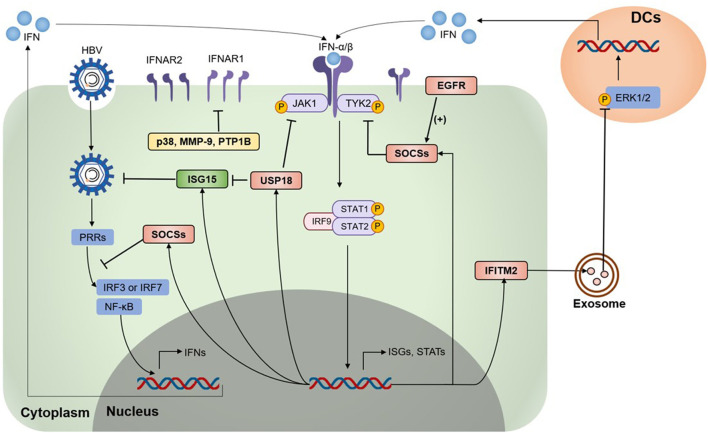
Chronic hepatitis B virus (CHB) infection remains a major global public health issue for which there is still lacking effective curative treatment. Interferon-α (IFN-α) and its pegylated form have been approved as an anti-HBV drug with the advantage of antiviral activity and host immunity against HBV infection enhancement, however, IFN-α treatment failure in CHB patients is a challenging obstacle with 70% of CHB patients respond poorly to exogenous IFN-α treatment. The IFN-α treatment response is negatively regulated by both viral and host factors, and the role of viral factors has been extensively illustrated, while much less attention has been paid to host negative factors. Here, we summarized evidence of host negative regulators and parameters involved in IFN-α therapy failure, review the mechanisms responsible for these effects, and discuss the possible improvement of IFN-based therapy and the rationale of combining the inhibitors of negative regulators in achieving an HBV cure.
慢性乙型肝炎病毒(CHB)感染仍然是一个重大的全球公共卫生问题,目前仍缺乏有效的治愈性治疗方法。干扰素-α(IFN-α)及其聚乙二醇化形式已被批准作为一种抗HBV药物,具有抗病毒活性和增强宿主对HBV感染免疫力的优势,然而,CHB患者中IFN-α治疗失败是一个具有挑战性的障碍,70%的CHB患者对外源性IFN-α治疗反应不佳。IFN-α治疗反应受到病毒和宿主因素的负调控,病毒因素的作用已得到广泛阐明,而宿主负性因素受到的关注则少得多。在此,我们总结了宿主负性调节因子和参与IFN-α治疗失败的参数的证据,回顾了这些效应的作用机制,并讨论了基于IFN治疗的可能改进以及联合负性调节因子抑制剂实现HBV治愈的理论依据。