Department of TeleHealth, College of Health Sciences, 72753University of KwaZulu-Natal, Durban, South Africa.
72753Health Information Systems Program South Africa, Pretoria, South Africa.
Inquiry. 2021 Jan-Dec;58:469580211059999. doi: 10.1177/00469580211059999.
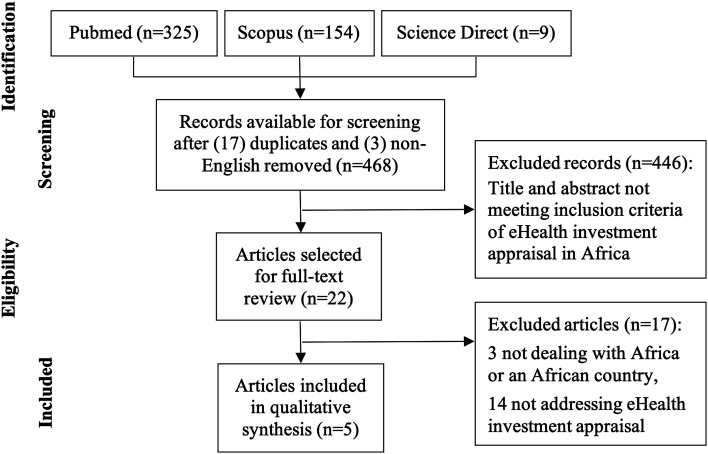
eHealth is an opportunity cost, competing for limited available funds with other health priorities such as clinics, vaccinations, medicines and even salaries. As such, it should be appraised for probable impact prior to allocation of funds. This is especially pertinent as recognition grows for the role of eHealth in attaining Universal Health Coverage. Despite optimism about eHealth's potential role, in Africa there remain insufficient data and skills for adequate economic appraisals to select optimal investments from numerous competing initiatives. The aim of this review is to identify eHealth investment appraisal approaches and tools that have been used in African countries, describe their characteristics and make recommendations regarding African eHealth investment appraisal in the face of limited data and expertise. Methods: Literature on eHealth investment appraisals conducted in African countries and published between January 1, 2010 and June 30, 2020 was reviewed. Selected papers' investment appraisal characteristics were assessed using the Joanna Briggs Institute checklist for economic evaluations and a newly developed Five-Case Model for Digital Health (FCM-DH) checklist for investment appraisal. 5 papers met inclusion criteria. Their assessments revealed important appraisal gaps. In particular, none of the papers addressed risk exposure, affordability, adjustment for optimism bias, clear delivery milestones, practical plans for implementation, change management or procurement, and only 1 paper described plans for building partnerships. Discussion: Using this insight, an extended 5-Case Model is proposed as the foundation of an African eHealth investment appraisal framework. This, combined with building local eHealth appraisal capabilities, may promote optimal eHealth investment decisions, strengthen implementations and improve the number and quality of related publications.
电子健康是一种机会成本,与诊所、疫苗接种、药品甚至工资等其他卫生重点竞争有限的可用资金。因此,在分配资金之前,应该对其可能产生的影响进行评估。随着电子健康在实现全民健康覆盖方面的作用得到越来越多的认可,这一点尤其重要。尽管对电子健康的潜在作用持乐观态度,但在非洲,仍然缺乏足够的数据和技能来进行充分的经济评估,以从众多相互竞争的举措中选择最佳投资。本综述旨在确定已在非洲国家使用的电子健康投资评估方法和工具,描述其特点,并针对数据和专业知识有限的情况,就非洲电子健康投资评估提出建议。方法:回顾了 2010 年 1 月 1 日至 2020 年 6 月 30 日期间在非洲国家开展并发表的电子健康投资评估相关文献。使用 Joanna Briggs 研究所经济评估检查表和新开发的数字健康投资评估 5 案例模型(FCM-DH)检查表评估选定论文的投资评估特征。有 5 篇论文符合纳入标准。它们的评估结果揭示了重要的评估差距。特别是,没有一篇论文涉及风险暴露、可负担性、对乐观偏差的调整、明确的交付里程碑、实际实施计划、变更管理或采购,只有 1 篇论文描述了建立伙伴关系的计划。讨论:利用这一见解,提出了一个扩展的 5 案例模型,作为非洲电子健康投资评估框架的基础。这与建立本地电子健康评估能力相结合,可能会促进最佳电子健康投资决策,加强实施,并增加相关出版物的数量和质量。