Angoorani Pooneh, Ejtahed Hanieh-Sadat, Hasani-Ranjbar Shirin, Siadat Seyed Davar, Soroush Ahmad Reza, Larijani Bagher
Obesity and Eating Habits Research Center, Endocrinology and Metabolism Clinical Sciences Institute, Tehran University of Medical Sciences, Tehran, Iran.
Endocrinology and Metabolism Research Center, Endocrinology and Metabolism Clinical Sciences Institute, Tehran University of Medical Sciences, North Kargar Ave, 1411413137, Tehran, Iran.
Nutr Metab (Lond). 2021 Dec 14;18(1):105. doi: 10.1186/s12986-021-00635-3.
Intermittent fasting has been reported to have positive effects on obesity, diabetes, cardiovascular diseases, hypertension, and several neurodegenerative diseases through different mechanisms such as alteration in the gut microbiota. This systematic review was conducted with the aim of providing an overview of the existing animal and human literature regarding the gut microbiota alterations in various fasting regimens.
A systematic literature search was conducted on PubMed, Scopus and Web of Science databases up to May 2021 to find all relevant studies examining the gut microbiota alteration during the fasting. Original researches on animal models or human patients were included in this study.
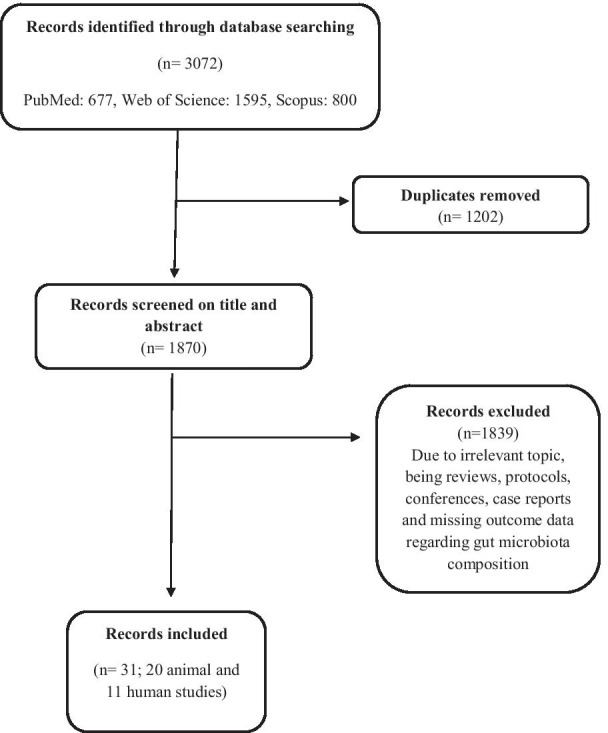
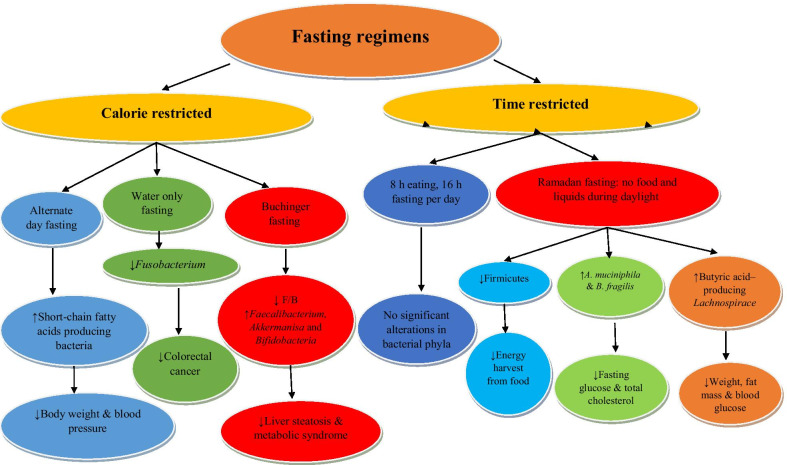
The search fulfilled 3072 documents from which 31 studies (20 animal and 11 human studies) were included. Upon fasting, abundance of several beneficial bacteria including Lactobacillus and Bifidobacterium shifted significantly. Moreover, some taxa, including Odoribacter which negatively associated with blood pressure bloomed during fasting. Ramadan fasting, as a kind of intermittent fasting, improves health parameters through positive changes in gut microbiota including upregulation of A. muciniphila, B. fragilis, Bacteroides and butyric acid-producing Lachnospiraceae.
The findings suggest that different fasting regimens including alternate-day fasting, calorie- and time-restricted fasting programs and Ramadan fasting could promote health maybe through the modulation of gut microbiome. However, further studies are needed to explore properly the connection between gut microbiota and meal frequency and timing.
据报道,间歇性禁食通过不同机制,如改变肠道微生物群,对肥胖、糖尿病、心血管疾病、高血压和几种神经退行性疾病具有积极影响。本系统评价旨在概述现有关于各种禁食方案中肠道微生物群改变的动物和人类文献。
截至2021年5月,在PubMed、Scopus和Web of Science数据库上进行了系统的文献检索,以找到所有研究禁食期间肠道微生物群改变的相关研究。本研究纳入了对动物模型或人类患者的原始研究。
检索到3072篇文献,其中包括31项研究(20项动物研究和11项人类研究)。禁食后,包括乳酸杆菌和双歧杆菌在内的几种有益细菌的丰度发生了显著变化。此外,一些分类群,包括与血压呈负相关的气味杆菌,在禁食期间大量繁殖。斋月禁食作为一种间歇性禁食,通过肠道微生物群的积极变化,包括嗜黏蛋白阿克曼菌、脆弱拟杆菌、拟杆菌和产丁酸的毛螺菌科的上调,改善健康参数。
研究结果表明,不同的禁食方案,包括隔日禁食、热量和时间限制的禁食计划以及斋月禁食,可能通过调节肠道微生物群促进健康。然而,需要进一步的研究来正确探索肠道微生物群与进餐频率和时间之间的联系。