Faculty of Medicine, University of Medicine and Pharmacy "Grigore T Popa", 700115 Iasi, Romania.
Nutrients. 2023 Apr 26;15(9):2095. doi: 10.3390/nu15092095.
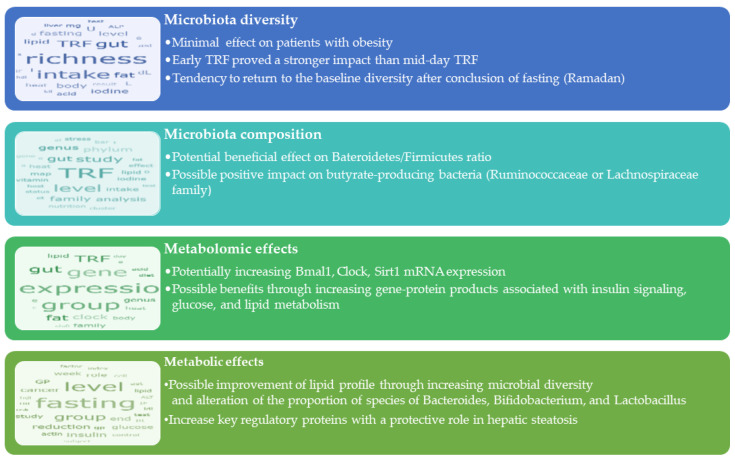
Intermittent fasting (IF) has been promoted as an alternative to dietary caloric restriction for the treatment of obesity. IF restricts the amount of food consumed and improves the metabolic balance by synchronizing it with the circadian rhythm. Dietary changes have a rapid effect on the gut microbiota, modulating the interaction between meal timing and host circadian rhythms. Our paper aims to review the relationships between IF and human gut microbiota. In this study, the primary area of focus was the effect of IF on the diversity and composition of gut microbiota and its relationship with weight loss and metabolomic alterations, which are particularly significant for metabolic syndrome characteristics. We discussed each of these findings according to the type of IF involved, i.e., time-restricted feeding, Ramadan fasting, alternate-day fasting, and the 5:2 diet. Favorable metabolic effects regarding the reciprocity between IF and gut microbiota changes have also been highlighted. In conclusion, IF may enhance metabolic health by modifying the gut microbiota. However additional research is required to draw definitive conclusions about this outcome because of the limited number and diverse designs of existing studies.
间歇性禁食(IF)已被提倡作为一种替代饮食热量限制的方法,用于治疗肥胖症。IF 通过使饮食与昼夜节律同步,限制了食物的摄入量并改善了代谢平衡。饮食变化对肠道微生物群有快速影响,调节了进食时间和宿主昼夜节律之间的相互作用。我们的论文旨在综述 IF 与人类肠道微生物群之间的关系。在这项研究中,主要关注的是 IF 对肠道微生物群多样性和组成的影响,以及它与体重减轻和代谢组学改变的关系,这些对于代谢综合征特征尤为重要。我们根据所涉及的 IF 类型,即限时喂养、斋月禁食、隔日禁食和 5:2 饮食,分别讨论了这些发现。还强调了 IF 与肠道微生物群变化之间的互惠性对代谢的有利影响。总之,IF 可能通过改变肠道微生物群来改善代谢健康。但是,由于现有研究数量有限且设计多样,需要进一步研究才能得出关于这一结果的明确结论。