Clinica Universidad de Navarra, Centro de Investigacion Medica Aplicada (CIMA), IDISNA, CIBERONC, Pamplona, Spain.
Department of Experimental and Clinical Medicine, "Magna Graecia", University of Catanzaro, Catanzaro, Italy.
Blood Cancer J. 2021 Dec 14;11(12):202. doi: 10.1038/s41408-021-00594-1.
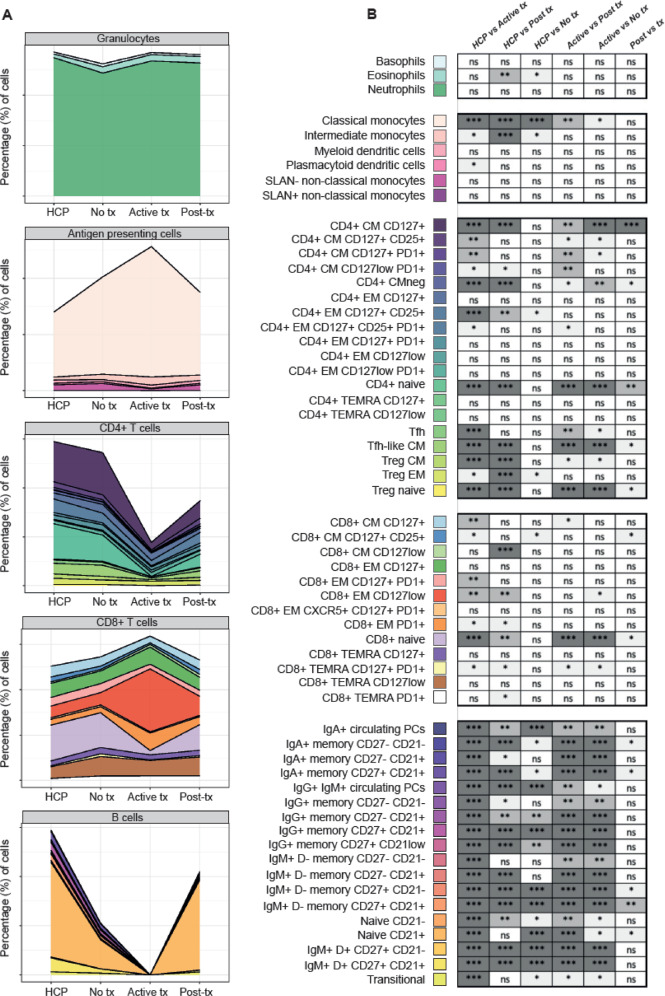
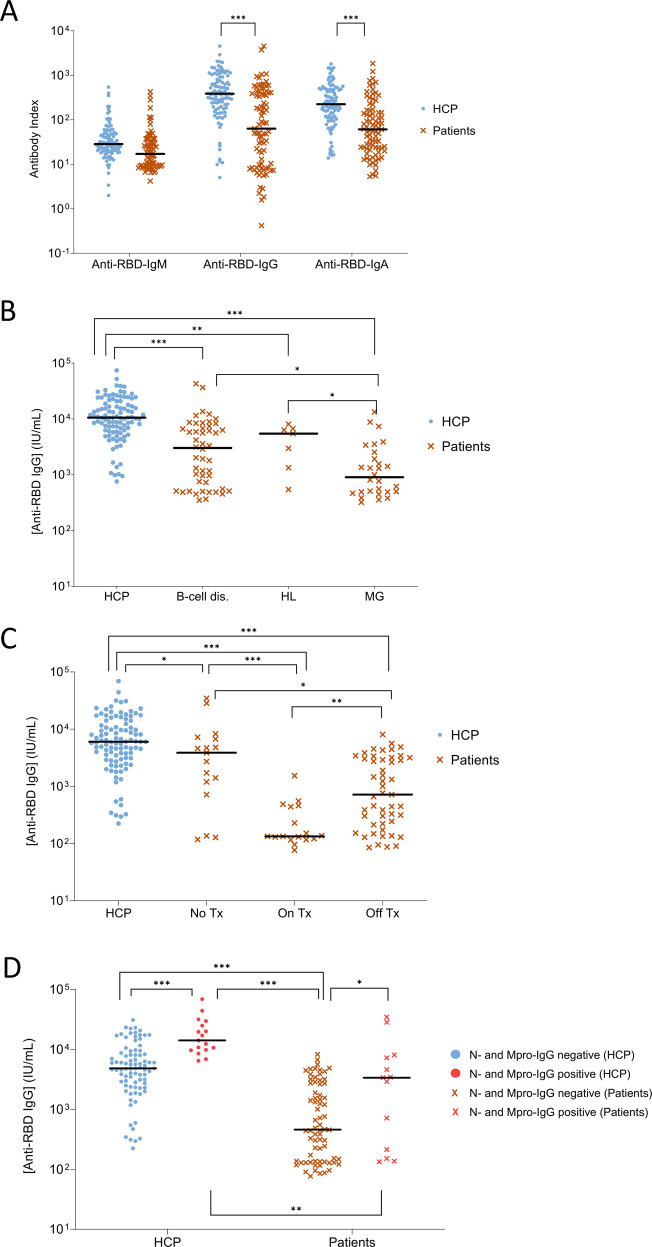
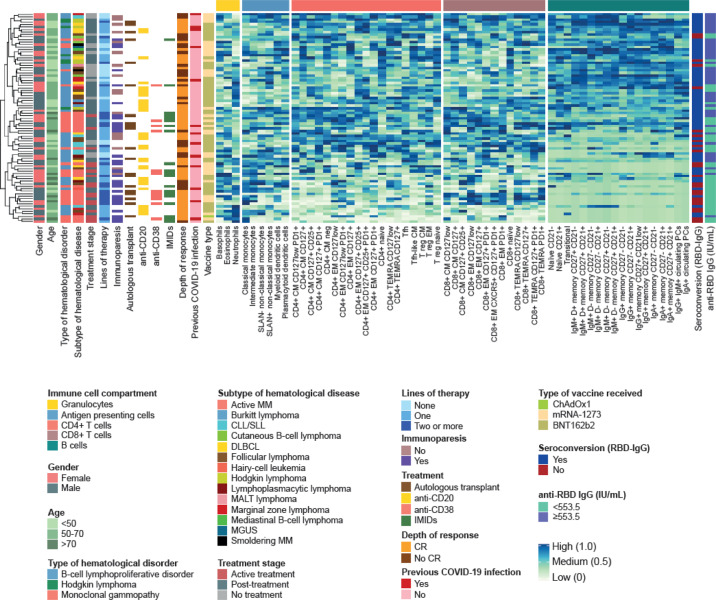
There is evidence of reduced SARS-CoV-2 vaccine effectiveness in patients with hematological malignancies. We hypothesized that tumor and treatment-related immunosuppression can be depicted in peripheral blood, and that immune profiling prior to vaccination can help predict immunogenicity. We performed a comprehensive immunological characterization of 83 hematological patients before vaccination and measured IgM, IgG, and IgA antibody response to four viral antigens at day +7 after second-dose COVID-19 vaccination using multidimensional and computational flow cytometry. Health care practitioners of similar age were the control group (n = 102). Forty-four out of 59 immune cell types were significantly altered in patients; those with monoclonal gammopathies showed greater immunosuppression than patients with B-cell disorders and Hodgkin lymphoma. Immune dysregulation emerged before treatment, peaked while on-therapy, and did not return to normalcy after stopping treatment. We identified an immunotype that was significantly associated with poor antibody response and uncovered that the frequency of neutrophils, classical monocytes, CD4, and CD8 effector memory CD127low T cells, as well as naive CD21+ and IgM+D+ memory B cells, were independently associated with immunogenicity. Thus, we provide novel immune biomarkers to predict COVID-19 vaccine effectiveness in hematological patients, which are complementary to treatment-related factors and may help tailoring possible vaccine boosters.
有证据表明,患有血液系统恶性肿瘤的患者的 SARS-CoV-2 疫苗有效性降低。我们假设肿瘤和治疗相关的免疫抑制可以在外周血中表现出来,并且接种疫苗前的免疫谱分析可以帮助预测免疫原性。我们对 83 名血液系统患者进行了全面的免疫学特征分析,并使用多维和计算流式细胞术测量了他们在接种第二剂 COVID-19 疫苗后第 7 天对四种病毒抗原的 IgM、IgG 和 IgA 抗体反应。年龄相似的医疗保健从业者为对照组(n=102)。在患者中,有 59 种免疫细胞类型中的 44 种发生了显著改变;那些患有单克隆丙种球蛋白病的患者比患有 B 细胞疾病和霍奇金淋巴瘤的患者表现出更大的免疫抑制。免疫失调在治疗前出现,在治疗期间达到高峰,并且在停止治疗后无法恢复正常。我们确定了一种与抗体反应不良显著相关的免疫表型,并发现中性粒细胞、经典单核细胞、CD4 和 CD8 效应记忆 CD127low T 细胞以及幼稚 CD21+和 IgM+D+记忆 B 细胞的频率与免疫原性独立相关。因此,我们提供了预测血液系统患者 COVID-19 疫苗有效性的新型免疫生物标志物,这些标志物与治疗相关因素互补,可能有助于定制可能的疫苗加强针。