Theoretical Biology and Biophysics (T-6), Los Alamos National Laboratory, Los Alamos, NM, USA.
New Mexico Consortium, Los Alamos, NM, USA.
Nat Commun. 2021 Dec 14;12(1):7239. doi: 10.1038/s41467-021-27369-3.
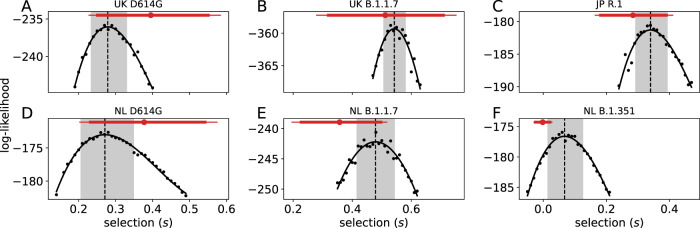
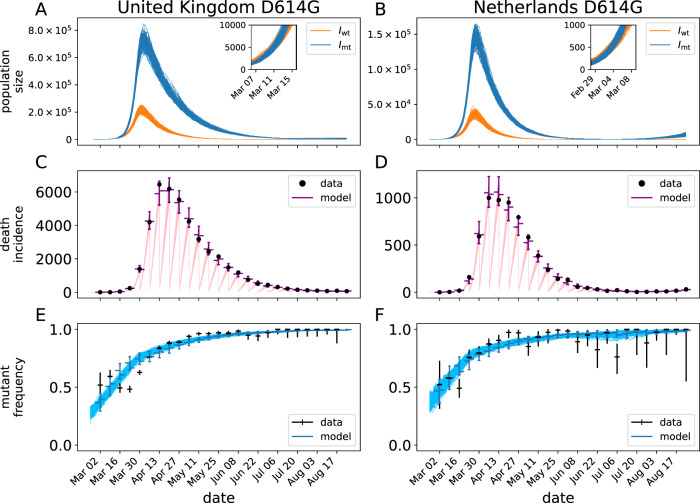
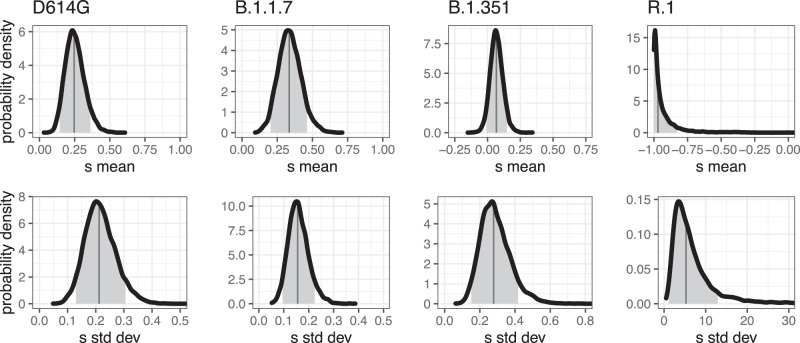
Controlling the SARS-CoV-2 pandemic becomes increasingly challenging as the virus adapts to human hosts through the continual emergence of more transmissible variants. Simply observing that a variant is increasing in frequency is relatively straightforward, but more sophisticated methodology is needed to determine whether a new variant is a global threat and the magnitude of its selective advantage. We present two models for quantifying the strength of selection for new and emerging variants of SARS-CoV-2 relative to the background of contemporaneous variants. These methods range from a detailed model of dynamics within one country to a broad analysis across all countries, and they include alternative explanations such as migration and drift. We find evidence for strong selection favoring the D614G spike mutation and B.1.1.7 (Alpha), weaker selection favoring B.1.351 (Beta), and no advantage of R.1 after it spreads beyond Japan. Cutting back data to earlier time horizons reveals that uncertainty is large very soon after emergence, but that estimates of selection stabilize after several weeks. Our results also show substantial heterogeneity among countries, demonstrating the need for a truly global perspective on the molecular epidemiology of SARS-CoV-2.
随着病毒通过不断出现更具传染性的变种来适应人类宿主,控制 SARS-CoV-2 大流行变得越来越具有挑战性。简单地观察到一个变种的频率在增加相对来说比较简单,但需要更复杂的方法来确定新变种是否对全球构成威胁,以及其选择优势的大小。我们提出了两种模型,用于定量评估 SARS-CoV-2 的新出现变种相对于同时代变种的选择强度。这些方法的范围从一个国家内部的详细动态模型到所有国家的广泛分析,并且包括了迁移和漂移等替代解释。我们发现有证据表明 D614G 刺突突变和 B.1.1.7(Alpha)受到强烈选择,B.1.351(Beta)受到较弱选择,而 R.1 在传播到日本以外后没有优势。将数据缩短到更早的时间范围可以发现,在出现后不久,不确定性非常大,但选择的估计值在数周后稳定下来。我们的结果还显示了各国之间存在很大的异质性,这表明需要从真正的全球视角来研究 SARS-CoV-2 的分子流行病学。