Pooja V, Khan Aslam, Patil Jaideep, Chaudhari Bhushan, Chaudhury Suprakash, Saldanha Daniel
Department of Psychiatry, Dr. D.Y. Patil Medical College, Dr. D Y Patil Vidyapeeth, Pune, Maharashtra, India.
Ind Psychiatry J. 2021 Oct;30(Suppl 1):S69-S74. doi: 10.4103/0972-6748.328792. Epub 2021 Oct 22.
The worldwide COVID-19 pandemic has significantly altered our life. Doctors more so than the general public because of their involvement in managing the COVID-infected individuals, some of them 24/7 end in burnout. Burnout in doctors can lead to reduced care of patients, increased medical errors, and poor health. Burnout among frontline health-care workers has become a major problem in this ongoing epidemic. On the other hand, doctors in preclinical department have a lack of interaction with patients, with not much nonclinical professional work to boot, find the profession less gratifying which perhaps increase their stress level.
The aim was to study the prevalence of burnout and measure resilience in doctors in clinical and in preclinical departments.
This observational, cross-sectional, comparative study was carried out in a tertiary care teaching hospital and COVID care center. By purposive sampling 60 preclinical and 60 clinical doctors in a tertiary health care center were included in the study. After obtaining the Institutional Ethics Committee approval and informed consent, the doctors were administered a self made socio-demographic questionnaire, the Copenhagen Burnout Inventory, and the Connor-Davidson Resilience Scale. Doctors were given a self-made questionnaire, the Copenhagen Burnout Inventory, and the Connor-Davidson Resilience Scale.
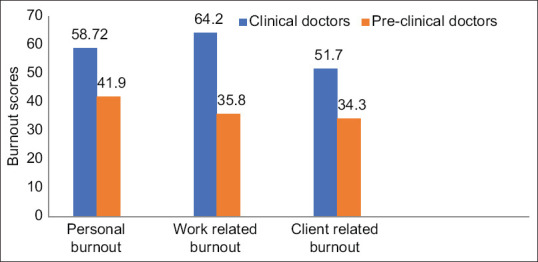
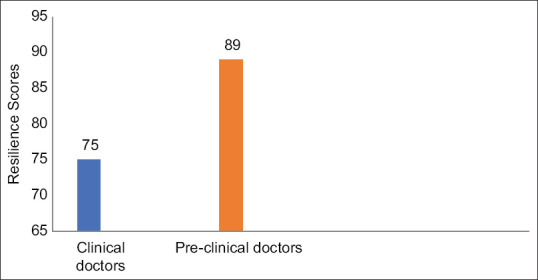
The prevalence of burnout was seen more in clinical doctors (55.47) and the resilience was observed more in preclinical doctors (88.9).
Resident doctors are a major force to combat COVID-19 as frontline health workers; hence, one can visualize burnout amongst them. On an individual basis, the work-related burnout was severely high in the clinical group owing to the workload which has been corresponding to a number of western studies. Nonclinical department doctors from pathology, community medicine, and microbiology did show burnout but showed a greater score in resilience. Psychological resilience has been identified as a component in preventing burnout.
Therapy sessions can be used in clinical doctors facing burnout to build up their resilience.
全球范围内的新冠疫情极大地改变了我们的生活。医生受到的影响比普通公众更大,因为他们参与管理新冠感染患者,其中一些人全天候工作,最终导致职业倦怠。医生的职业倦怠会导致对患者的护理减少、医疗失误增加以及健康状况不佳。在这场持续的疫情中,一线医护人员的职业倦怠已成为一个主要问题。另一方面,临床前科室的医生与患者缺乏互动,非临床专业工作也不多,觉得这个职业不太能带来满足感,这可能会增加他们的压力水平。
本研究旨在调查临床科室和临床前科室医生职业倦怠的患病率,并评估他们的心理韧性。
本观察性、横断面、对比性研究在一家三级医疗教学医院和新冠护理中心进行。通过目的抽样法,选取了该三级医疗中心的60名临床前医生和60名临床医生纳入研究。在获得机构伦理委员会批准并取得知情同意后,向医生发放了一份自制的社会人口学问卷、哥本哈根职业倦怠量表和康纳-戴维森心理韧性量表。
临床医生的职业倦怠患病率更高(55.47),而临床前医生的心理韧性更强(88.9)。
住院医生作为一线医护人员,是抗击新冠疫情的主要力量;因此,可以想象他们当中会出现职业倦怠。就个体而言,由于工作量的原因,临床组与工作相关的职业倦怠非常严重,这与一些西方研究结果相符。来自病理科、社区医学和微生物学等非临床科室的医生确实也出现了职业倦怠,但心理韧性得分更高。心理韧性已被确认为预防职业倦怠的一个因素。
对于面临职业倦怠的临床医生,可以通过治疗课程来增强他们的心理韧性。