Christensen Brenda, Huber Lee-Anne
Department of Animal Biosciences, University of Guelph, Guelph, ON, Canada.
Transl Anim Sci. 2021 Nov 10;5(4):txab211. doi: 10.1093/tas/txab211. eCollection 2021 Oct.
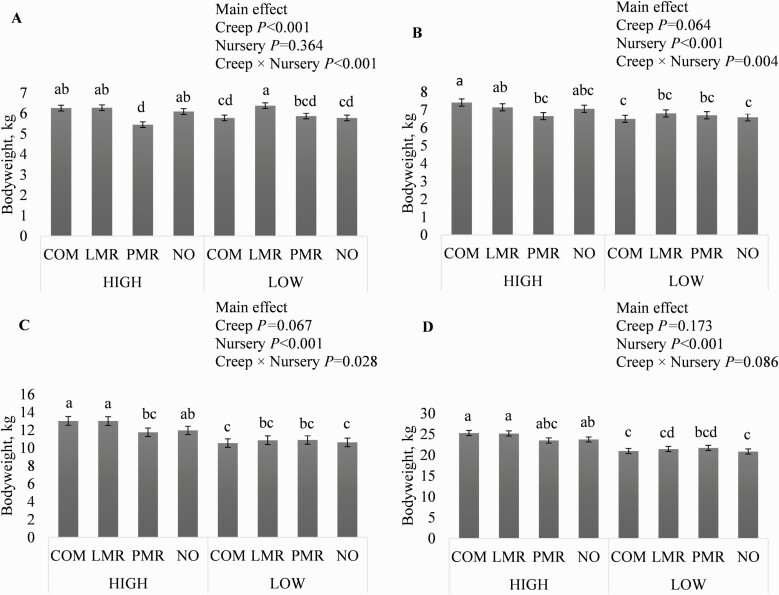
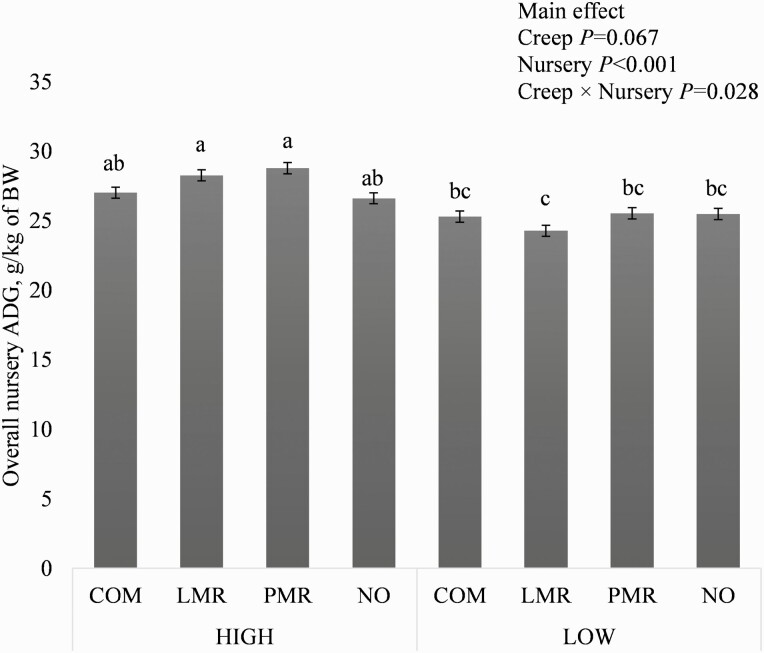
Fifty-six litters from first-parity sows standardized to 12 piglets were used to determine the effects of creep feed composition and form on pre- and post-weaning pig growth performance and the utilization of low-complexity nursery diets. At 5 days of age, litters (initial body weight [BW] 2.31 ± 0.61 kg) were assigned to one of four creep feeding regimens ( = 14): 1) pelleted commercial creep feed (COM), 2) liquid milk replacer (LMR), 3) pelleted milk replacer (PMR), or 4) no creep feed (NO); creep feeds contained 1.0% brilliant blue as a fecal marker. Individual piglet BW and fecal swabs were collected every 3 ± 1 days during the creep-feeding period. The latter was to identify piglets that regularly consumed creep feed via the visual appearance of blue dye in the feces. At weaning (21 ± 2 days of age), six pigs per litter with median BW that consumed creep feed were placed on either a HIGH- (contained highly digestible animal proteins) or LOW- (contained corn and soybean meal as the main protein sources) complexity nursery diet ( = 7) in a three-phase feeding program over 39 days. On day 8, two pigs per pen were sacrificed to collect organ weights and digesta. The LMR disappeared at the greatest rate (average 37.7 g/pig/d; dry matter-basis) versus COM and PMR (10.6 and 10.3 ± 1.5 g/pig/d, respectively; < 0.001). Litters that received LMR had the greatest proportion of pigs with blue fecal swabs throughout the creep feeding period (85.0 vs. 54.9 and 63.0% ± 0.4% for COM and PMR, respectively; < 0.05) and LMR piglets had greater BW at weaning versus all other treatments (6.32 vs. 6.02, 5.92, and 5.67 ± 0.14 kg, for LMR, COM, NO, and PMR, respectively; < 0.001). Overall, pigs given LOW (vs. HIGH) diets in the nursery period had reduced average daily gain (25.1 vs. 27.7 ± 0.4 g/kg BW; < 0.001), gain:feed (0.75 vs. 0.81 ± 0.02; < 0.001), and exit BW (21.2 vs. 24.4 ± 0.6 kg; < 0.001); no carryover effects of creep feeding program were observed. Creep feed regimen had limited effects on nutrient digestibility of nursery diets but the apparent ileal digestibility of organic matter tended to be less at 28 days of age for pigs that received the LOW nursery diet (64.2 vs. 68.8% ± 2.5%; = 0.076). Providing supplemental nutrition during the suckling period via LMR improved piglet BW at weaning, which did not correspond to improved post-weaning growth performance, regardless of nursery diet complexity.
选用56窝初产母猪所产仔猪(每窝标准化为12头仔猪)来确定教槽料组成和形态对断奶前后仔猪生长性能以及低复杂度保育日粮利用率的影响。在仔猪5日龄时(初始体重[BW]为2.31±0.61千克),将仔猪窝(每组n = 14)分配到四种教槽料饲喂方案之一:1)颗粒状商业教槽料(COM),2)液态代乳粉(LMR),3)颗粒状代乳粉(PMR),或4)不使用教槽料(NO);教槽料中含有1.0%的亮蓝作为粪便标记物。在教槽料饲喂期间,每隔3±1天收集每头仔猪的体重和粪便拭子。收集粪便拭子是为了通过粪便中蓝色染料的外观来识别经常采食教槽料的仔猪。在断奶时(21±2日龄),从每窝中选取6头采食教槽料且体重中位数的仔猪,在一个为期39天的三阶段饲喂方案中,将其置于高复杂度(含有高消化率动物蛋白)或低复杂度(以玉米和豆粕作为主要蛋白质来源)的保育日粮中(每组n = 7)。在第8天,每栏选取2头仔猪屠宰以收集器官重量和消化物。与COM和PMR相比,LMR的消失速度最快(平均37.7克/头/天;以干物质计),COM和PMR分别为10.6和10.3±1.5克/头/天(P < 0.001)。在整个教槽料饲喂期间,采食LMR的仔猪窝中粪便拭子呈蓝色的仔猪比例最高(分别为85.0%,COM为54.9%,PMR为63.0%±0.4%;P < 0.05),并且与所有其他处理相比,采食LMR的仔猪断奶时体重更大(分别为6.32千克,COM为6.02千克,NO为5.92千克,PMR为5.67±0.14千克;P < 0.001)。总体而言(与高复杂度日粮相比),保育期饲喂低复杂度日粮的仔猪平均日增重降低(分别为25.1克/千克体重,高复杂度日粮为27.7±0.4克/千克体重;P < 0.001),增重:采食量降低(分别为0.75,高复杂度日粮为0.81±0.02;P < 0.001),出栏体重降低(分别为21.2千克,高复杂度日粮为24.4±0.6千克;P < 0.001);未观察到教槽料饲喂方案的残留效应。教槽料方案对保育日粮的养分消化率影响有限,但对于采食低复杂度保育日粮的仔猪,28日龄时有机物的表观回肠消化率往往较低(分别为64.2%,高复杂度日粮为68.8%±2.5%;P = 0.076)。在哺乳期通过LMR提供补充营养可提高仔猪断奶时的体重,无论保育日粮复杂度如何,这与断奶后生长性能的改善无关。