Horner Carolyne, Mushtaq Shazad, Allen Michael, Hope Russell, Gerver Sarah, Longshaw Christopher, Reynolds Rosy, Woodford Neil, Livermore David M
British Society for Antimicrobial Chemotherapy, Birmingham, UK.
UK Health Security Agency, London, UK.
JAC Antimicrob Resist. 2021 Dec 10;3(4):dlab185. doi: 10.1093/jacamr/dlab185. eCollection 2021 Dec.
To review temporal changes in the proportions of different species recorded in two UK bacteraemia surveillance systems. Antibiotic resistance trends were also considered.
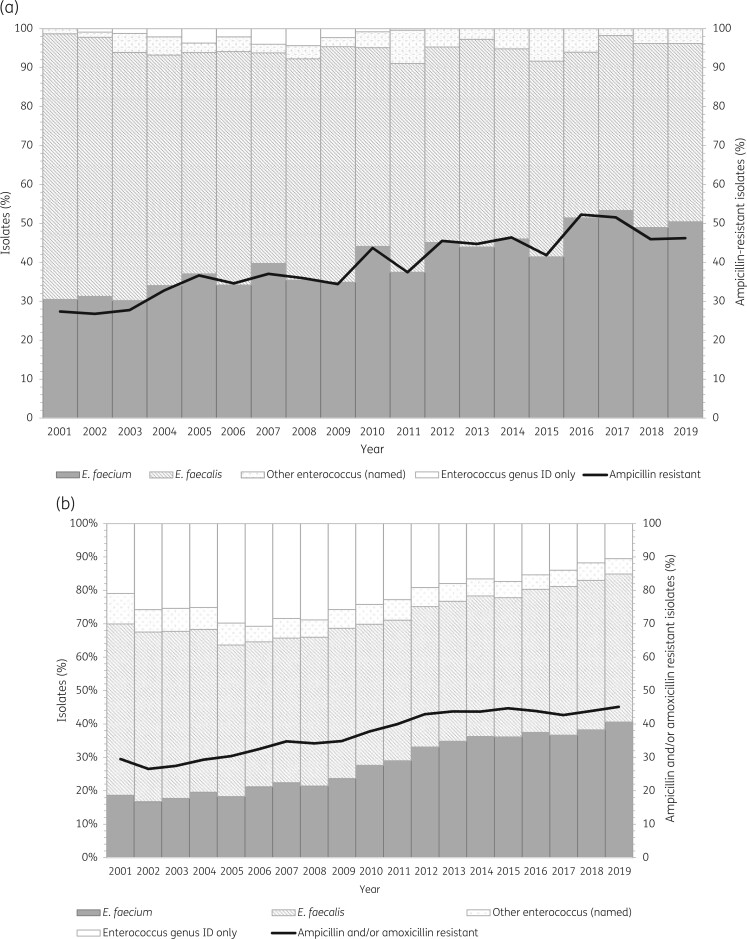
We reviewed data for enterococci from 2001 to 2019 in: (a) the BSAC Resistance Surveillance Programme, which collected up to 7-10 bloodstream enterococci every year from each of 23-39 hospitals in the UK and Ireland and tested these centrally; and (b) PHE bacteraemia surveillance, using routine results from NHS microbiology laboratories in England.
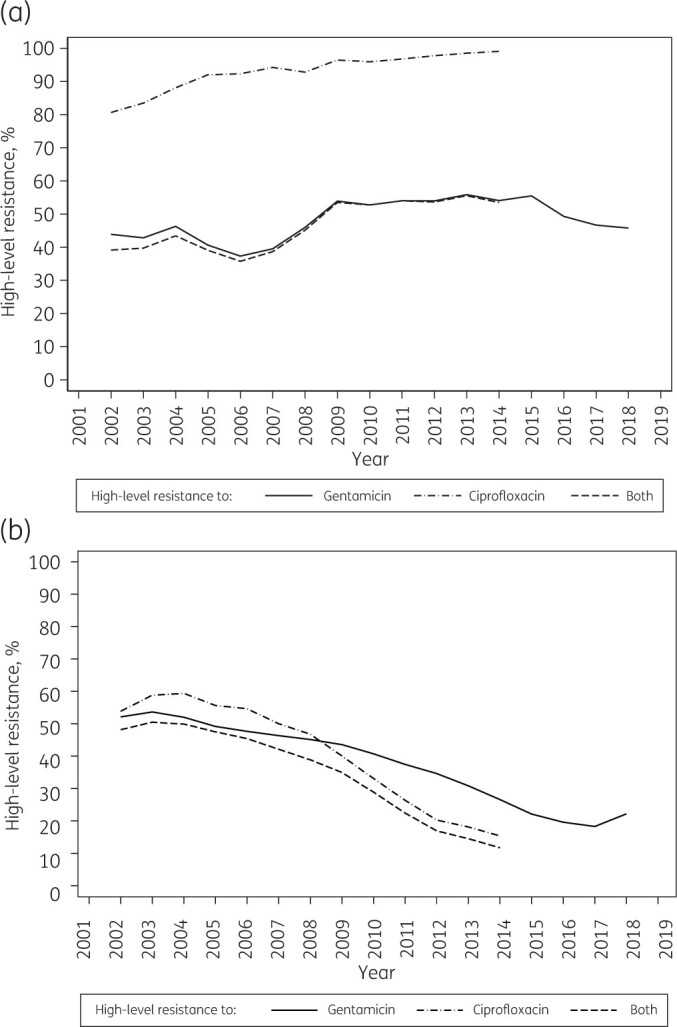
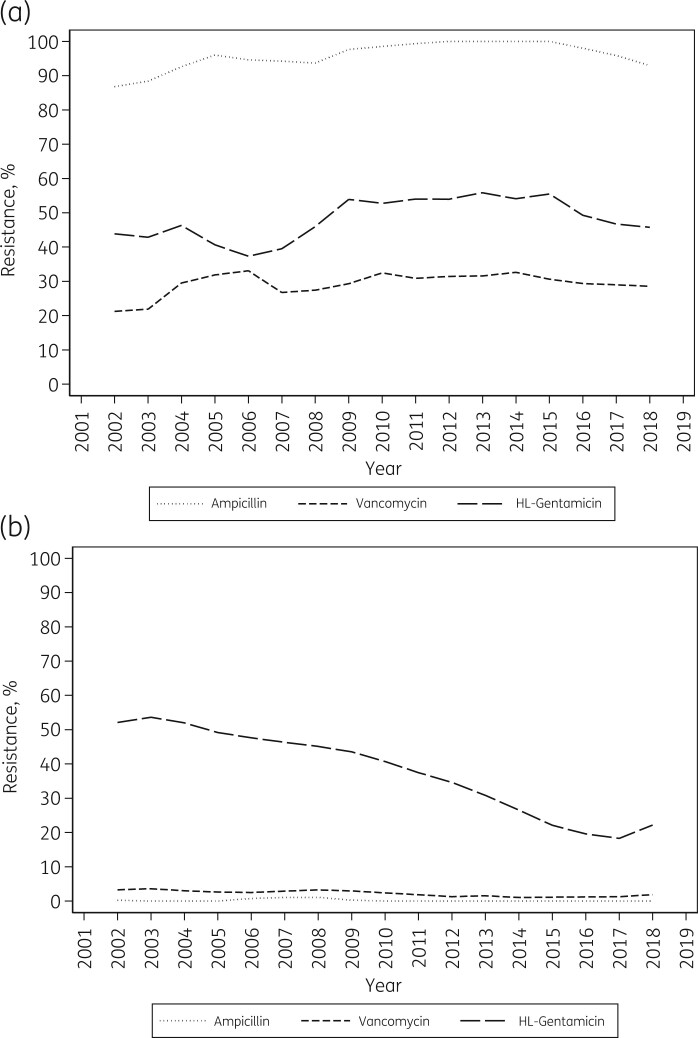
BSAC surveillance, based upon 206-255 enterococci each year (4486 in total), indicated that the proportion of rose from 31% (212/692) in the period 2001-3 to 51% (354/696) in the period 2017-19, balanced by corresponding falls in the proportion of . PHE surveillance provided a larger dataset, with >5000 enterococcus reports per year; although its identifications are less precise, it too indicated a rise in the proportion of . BSAC surveillance for indicated no consistent trends in resistance to ampicillin (≥86% in all years), vancomycin (annual rates 19%-40%) or high-level resistance to gentamicin (31%-59%). Resistance to vancomycin remained <4% in in all years, whilst high-level resistance to gentamicin fell, perhaps partly reflecting the decline of two initially prevalent gentamicin- and ciprofloxacin-resistant clones.
Both surveillance systems indicate a growing proportion of in enterococcal bloodstream infections. This is important because fewer therapeutic options remain against this frequently multiresistant species than against .
回顾英国两个菌血症监测系统中记录的不同菌种比例的时间变化情况。同时也考虑了抗生素耐药性趋势。
我们回顾了2001年至2019年肠球菌的数据,数据来源于:(a)英国抗菌化疗学会(BSAC)耐药性监测项目,该项目每年从英国和爱尔兰的23至39家医院中每家收集多达7 - 10株血流感染肠球菌,并进行集中检测;(b)英国公共卫生署(PHE)菌血症监测,使用英格兰国民保健服务(NHS)微生物实验室的常规结果。
BSAC监测每年基于206 - 255株肠球菌(共4486株),结果显示[具体菌种1]的比例从2001 - 2003年期间的31%(212/692)上升至2017 - 2019年期间的51%(354/696),相应地[具体菌种2]的比例下降。PHE监测提供了一个更大的数据集,每年有超过5000份肠球菌报告;尽管其鉴定不够精确,但也表明[具体菌种1]的比例有所上升。BSAC对[具体菌种3]的监测表明,对氨苄西林的耐药性(所有年份≥86%)、对万古霉素的耐药性(年发生率19% - 40%)或对庆大霉素的高水平耐药性(31% - 59%)均无一致趋势。所有年份中[具体菌种4]对万古霉素的耐药性仍<4%,而对庆大霉素的高水平耐药性下降,这可能部分反映了最初两种常见的对庆大霉素和环丙沙星耐药的克隆株的减少。
两个监测系统均表明肠球菌血流感染中[具体菌种1]的比例在增加。这很重要,因为针对这种通常具有多重耐药性的菌种,与[具体菌种2]相比,可用的治疗选择更少。