Enos Clinton W, O'Connell Katie A, Harrison Ryan W, McLean Robert R, Dube Blessing, Van Voorhees Abby S
Department of Dermatology, Eastern Virginia Medical School, Norfolk, Virginia, USA.
CorEvitas, LLC, Waltham, Massachusetts, USA.
JID Innov. 2021 May 6;1(2):100025. doi: 10.1016/j.xjidi.2021.100025. eCollection 2021 Jun.
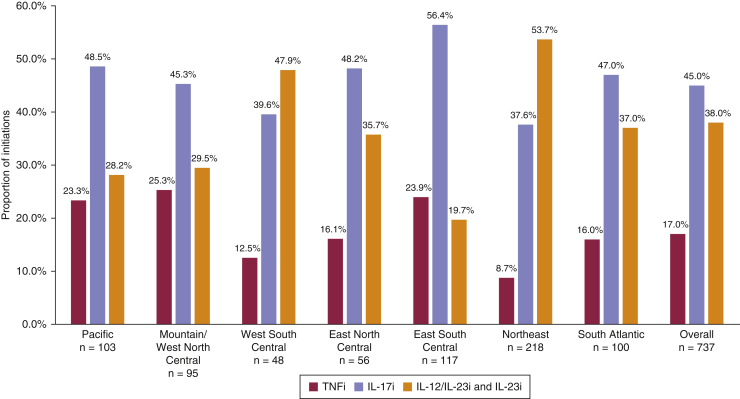
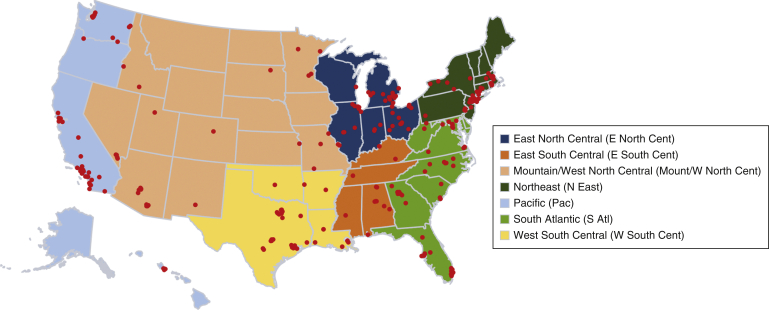
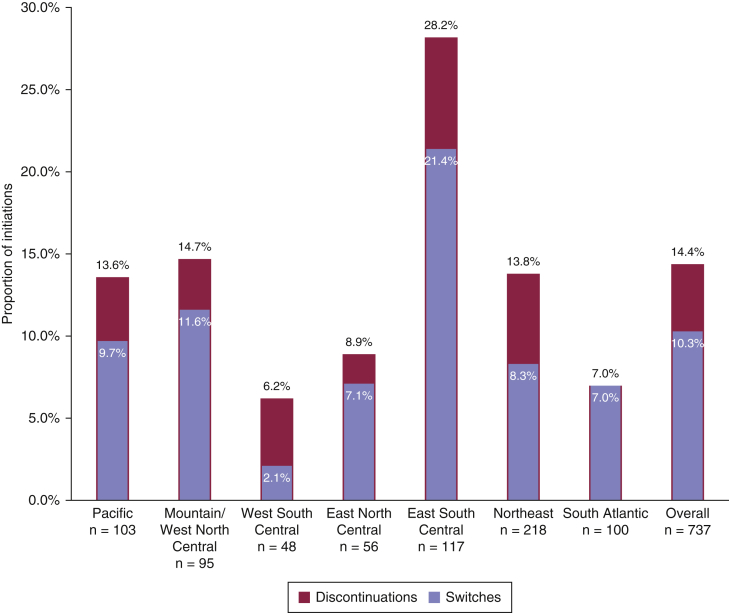
Little is known about how psoriatic disease characteristics and treatment outcomes differ geographically in the United States. Our aim was to explore real-world, geographic variations in the use of biologic classes and outcomes within the Corrona Psoriasis Registry. Patient demographics and disease characteristics were assessed at biologic initiation and at 6 months. Logistic regressions were conducted to evaluate the odds of achieving targeted outcomes for seven United States geographic regions. We examined 737 biologic initiations among 717 patients. IL-17 inhibitors were used most frequently (45%), followed by IL-12‒IL-23 and IL-23 inhibitors (38%) and TNF inhibitors (17%). The proportions of patients with obesity (body mass index > 30) and very severe psoriasis (body surface area > 20) were greatest in the East South Central and West South Central regions. After adjusting for age, sex, race, body mass index, and baseline body surface area, decreased odds of achieving 75% improvement in PASI at 6 months were observed among patients in the East South Central (OR = 0.47, 95% confidence interval = 0.28-0.79, = 0.004), West South Central (OR = 0.43, 95% confidence interval = 0.22-0.87, = 0.019), and Pacific (OR = 0.49, 95% confidence interval = 0.28-0.84, = 0.010) regions compared with those observed among patients in the Northeast. The East South Central and West South Central regions may have the greatest frequencies of very severe disease burden and, along with the Pacific region, may be less likely to achieve targeted response within 6 months of initiating biologic therapy.
在美国,银屑病疾病特征和治疗结果在地理上的差异鲜为人知。我们的目的是在科罗纳银屑病登记处探索生物制剂类别使用情况和治疗结果的真实世界地理差异。在开始使用生物制剂时和6个月时评估患者的人口统计学特征和疾病特征。进行逻辑回归以评估美国七个地理区域实现目标治疗结果的几率。我们研究了717例患者中的737次生物制剂起始治疗情况。最常使用的是IL-17抑制剂(45%),其次是IL-12–IL-23和IL-23抑制剂(38%)以及TNF抑制剂(17%)。肥胖(体重指数>30)和极重度银屑病(体表面积>20)患者的比例在东中南部和西中南部地区最高。在调整年龄、性别、种族、体重指数和基线体表面积后,与东北部患者相比,东中南部(OR = 0.47,95%置信区间 = 0.28 - 0.79,P = 0.004)、西中南部(OR = 0.43,95%置信区间 = 0.22 - 0.87,P = 0.019)和太平洋地区(OR = 0.49,95%置信区间 = 0.28 - 0.84,P = 0.010)的患者在6个月时达到PASI改善75%的几率降低。东中南部和西中南部地区可能极重度疾病负担的发生率最高,并且与太平洋地区一样,在开始生物治疗6个月内实现目标反应的可能性可能较小。