Liu Shuang, Yan Wen, Hu Yanbing, Wu Huiying
Department of Ultrasound in the Second Hospital of Jilin University, Changchun, China.
Department of Anesthesiology, The Second Hospital of Jilin University, Changchun, China.
Evid Based Complement Alternat Med. 2021 Dec 6;2021:5881321. doi: 10.1155/2021/5881321. eCollection 2021.
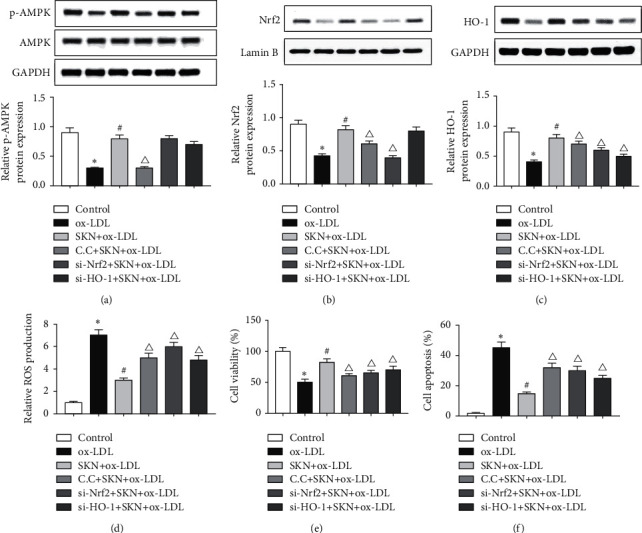
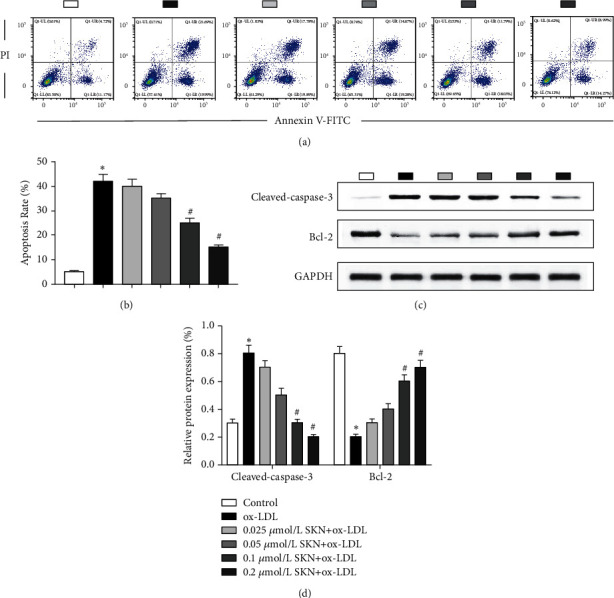
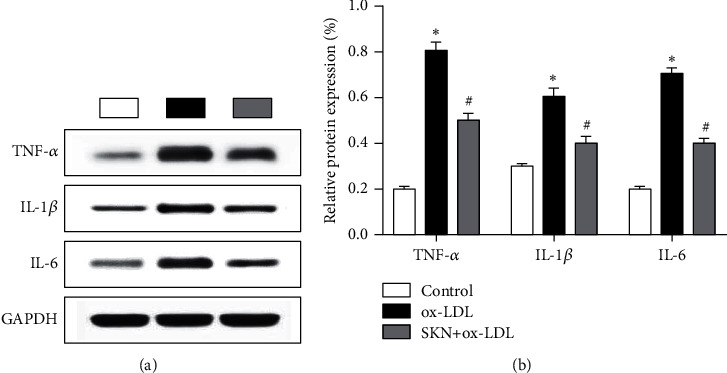
The present study aimed to explore the effects of shikonin (SKN) on the damage of human venous endothelial cells (HUVECs) induced by ox-LDL and the underlying molecular mechanism. The HUVECs were randomly divided into six groups: control, ox-LDL, SKN + ox-LDL, SKN + ox-LDL + compound C, SKN + ox-LDL + si-Nrf2, and SKN + ox-LDL + si-HO-1. The MTT method was used to detect cell viability, flow cytometry was used to detect cell apoptosis and reactive oxygen species (ROS) levels, and Western blot was used to detect protein levels. Compared to the control group, the cell viability of the ox-LDL group decreased, the apoptosis rate increased, the level of cleaved caspase-3 was upregulated, and the level of Bcl-2 protein was downregulated. The level of TNF-, IL-1, IL-6, vascular cell adhesion molecule-1 (VCAM1), intercellular adhesion molecule-1 (ICAM1), and E-selectin (E-sel) was increased, ROS levels increased, and superoxide dismutase (SOD) level decreased. Moreover, the protein levels of p-AMPK, Nrf2, and HO-1 were decreased. Compared to the ox-LDL group, SKN treatment improves cell viability, alleviates cell apoptosis and oxidative stress injury, and upregulates the protein levels of p-AMPK, Nrf2, and HO-1. Compound C, si-Nrf2, and si-HO-1 administration inhibits the AMPK/Nrf2/HO-1 signaling pathway, increases ROS generation, and inhibits the antagonistic effect of SKN on ox-LDL-induced HUVECs damage. In summary, SKN suppressed ox-LDL-induced ROS production and improved cell viability and cell apoptosis via the AMPK/Nrf2/HO-1 pathway.
本研究旨在探讨紫草素(SKN)对氧化型低密度脂蛋白(ox-LDL)诱导的人脐静脉内皮细胞(HUVECs)损伤的影响及其潜在分子机制。将HUVECs随机分为六组:对照组、ox-LDL组、SKN + ox-LDL组、SKN + ox-LDL + 复合C组、SKN + ox-LDL + si-Nrf2组和SKN + ox-LDL + si-HO-1组。采用MTT法检测细胞活力,流式细胞术检测细胞凋亡和活性氧(ROS)水平,蛋白质免疫印迹法检测蛋白质水平。与对照组相比,ox-LDL组细胞活力降低,凋亡率增加,裂解的半胱天冬酶-3水平上调,Bcl-2蛋白水平下调。肿瘤坏死因子-α、白细胞介素-1、白细胞介素-6、血管细胞黏附分子-1(VCAM1)、细胞间黏附分子-1(ICAM1)和E-选择素(E-sel)水平升高,ROS水平升高而过氧化物歧化酶(SOD)水平降低。此外,p-AMPK、Nrf2和HO-1的蛋白质水平降低。与ox-LDL组相比,SKN处理可提高细胞活力,减轻细胞凋亡和氧化应激损伤,并上调p-AMPK、Nrf2和HO-1的蛋白质水平。给予复合C、si-Nrf2和si-HO-1可抑制AMPK/Nrf2/HO-1信号通路,增加ROS生成,并抑制SKN对ox-LDL诱导的HUVECs损伤的拮抗作用。综上所述,SKN通过AMPK/Nrf2/HO-1途径抑制ox-LDL诱导的ROS产生,提高细胞活力并改善细胞凋亡。