Centre for Public Health, Queen's University Belfast, Belfast, BT12 6BA, UK.
Institute for Global Food Security, Queen's University Belfast, Belfast, BT9 5DL, UK.
BMC Public Health. 2021 Dec 16;21(1):2291. doi: 10.1186/s12889-021-12307-1.
The first UK-wide lockdown to prevent the spread of COVID-19 had a serious financial impact on low-income households, a population already in higher risk of food insecurity and poor dietary choices. Qualitative data on the impact of COVID-19 lockdown on food decisions of UK families are scarce. This study aimed to explore how the measures to control the spread of COVID-19 influenced the food-related decisions of socioeconomically deprived families in Northern Ireland.
A qualitative study captured data from online individual interviews. Participation was open for parents of children 2-17 years old living on a tight budget in urban and rural areas of Northern Ireland. A sampling matrix enabled equal representation of single- and two-parent households, as well as parents of younger children (<12y) and adolescents (≥12y). Data were collected by using the methods of Photovoice and mapping exercise. Data were analysed through a thematic approach.
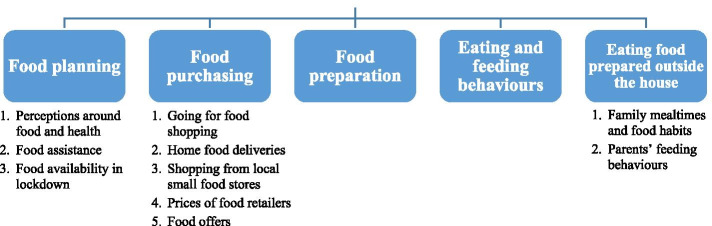
Twelve online interviews were conducted and five distinct themes were identified reflecting families' food-related decisions that were affected by the COVID-19 lockdown: 1) food planning; 2) food purchasing; 3) meal preparation; 4) eating and feeding behaviours and 5) eating food prepared outside the house.
The restrictions put in place to inhibit the spread of COVID-19 influenced all aspects of dietary decisions of low-income families. Changes observed during this period included frequent consumption of homemade meals, but also increased unhealthy snacking. Infrequent food shopping encouraged good meal planning, but was also a barrier to securing adequate fresh food. Food-related support including school meal assistance contributed to families' food security, particularly those of single parents.
为防止 COVID-19 传播而在英国实施的首次全国封锁对低收入家庭造成了严重的财务影响,这些家庭已经面临更高的食品安全风险和不良饮食选择。关于 COVID-19 封锁对英国家庭食品决策影响的定性数据很少。本研究旨在探讨控制 COVID-19 传播的措施如何影响北爱尔兰社会经济贫困家庭的与食品相关的决策。
一项定性研究通过在线个人访谈收集数据。参与者是居住在北爱尔兰城乡地区、预算紧张的 2-17 岁儿童的父母。抽样矩阵使单亲家庭和双亲家庭以及年幼(<12 岁)和青少年(≥12 岁)的父母的代表性均等。数据收集使用摄影和地图绘制练习的方法。通过主题分析方法分析数据。
进行了 12 次在线访谈,确定了五个反映家庭受 COVID-19 封锁影响的与食品相关决策的不同主题:1)食品计划;2)食品购买;3)膳食准备;4)饮食和喂养行为;5)食用在外面准备的食物。
为抑制 COVID-19 传播而实施的限制措施影响了低收入家庭饮食决策的各个方面。在此期间观察到的变化包括经常食用自制餐,但也增加了不健康的零食消费。不频繁的购物鼓励了良好的膳食计划,但也成为确保获得足够新鲜食物的障碍。包括学校餐援助在内的食品相关支持有助于家庭的食品安全,尤其是单亲家庭。