University of Sheffield, Sheffield, England.
Royal Holloway, University of London, Egham, England.
PLoS One. 2021 Jan 27;16(1):e0246339. doi: 10.1371/journal.pone.0246339. eCollection 2021.
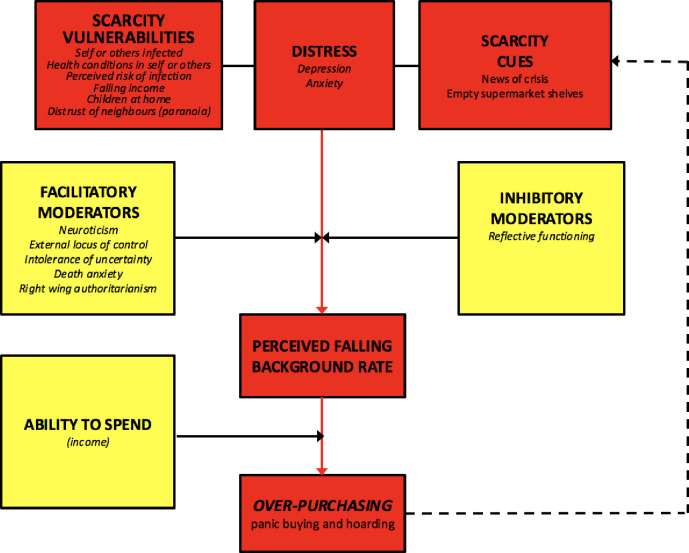
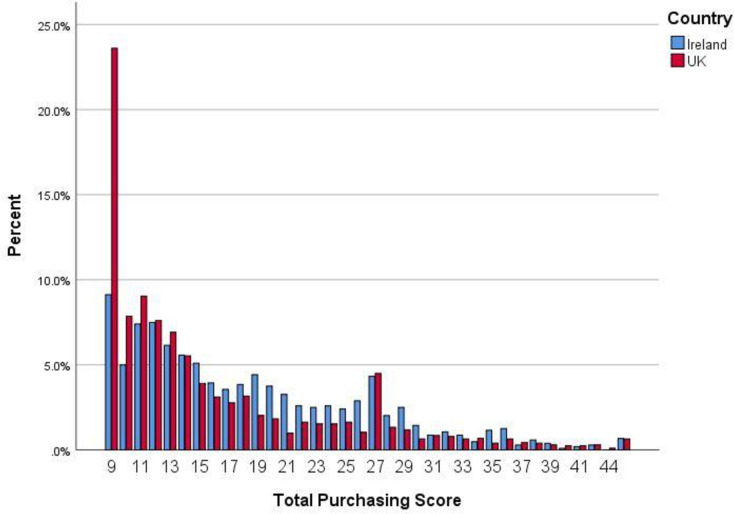
The over-purchasing and hoarding of necessities is a common response to crises, especially in developed economies where there is normally an expectation of plentiful supply. This behaviour was observed internationally during the early stages of the Covid-19 pandemic. In the absence of actual scarcity, this behaviour can be described as 'panic buying' and can lead to temporary shortages. However, there have been few psychological studies of this phenomenon. Here we propose a psychological model of over-purchasing informed by animal foraging theory and make predictions about variables that predict over-purchasing by either exacerbating or mitigating the anticipation of future scarcity. These variables include additional scarcity cues (e.g. loss of income), distress (e.g. depression), psychological factors that draw attention to these cues (e.g. neuroticism) or to reassuring messages (eg. analytical reasoning) or which facilitate over-purchasing (e.g. income). We tested our model in parallel nationally representative internet surveys of the adult general population conducted in the United Kingdom (UK: N = 2025) and the Republic of Ireland (RoI: N = 1041) 52 and 31 days after the first confirmed cases of COVID-19 were detected in the UK and RoI, respectively. About three quarters of participants reported minimal over-purchasing. There was more over-purchasing in RoI vs UK and in urban vs rural areas. When over-purchasing occurred, in both countries it was observed across a wide range of product categories and was accounted for by a single latent factor. It was positively predicted by household income, the presence of children at home, psychological distress (depression, death anxiety), threat sensitivity (right wing authoritarianism) and mistrust of others (paranoia). Analytic reasoning ability had an inhibitory effect. Predictor variables accounted for 36% and 34% of the variance in over-purchasing in the UK and RoI respectively. With some caveats, the data supported our model and points to strategies to mitigate over-purchasing in future crises.
过度购买和囤积必需品是应对危机的常见反应,尤其是在通常预期供应充足的发达经济体中。这种行为在新冠疫情早期的国际上都有观察到。在不存在实际短缺的情况下,这种行为可以被描述为“恐慌性购买”,并可能导致暂时短缺。然而,对于这种现象,心理学研究很少。在这里,我们提出了一个基于动物觅食理论的过度购买心理模型,并对可能加剧或减轻对未来稀缺性预期的变量做出预测。这些变量包括额外的稀缺性线索(例如收入损失)、痛苦(例如抑郁)、引起对这些线索关注的心理因素(例如神经质)或令人安心的信息(例如分析推理)或促进过度购买的因素(例如收入)。我们在英国(英国:N = 2025)和爱尔兰共和国(RoI:N = 1041)的全国代表性互联网调查中并行测试了我们的模型,分别在英国和 RoI 首次确诊新冠病例后 52 天和 31 天进行。大约四分之三的参与者报告说购买量很少。RoI 的购买量多于英国,城市的购买量多于农村。当出现过度购买时,在这两个国家,它都出现在广泛的产品类别中,并由单个潜在因素解释。家庭收入、家中有孩子、心理困扰(抑郁、死亡焦虑)、威胁敏感性(右翼独裁主义)和对他人的不信任(偏执)等因素正向预测过度购买。分析推理能力具有抑制作用。预测变量分别解释了英国和 RoI 过度购买的 36%和 34%的方差。有一些注意事项,但数据支持我们的模型,并指出了在未来危机中减轻过度购买的策略。