Outpatient Comprehensive Treatment, Cangzhou Central Hospital, Cangzhou, Hebei Province, People's Republic of China.
Department of Thyroid and Breast I, Cangzhou Central Hospital, Cangzhou, Hebei Province, People's Republic of China.
Drug Des Devel Ther. 2021 Dec 10;15:4961-4972. doi: 10.2147/DDDT.S330059. eCollection 2021.
Breast cancer is a malignant tumor that seriously threatens women's life and health.
In this study, we proposed to use graphene nanoparticles loaded with siRNA that can silence Rictor molecules essential for the mammalian target of rapamycin (mTOR) complex 2 (mTORC2) complex to enhance gene delivery to tumor cells through modification of cell-penetrating peptide (CPP) for the treatment of breast cancer.
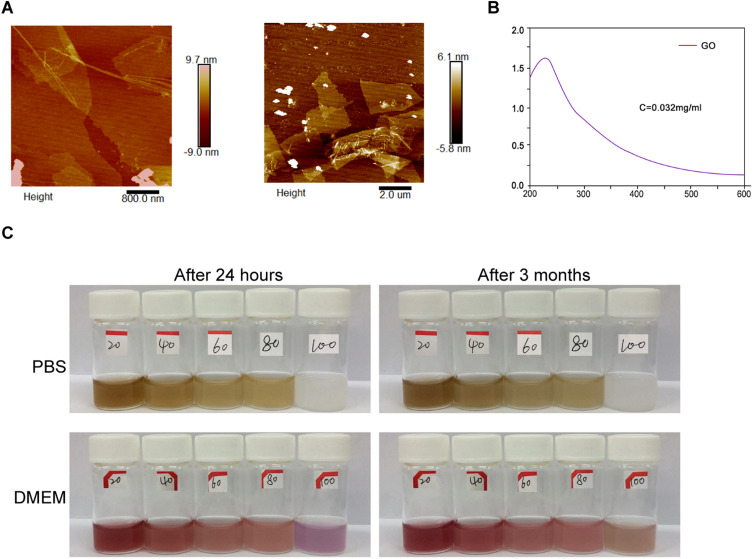
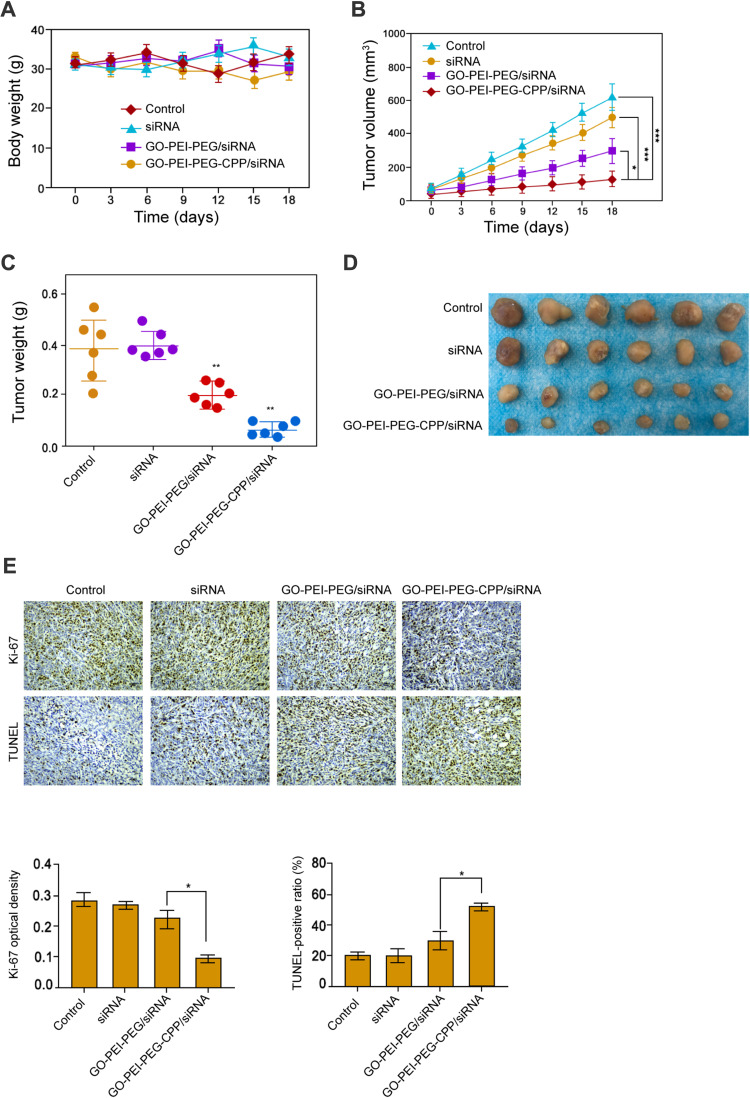
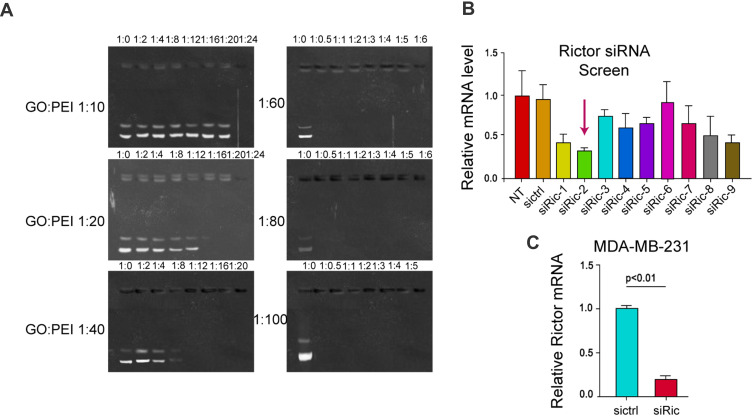
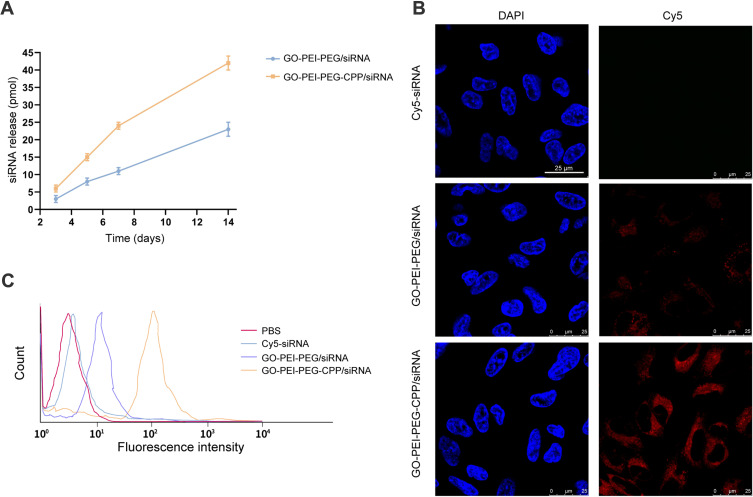
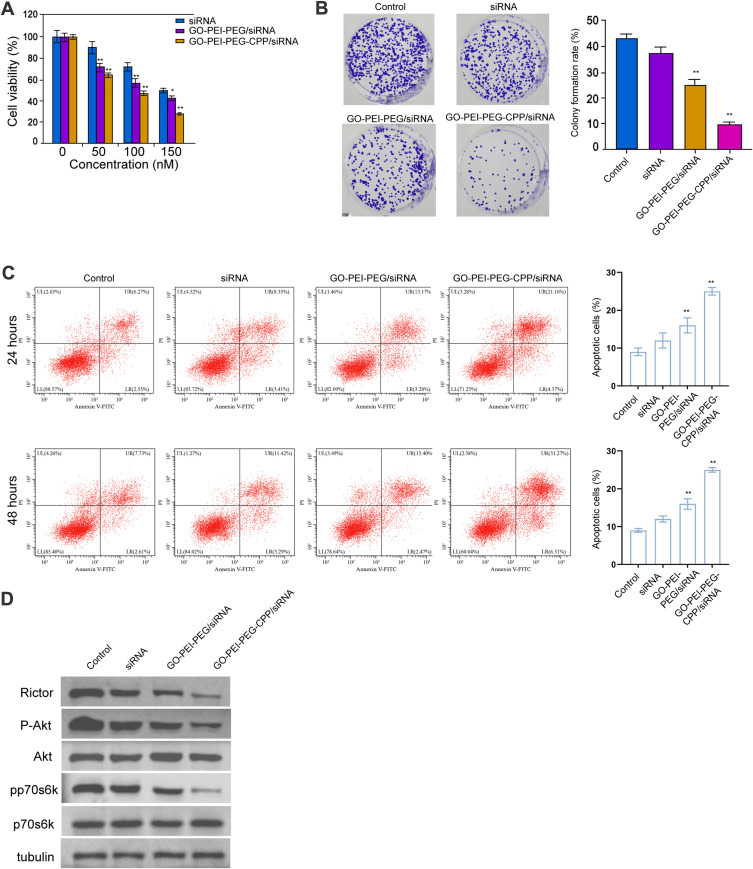
Remarkably, we successfully synthesized graphene oxide (GO)/polyethyleneimine (PEI)/polyethylene glycol (PEG)/CPP/small interfering RNA (siRNA) system, and the results were observed by atomic force microscopy (AFM) and ultraviolet visible (UV-Vis) absorption spectra. The optimum mass ratio of siRNA to GO-PEI-PEG-CPP was 1:0.5. We screened out Rictor siRNA-2 from 9 candidates, which presented the highest inhibition rate, and this siRNA was selected for the subsequent experiments. We validated that Rictor siRNA-2 significantly reduced the Rictor expression in triple negative breast cancer (TNBC) cells. Confocal fluorescence microscope and flow cytometry analysis showed that GO-PEI-PEG-CPP/siRNA was able to be effectively uptake by TNBC cells. GO-PEI-PEG-CPP/siRNA improved the effect of siRNA on the inhibition of TNBC cell viability and the induction of TNBC cell apoptosis. The expression of Rictor and the phosphorylation of Akt and p70s6k were inhibited by GO-PEI-PEG-CPP/siRNA. Tumorigenicity analysis in nude mice showed that GO-PEI-PEG-CPP/siRNA significantly repressed the tumor growth of TNBC cells in vivo. The levels of ki-67 were repressed by GO-PEI-PEG-CPP/siRNA, and the apoptosis was induced by GO-PEI-PEG-CPP/siRNA in the system.
Therefore, we concluded that CPP-modified GO nanoparticles loaded with Rictor siRNA significantly repressed TNBC progression by the inhibition of PI3K/Akt/mTOR signaling. Our finding provides a promising therapeutic strategy for the treatment of TNBC.
乳腺癌是一种严重威胁女性生命和健康的恶性肿瘤。
本研究拟采用载有沉默雷帕霉素靶蛋白复合物 2(mTORC2)复合物所必需的 Rictor 分子的 siRNA 的石墨烯纳米粒子,通过细胞穿透肽(CPP)修饰增强基因向肿瘤细胞的传递,用于治疗乳腺癌。
值得注意的是,我们成功合成了氧化石墨烯(GO)/聚乙烯亚胺(PEI)/聚乙二醇(PEG)/CPP/小干扰 RNA(siRNA)系统,并通过原子力显微镜(AFM)和紫外可见(UV-Vis)吸收光谱观察到结果。siRNA 与 GO-PEI-PEG-CPP 的最佳质量比为 1:0.5。我们从 9 个候选物中筛选出 Rictor siRNA-2,其抑制率最高,该 siRNA 被选用于后续实验。我们验证了 Rictor siRNA-2 可显著降低三阴性乳腺癌(TNBC)细胞中的 Rictor 表达。共聚焦荧光显微镜和流式细胞术分析表明,GO-PEI-PEG-CPP/siRNA 能够被 TNBC 细胞有效摄取。GO-PEI-PEG-CPP/siRNA 提高了 siRNA 对抑制 TNBC 细胞活力和诱导 TNBC 细胞凋亡的作用。GO-PEI-PEG-CPP/siRNA 抑制了 Rictor 的表达以及 Akt 和 p70s6k 的磷酸化。GO-PEI-PEG-CPP/siRNA 在裸鼠中的肿瘤发生分析表明,GO-PEI-PEG-CPP/siRNA 显著抑制了体内 TNBC 细胞的肿瘤生长。GO-PEI-PEG-CPP/siRNA 抑制了 ki-67 的水平,并诱导了 GO-PEI-PEG-CPP/siRNA 系统中的细胞凋亡。
因此,我们得出结论,CPP 修饰的载有 Rictor siRNA 的 GO 纳米粒子通过抑制 PI3K/Akt/mTOR 信号通路显著抑制 TNBC 的进展。我们的发现为治疗 TNBC 提供了一种有前途的治疗策略。