Decker Lars, Basta Dietmar, Burkart Martin, Ernst Arne
Department of Otolaryngology, Unfallkrankenhaus Berlin, Hospital of the University of Berlin, Charité Medical School, Berlin, Germany.
Dr. Willmar Schwabe GmbH & Co. KG, Karlsruhe, Germany.
Front Neurol. 2021 Nov 30;12:691917. doi: 10.3389/fneur.2021.691917. eCollection 2021.
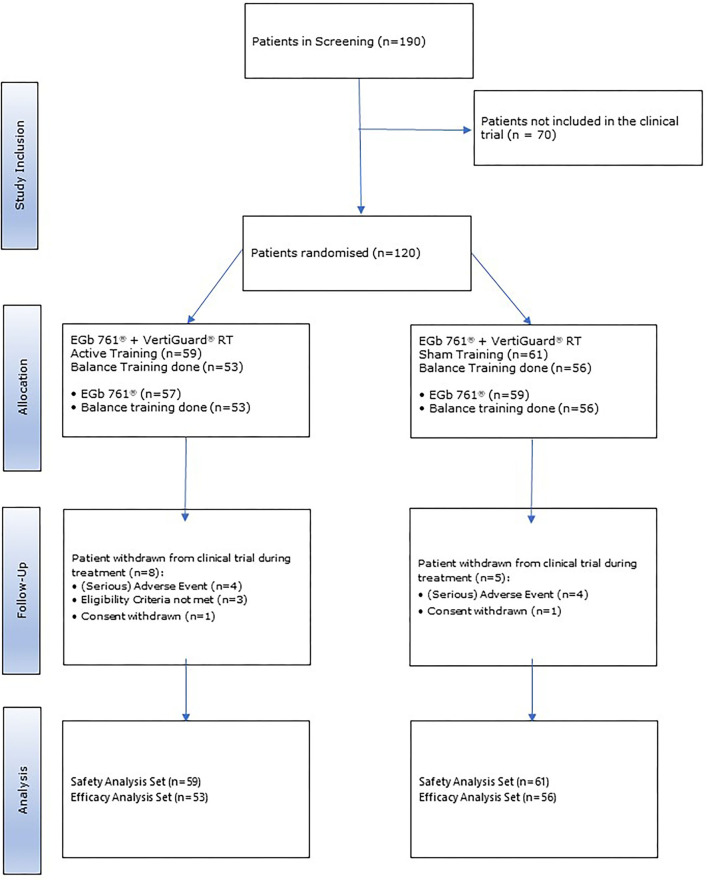
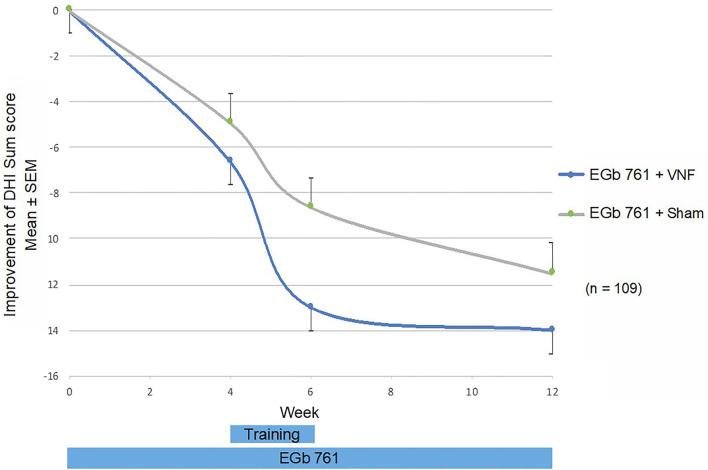
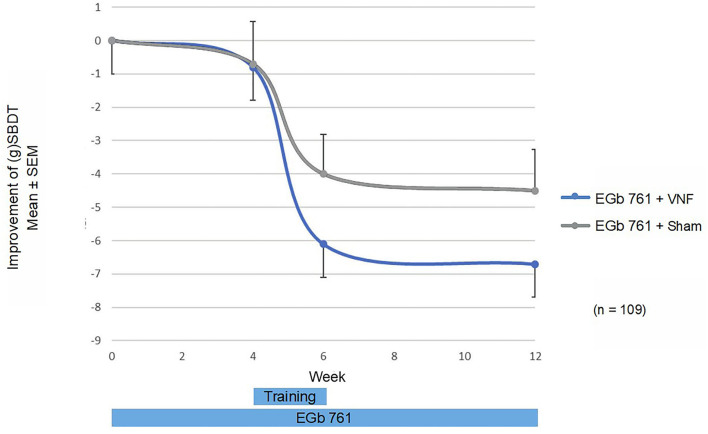
Balance training with vibrotactile neurofeedback (VNF) can improve balance and subjective impairment in age-related vertigo and dizziness. dry extract EGb 761 has been shown to improve subjective impairment in chronic vertigo and the efficacy of conventional balance training. The combination was expected to work synergistically in this difficult-to-treat population. To demonstrate the efficacy of VNF added to EGb 761 for age-related vertigo and dizziness. Multicenter, prospective, controlled, randomized, single-blind, two-arm trial (German Clinical Trials Register https://www.drks.de No. DRKS00007633). Specialist offices and tertiary care outpatient department. One hundred and twenty subjects aged 60+ years with chronic dizziness for over 3 months, a Dizziness Handicap Inventory (DHI) Sum Score >25 and fall risk in balance-related situations as measured by the geriatric Standard Balance Deficit Test Composite Score (gSBDT-CS)>40. Patients with other distinct vestibular pathology (e.g., Meniére's disease, stroke, BPPV) were excluded. EGb 761 (80 mg twice daily for 12 weeks) plus 10 days of individually adapted balance training with VNF, randomized 1:1 to sensitive (active) or non-sensitive (sham) neurofeedback. The change in gSBDT-CS after 6 weeks (primary), other gSBDT outcomes, DHI, cognition, hearing, and safety. One hundred nine of 120 enrolled subjects received both treatments at least once. Over 12 weeks, the gSBDT-CS improved by 6.7 (active) vs. 4.5 (sham). There was a difference in favor of the active treatment of -2.4 (95% CI -5.4; 0.6) after 6 weeks. Under active treatment, more pronounced effects occurred in all secondary analyses and in nearly all secondary endpoints. The DHI sum score decreased from 44.1 to 31.1 in the total sample with a treatment group difference after 6 weeks of -3.1, 95% CI (-7.1; 0.9). No safety issues were reported. Over 12 weeks, the combination of balance training with VNF and dry extract EGb 761 reached a clinically relevant improvement of age-related vertigo and dizziness with a good pharmacological safety profile.
采用振动触觉神经反馈(VNF)的平衡训练可改善与年龄相关的眩晕和头晕的平衡能力及主观不适。银杏叶提取物EGb 761已被证明可改善慢性眩晕的主观不适以及传统平衡训练的效果。预计这种联合疗法在这一难以治疗的人群中会产生协同作用。为了证明在EGb 761基础上加用VNF治疗与年龄相关的眩晕和头晕的疗效。进行了一项多中心、前瞻性、对照、随机、单盲、双臂试验(德国临床试验注册中心https://www.drks.de,编号DRKS00007633)。研究地点为专科诊所和三级护理门诊部。120名年龄在60岁及以上、患有慢性头晕超过3个月、头晕残障量表(DHI)总分>25且根据老年标准平衡缺陷测试综合评分(gSBDT-CS)>40判断在平衡相关情况下有跌倒风险的受试者纳入研究。排除患有其他明确前庭疾病(如梅尼埃病、中风、良性阵发性位置性眩晕)的患者。给予EGb 761(每日两次,每次80mg,共12周)加10天根据个体情况调整的VNF平衡训练,随机分为敏感(活性)或不敏感(假)神经反馈,比例为1:1。观察6周后gSBDT-CS的变化(主要指标)、其他gSBDT结果、DHI、认知、听力及安全性。120名入组受试者中有109名至少接受了一次两种治疗。在12周内,活性组gSBDT-CS改善了6.7,假手术组改善了4.5。6周后,活性治疗组有优势,差异为-2.4(95%CI -5.4;0.6)。在活性治疗下,所有次要分析和几乎所有次要终点均出现更明显的效果。总样本中DHI总分从44.1降至31.1,治疗组在6周后的差异为-3.1,95%CI(-7.1;-0.9)。未报告安全问题。在12周内,VNF平衡训练与银杏叶提取物EGb 761的联合疗法在改善与年龄相关的眩晕和头晕方面达到了临床相关程度,且具有良好的药理安全性。