Carruthers David N, Lee Taek Soon
Joint BioEnergy Institute, Emeryville, CA, United States.
Biological Systems and Engineering Division, Lawrence Berkeley National Laboratory, Berkeley, CA, United States.
Front Microbiol. 2021 Dec 2;12:791089. doi: 10.3389/fmicb.2021.791089. eCollection 2021.
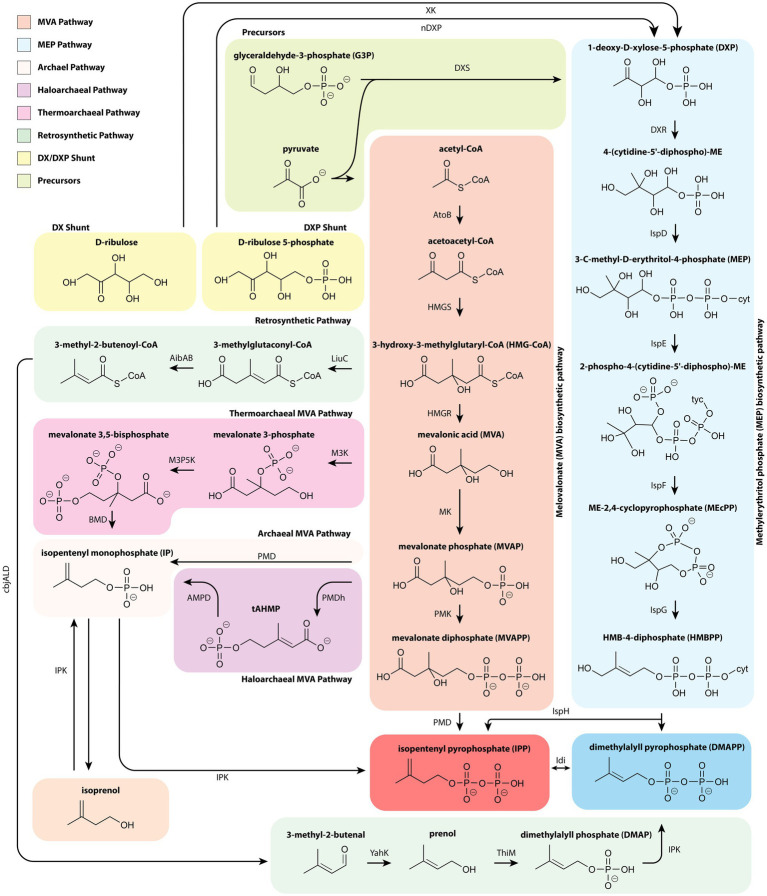
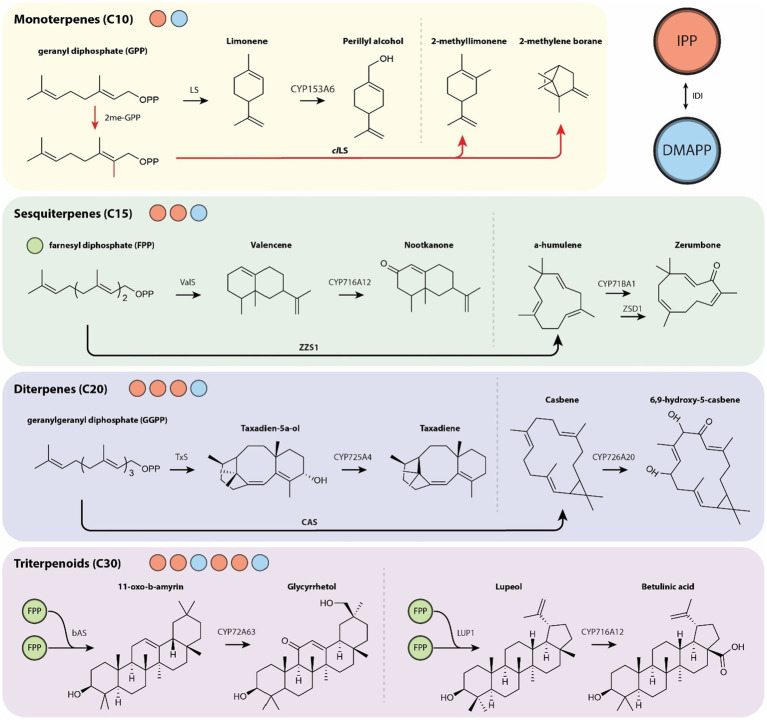
Isoprenoid compounds are biologically ubiquitous, and their characteristic modularity has afforded products ranging from pharmaceuticals to biofuels. Isoprenoid production has been largely successful in and with metabolic engineering of the mevalonate (MVA) and methylerythritol phosphate (MEP) pathways coupled with the expression of heterologous terpene synthases. Yet conventional microbial chassis pose several major obstacles to successful commercialization including the affordability of sugar substrates at scale, precursor flux limitations, and intermediate feedback-inhibition. Now, recent studies have challenged typical isoprenoid paradigms by expanding the boundaries of terpene biosynthesis and using non-model organisms including those capable of metabolizing atypical C1 substrates. Conversely, investigations of non-model organisms have historically informed optimization in conventional microbes by tuning heterologous gene expression. Here, we review advances in isoprenoid biosynthesis with specific focus on the synergy between model and non-model organisms that may elevate the commercial viability of isoprenoid platforms by addressing the dichotomy between high titer production and inexpensive substrates.
类异戊二烯化合物在生物学上普遍存在,其独特的模块化结构产生了从药物到生物燃料等各种产品。通过甲羟戊酸(MVA)和甲基赤藓糖醇磷酸(MEP)途径的代谢工程与异源萜烯合酶的表达相结合,类异戊二烯的生产在[具体内容缺失]方面已取得很大成功。然而,传统的微生物底盘对成功商业化构成了几个主要障碍,包括大规模糖底物的可承受性、前体通量限制和中间产物反馈抑制。如今,最近的研究通过扩展萜烯生物合成的边界并使用包括能够代谢非典型C1底物的非模式生物,对典型的类异戊二烯模式提出了挑战。相反,对非模式生物的研究历来通过调整异源基因表达为传统微生物的优化提供了依据。在这里,我们回顾类异戊二烯生物合成的进展,特别关注模式生物和非模式生物之间的协同作用,这种协同作用可能通过解决高产量生产和廉价底物之间的二分法来提高类异戊二烯平台的商业可行性。