Mohamed Elsayed T, Werner Allison Z, Salvachúa Davinia, Singer Christine A, Szostkiewicz Kiki, Rafael Jiménez-Díaz Manuel, Eng Thomas, Radi Mohammad S, Simmons Blake A, Mukhopadhyay Aindrila, Herrgård Markus J, Singer Steven W, Beckham Gregg T, Feist Adam M
Novo Nordisk Foundation Center for Biosustainability, Technical University of Denmark, Lyngby, Denmark.
Renewable Resources and Enabling Sciences Center, National Renewable Energy Laboratory, Golden, CO, USA.
Metab Eng Commun. 2020 Aug 29;11:e00143. doi: 10.1016/j.mec.2020.e00143. eCollection 2020 Dec.
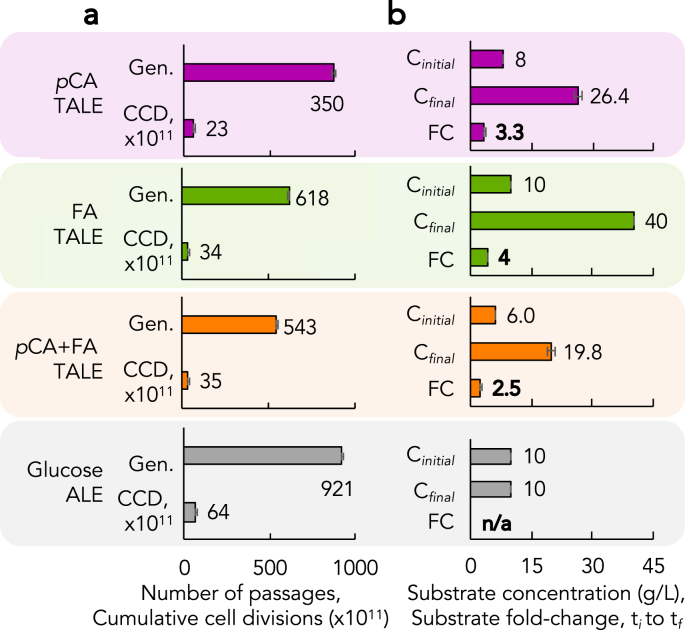
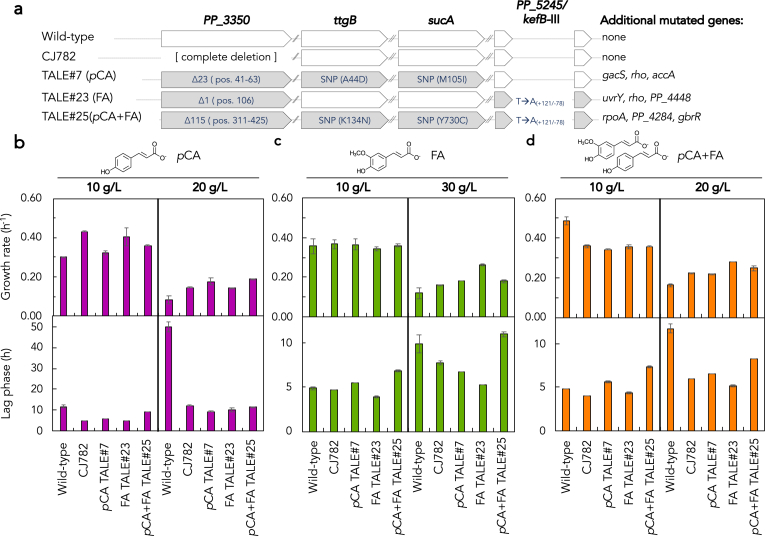
KT2440 is a promising bacterial chassis for the conversion of lignin-derived aromatic compound mixtures to biofuels and bioproducts. Despite the inherent robustness of this strain, further improvements to aromatic catabolism and toxicity tolerance of will be required to achieve industrial relevance. Here, tolerance adaptive laboratory evolution (TALE) was employed with increasing concentrations of the hydroxycinnamic acids -coumaric acid (CA) and ferulic acid (FA) individually and in combination (CA + FA). The TALE experiments led to evolved strains with increased tolerance to the targeted acids as compared to wild type. Specifically, a 37 h decrease in lag phase in 20 g/L CA and a 2.4-fold increase in growth rate in 30 g/L FA was observed. Whole genome sequencing of intermediate and endpoint evolved populations revealed several expected and non-intuitive genetic targets underlying these aromatic catabolic and toxicity tolerance enhancements. and were among the most frequently mutated genes, and the beneficial contributions of these mutations were verified via gene knockouts. Deletion of encoding a hypothetical protein, recapitulated improved toxicity tolerance to high concentrations of CA, but not an improved growth rate in high concentrations of FA. Deletion of part of the TtgABC efflux pump, severely inhibited growth in CA + FA TALE-derived strains but did not affect growth in CA + FA in a wild type background, suggesting epistatic interactions. Genes involved in flagellar movement and transcriptional regulation were often mutated in the TALE experiments on multiple substrates, reinforcing ideas of a minimal and deregulated cell as optimal for domesticated growth. Overall, this work demonstrates increased tolerance towards and growth rate at the expense of hydroxycinnamic acids and presents new targets for improving for microbial lignin valorization.
KT2440是一种很有前景的细菌底盘,可用于将木质素衍生的芳香族化合物混合物转化为生物燃料和生物产品。尽管该菌株具有内在的稳健性,但仍需要进一步改善其芳香族分解代谢和毒性耐受性,以实现工业应用价值。在此,采用耐受性适应性实验室进化(TALE)方法,分别单独以及组合增加羟基肉桂酸(香豆酸(CA)和阿魏酸(FA))的浓度。与野生型相比,TALE实验产生了对目标酸耐受性增强的进化菌株。具体而言,观察到在20 g/L CA中滞后期减少了37小时,在30 g/L FA中生长速率提高了2.4倍。对中间和终点进化群体的全基因组测序揭示了这些芳香族分解代谢和毒性耐受性增强背后的几个预期和非直观的遗传靶点。 和 是最常发生突变的基因之一,并且通过基因敲除验证了这些突变的有益作用。编码一种假定蛋白的 的缺失,重现了对高浓度CA的毒性耐受性提高,但没有提高在高浓度FA中的生长速率。TtgABC外排泵的一部分 的缺失,严重抑制了CA + FA TALE衍生菌株中的生长,但在野生型背景下不影响CA + FA中的生长,表明存在上位性相互作用。在多个底物的TALE实验中,参与鞭毛运动和转录调控的基因经常发生突变,强化了最小化和失调细胞最适合驯化生长的观点。总体而言,这项工作证明了以羟基肉桂酸为代价提高了耐受性和生长速率,并为改善用于微生物木质素增值的 提出了新的靶点。