Douillard Venceslas, Castelli Erick C, Mack Steven J, Hollenbach Jill A, Gourraud Pierre-Antoine, Vince Nicolas, Limou Sophie
Centre de Recherche en Transplantation et Immunologie, CHU Nantes, Inserm, Centre de Recherche en Transplantation et Immunologie, Université de Nantes, Nantes, France.
Unesp-Universidade Estadual Paulista, Botucatu, Brazil.
Front Genet. 2021 Dec 2;12:774916. doi: 10.3389/fgene.2021.774916. eCollection 2021.
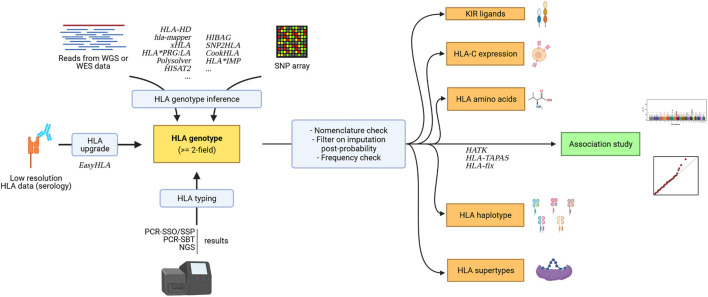
The current SARS-CoV-2 pandemic era launched an immediate and broad response of the research community with studies both about the virus and host genetics. Research in genetics investigated HLA association with COVID-19 based on , population, and individual data. However, they were conducted with variable scale and success; convincing results were mostly obtained with broader whole-genome association studies. Here, we propose a technical review of HLA analysis, including basic HLA knowledge as well as available tools and advice. We notably describe recent algorithms to infer and call HLA genotypes from GWAS SNPs and NGS data, respectively, which opens the possibility to investigate HLA from large datasets without a specific initial focus on this region. We thus hope this overview will empower geneticists who were unfamiliar with HLA to run MHC-focused analyses following the footsteps of the Covid-19|HLA & Immunogenetics Consortium.
当前的新冠病毒大流行时代促使研究界立即做出广泛回应,开展了有关病毒和宿主遗传学的研究。遗传学研究基于群体和个体数据调查了人类白细胞抗原(HLA)与新冠病毒疾病(COVID-19)的关联。然而,这些研究的规模和成果各不相同;令人信服的结果大多来自更广泛的全基因组关联研究。在此,我们提出对HLA分析的技术综述,包括HLA的基础知识以及可用工具和建议。我们特别描述了最近分别从全基因组关联研究(GWAS)单核苷酸多态性(SNP)和二代测序(NGS)数据推断和调用HLA基因型的算法,这使得从大型数据集中研究HLA成为可能,而无需一开始就特别关注该区域。因此,我们希望这一综述能让不熟悉HLA的遗传学家有能力效仿新冠病毒|HLA与免疫遗传学联盟,开展以主要组织相容性复合体(MHC)为重点的分析。