Kong Juin Yee, Bharadwaj Srabani Samanta, Chinnadurai Amutha, Ho Selina Kah Ying
Department of Neonatology, KK Women's and Children's Hospital, Singapore, Singapore.
Duke-NUS Medical School, Singapore, Singapore.
Front Pediatr. 2021 Dec 2;9:785524. doi: 10.3389/fped.2021.785524. eCollection 2021.
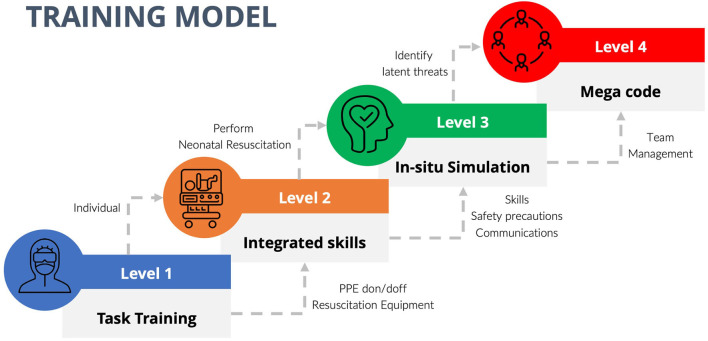
Rapid spread of the COVID-19 pandemic raised an urgent need for preparedness in the healthcare sector, including training of healthcare workers to cope with the burden of infected cases while ensuring proper protection of themselves. Improper infection prevention and control measures were key reasons for infection in healthcare workers during the early phase of the outbreak. This paper describes the combined approach of 3 restructured hospitals in Singapore in preparing and training neonatal healthcare workers' during the COVID-19 pandemic crisis, as well as lessons learnt during this process. Information sharing was conducted in the form of e-learning, emphasizing on topics like disease knowledge and infection prevention and control procedures. Skills and competency training were carried out in the form of simulation, with sessions scaled into 4 levels progressing from individual task training to larger group simulations involving multiple disciplines and departments. Challenges encountered included information fatigue by large amount of constantly changing information and multiple amendments to workflows as more information arose. Difficulties conducting training and simulation sessions included restriction of group size to mitigate infection risk amongst participants and the limited supply of personal protective equipment prioritized for direct patient care. Healthcare institutions should ensure adequate dissemination of conceptual knowledge as well as skills competency training of staff in infection control measures for the protection of healthcare workers and patient safety. Ongoing training for sustainability of knowledge and skills, while adapting to the rapidly evolving situation is important in the preparation for future outbreaks.
新冠疫情的迅速蔓延使得医疗保健部门迫切需要做好准备,包括培训医护人员,以便在应对感染病例负担的同时确保自身得到妥善保护。在疫情爆发初期,感染预防和控制措施不当是医护人员感染的主要原因。本文介绍了新加坡3家重组医院在新冠疫情危机期间对新生儿医护人员进行准备和培训的综合方法,以及在此过程中吸取的经验教训。信息共享以电子学习的形式进行,重点关注疾病知识和感染预防与控制程序等主题。技能和能力培训以模拟的形式开展,课程分为4个级别,从个人任务培训逐步过渡到涉及多个学科和部门的大型团队模拟。遇到的挑战包括大量不断变化的信息导致的信息疲劳,以及随着更多信息出现对工作流程进行的多次修订。开展培训和模拟课程的困难包括限制小组规模以降低参与者之间感染风险,以及优先用于直接患者护理的个人防护装备供应有限。医疗机构应确保充分传播概念知识以及对工作人员进行感染控制措施方面的技能能力培训,以保护医护人员和患者安全。在适应快速变化的形势的同时,持续进行知识和技能的可持续培训,对于未来疫情爆发的准备工作至关重要。