Du Fawang, Huang Huiling, Cao Yalin, Ran Yan, Wu Qiang, Chen Baolin
Department of Cardiology, Guizhou Provincial People's Hospital, Guiyang, China.
Department of Cardiology, The First Affiliated Hospital of Sun Yat-Sen University, Guangzhou, China.
Front Cell Dev Biol. 2021 Dec 1;9:791643. doi: 10.3389/fcell.2021.791643. eCollection 2021.
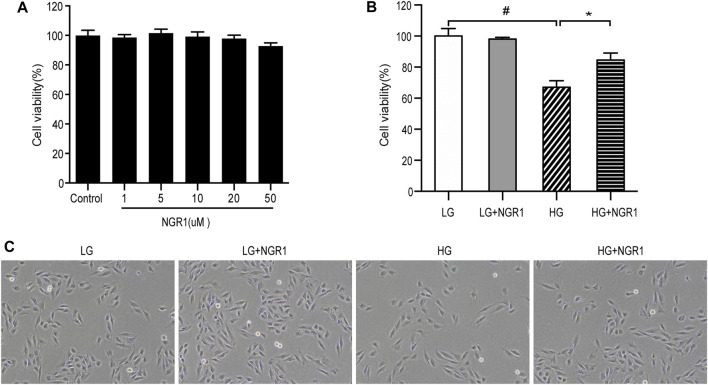
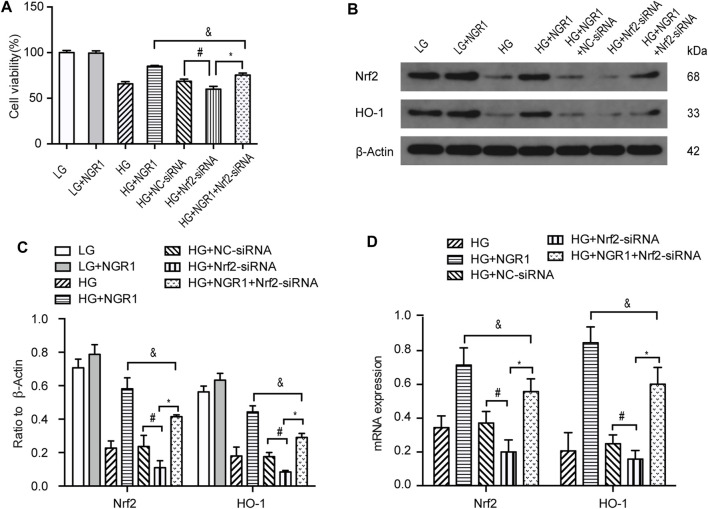
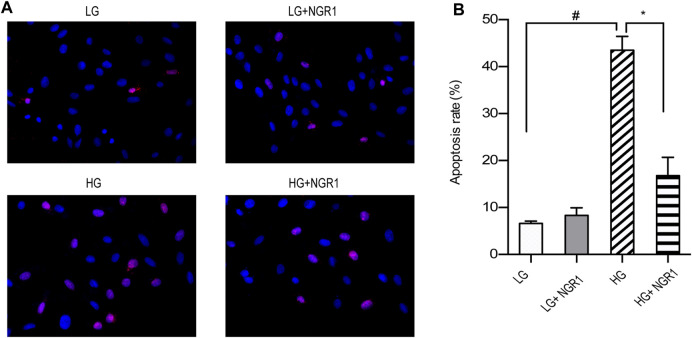
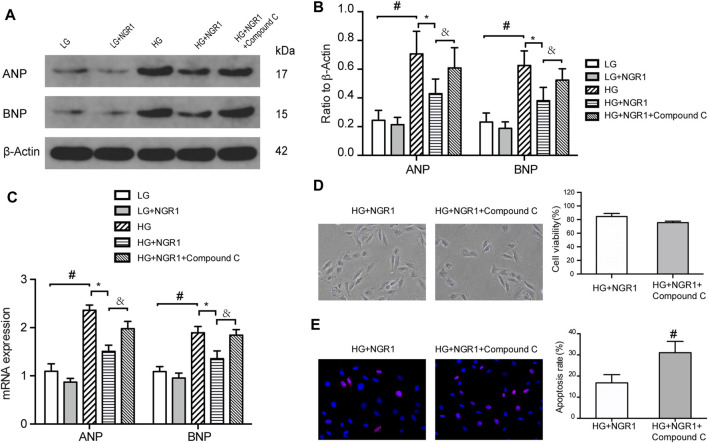
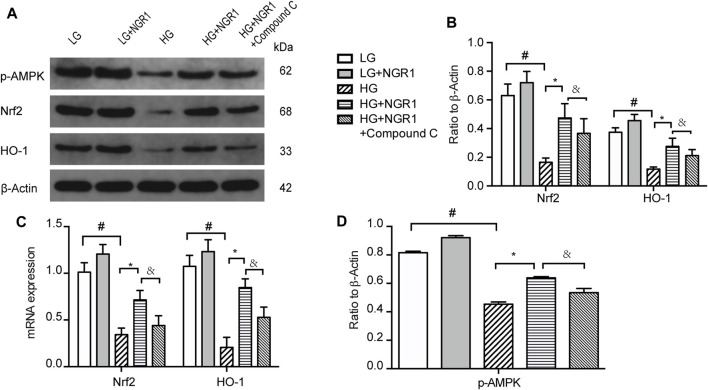
Notoginsenoside R1 (NGR1), the primary bioactive compound found in Panax notoginseng, is believed to have antihypertrophic and antiapoptotic properties, and has long been used to prevent and treat cardiovascular diseases. However, its potential role in prevention of diabetic cardiomyopathy remains unclear. The present study aimed to investigate the mechanism of NGR1 action in high glucose-induced cell injury. H9c2 cardiomyocytes were cultured in a high-glucose medium as an model, and apoptotic cells were visualized using TUNEL staining. Expression of Nrf2 and HO-1 was measured using Western blotting or reverse transcription-quantitative PCR (RT-qPCR). The Nrf2 small interfering (si) RNA was transfected into cardiomyocytes using Opti-MEM containing Lipofectamine RNAiMAX. NGR1 protected H9c2 cardiomyocytes from cell death, apoptosis and hypertrophy induced by high glucose concentration. Expression of auricular natriuretic peptide and brain natriuretic peptide was remarkably reduced in NGR1-treated H9C2 cells. Western blot analysis showed that high glucose concentration markedly inhibited AMPK, Nrf2 and HO-1, and this could be reversed by NGR1 treatment. However, the cardioprotective effect of NGR1 was attenuated by compound C, which reverses Nrf2 and HO-1 expression levels, suggesting that AMPK upregulates Nrf2 and HO-1 gene expression, protein synthesis and secretion. Transfection of H9C2 cells with Nrf2 siRNA markedly reduced the cardioprotective effect of NGR1 via reduced expression of HO-1. These results indicated that NGR1 attenuated high glucose-induced cell injury via AMPK/Nrf2 signaling and its downstream target, the HO-1 pathway. We conclude that the cardioprotective effects of NGR1 result from upregulation of AMPK/Nrf2 signaling and HO-1 expression in cardiomyocytes. Our findings suggest that NGR1 treatment might provide a novel therapy for diabetic cardiomyopathy.
三七皂苷R1(NGR1)是三七中发现的主要生物活性化合物,被认为具有抗肥厚和抗凋亡特性,长期以来一直用于预防和治疗心血管疾病。然而,其在预防糖尿病性心肌病中的潜在作用仍不清楚。本研究旨在探讨NGR1在高糖诱导的细胞损伤中的作用机制。将H9c2心肌细胞培养在高糖培养基中作为模型,使用TUNEL染色观察凋亡细胞。使用蛋白质免疫印迹法或逆转录定量聚合酶链反应(RT-qPCR)检测Nrf2和HO-1的表达。使用含有Lipofectamine RNAiMAX的Opti-MEM将Nrf2小干扰(si)RNA转染到心肌细胞中。NGR1保护H9c2心肌细胞免受高糖浓度诱导的细胞死亡、凋亡和肥大。在NGR1处理的H9C2细胞中,心钠素和脑钠素的表达显著降低。蛋白质免疫印迹分析表明,高糖浓度显著抑制AMPK、Nrf2和HO-1,而NGR1处理可逆转这种抑制作用。然而,化合物C减弱了NGR1的心脏保护作用,化合物C可逆转Nrf2和HO-1的表达水平,这表明AMPK上调Nrf2和HO-1基因表达、蛋白质合成和分泌。用Nrf2 siRNA转染H9C2细胞,通过降低HO-1的表达显著减弱了NGR1的心脏保护作用。这些结果表明,NGR1通过AMPK/Nrf2信号通路及其下游靶点HO-1途径减轻高糖诱导的细胞损伤。我们得出结论,NGR1的心脏保护作用源于心肌细胞中AMPK/Nrf2信号通路的上调和HO-1表达的增加。我们的研究结果表明,NGR1治疗可能为糖尿病性心肌病提供一种新的治疗方法。