Department of Medical Microbiology, İstanbul University-Cerrahpaşa, Cerrahpaşa School of Medicine, İstanbul, Turkey
Department of Infectious Diseases and Clinical Microbiology, İstanbul University-Cerrahpaşa, Cerrahpaşa School of Medicine, İstanbul, Turkey
Balkan Med J. 2022 Jan 25;39(1):48-54. doi: 10.5152/balkanmedj.2021.21135. Epub 2021 Dec 20.
Widespread and effective use of molecular diagnostic tests is indispensable for protecting public health and containing the severe respiratory syndrome coronavirus 2 (SARS-CoV-2) pandemic. More than 1 year into the pandemic, as resources have reached a point of depletion, grouping samples in pools of certain sizes appears to be a reasonable method to reduce both the costs and the processing time without necessitating additional training, equipment, or materials.
To assess whether the pooling strategy that was used in past outbreaks and is used in blood tests prior to transfusion for screening large populations can also be used in SARS CoV-2 tests.
Diagnostic accuracy study.
This prospective study was conducted with 2815 samples, sent to the coronavirus disease 2019 (COVID-19) Laboratory of our hospital between February 12 and 21, 2021, to be tested for the presence of SARS-CoV-2. The samples were examined individually and in pools of five 100 μl taken from each sequential sample, using 3 different SARS-CoV-2 reverse transcription-polymerase chain reaction (RT-PCR) kits, the Allplex™ 2019-nCoV Assay kit (Seegene, Republic of Korea), the GeneMAP™ 2019-nCoV detection V.3 kit (GenMark, Türkiye), and the Bio-Speedy™ SARS-CoV-2 Double Gene™ RT-qPCR kit (Bioeksen, Türkiye) on the BioRAD CFX96™ Touch (Bio-Rad Laboratories Inc., Hercules, CA, USA) platform available in our laboratory.
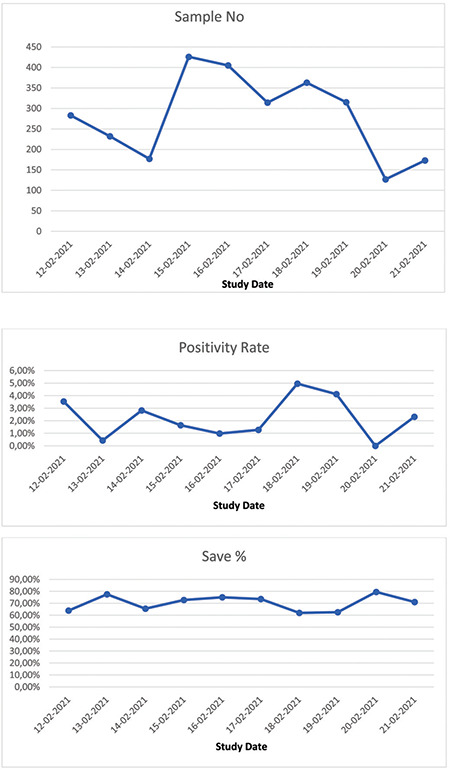
Following the extraction of serial dilutions prepared from the SARS-CoV-2 RNA positive (cycle of threshold: 20) sample, the standard curves of RT-PCR were analyzed. By evaluating the efficiency (E) values, all 3 kits showed high sensitivity and similar results; while the highest level was detected with the Allplex™ 2019-nCoV Assay kit in the nucleocapsid (N) gene (E: 124%), the lowest was detected with the Double Gene™ RT-qPCR kit in the N and ORF 1ab genes (E: 90%). Of the samples included in the study, only 1 positive sample with low viral load was found to be negative when studied by pooling. The total number of kits to be used in pooled tests and then to individually retest the 5 samples in positive pools was calculated as 827 and the savings rate as 69.91% (1968/2815).
The pooling strategy is an effective approach to extend the impact of limited testing resources and reagents available in certain periods of the COVID-19 pandemic. Testing by pooling samples requires improvement of RNA extraction methods and careful monitoring of RT-PCR test sensitivity to avoid missing low-positive entities. Therefore, based on the prevalence of COVID-19 in their regions, laboratories should conduct their own validation of pooling studies for RNA extraction and amplification methods they use.
广泛有效地使用分子诊断检测对于保护公众健康和控制严重的呼吸道综合征冠状病毒 2(SARS-CoV-2)大流行是必不可少的。大流行已经持续了 1 年多,资源已经达到枯竭的地步,将样本按一定大小分组成池似乎是一种合理的方法,可以在不增加额外培训、设备或材料的情况下降低成本和处理时间。
评估过去爆发和输血前用于筛查大人群的血液检测中使用的分组策略是否也可用于 SARS-CoV-2 检测。
诊断准确性研究。
这项前瞻性研究共纳入 2815 份样本,于 2021 年 2 月 12 日至 21 日送到我们医院的 2019 年冠状病毒病(COVID-19)实验室进行 SARS-CoV-2 检测。这些样本单独检测,也按每个连续样本中抽取的 5 个 100 μl 进行分组检测,使用 3 种不同的 SARS-CoV-2 逆转录-聚合酶链反应(RT-PCR)试剂盒,Allplex™ 2019-nCoV 检测试剂盒(Seegene,大韩民国)、GeneMAP™ 2019-nCoV 检测试剂盒 V.3(GenMark,土耳其)和 Bio-Speedy™ SARS-CoV-2 双基因™ RT-qPCR 试剂盒(Bioeksen,土耳其),在我们实验室的 BioRAD CFX96™ Touch(Bio-Rad Laboratories Inc.,加利福尼亚州赫拉克勒斯)平台上进行。
对 SARS-CoV-2 RNA 阳性(阈值循环:20)样本的连续稀释液进行提取后,分析 RT-PCR 的标准曲线。通过评估效率(E)值,所有 3 种试剂盒均表现出高灵敏度和相似的结果;Allplex™ 2019-nCoV 检测试剂盒在核衣壳(N)基因中检测到的灵敏度最高(E:124%),而 Double Gene™ RT-qPCR 试剂盒在 N 和 ORF 1ab 基因中检测到的灵敏度最低(E:90%)。在研究的样本中,只有 1 份低病毒载量的阳性样本在分组检测时被发现为阴性。在阳性池中的 5 个样本进行单独复测所需的试剂盒总数和节省率计算结果分别为 827 和 69.91%(1968/2815)。
分组策略是在 COVID-19 大流行的某些时期扩展有限的检测资源和试剂的有效方法。样本分组检测需要改进 RNA 提取方法,并仔细监测 RT-PCR 检测的灵敏度,以避免漏检低阳性实体。因此,实验室应根据其所在地区 COVID-19 的流行情况,自行验证他们使用的 RNA 提取和扩增方法的分组研究。