Ohno Kanta, Tomori Kounosuke, Sawada Tatsunori, Kobayashi Ryuji
Major of Occupational Therapy, Department of Rehabilitation, School of Health Science, Tokyo University of Technology, 5-23-22, Nishikamata, Ota-City, Tokyo, 144-8535, Japan.
Department of Occupational Therapy, Graduate School of Human Health Sciences, Tokyo Metropolitan University, Tokyo, Japan.
J Patient Rep Outcomes. 2021 Dec 20;5(1):133. doi: 10.1186/s41687-021-00405-y.
The Canadian Occupational Performance Measure (COPM) is an individualized patient-reported outcome designed to evaluate the self-perceptions of a patient's occupational performance. Our study aimed to examine the minimal important change (MIC) in inpatients undergoing subacute rehabilitation. The MIC values were calculated using the three different anchor-based analyses with the transition index as an external criterion; the mean change method (MIC), the receiver operating characteristic (MIC) analysis, and the predictive modeling method adjusted for the proportion of improved patients (MIC). In this study, the MIC value was considered as the most valid statistical method. We recruited 100 inpatients with various health conditions from subacute rehabilitation hospitals. Data were collected twice: an initial assessment and a reassessment one month later. The systematic interview format (Five Ws and How) was used for both the initial and second assessments to prevent information bias (response shift).
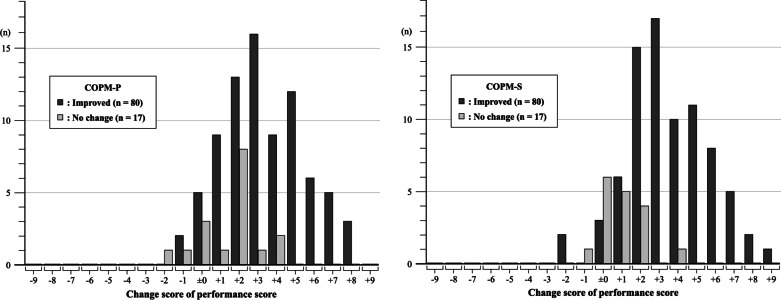
Three patients who indicated deterioration on the transition index were excluded from all analyses, and 97 patients were analyzed in this study. The MIC values were 2.20 points (95% confidence interval 1.80-2.59) for the COPM performance score and 2.06 points (95% confidence interval 1.73-2.39) for the COPM satisfaction score. The MIC and MIC values were considered less reasonable to interpret because the proportions of the improved patients subgroup were more than 50% (82.5%).
The MIC value estimates from this study can help detect whether the patients' perceived occupational performance improved or did not change. The results support the multidisciplinary use of COPM in clinical practice and research on subacute rehabilitation inpatients.
加拿大职业表现测量量表(COPM)是一种个体化的患者报告结局,旨在评估患者对自身职业表现的自我认知。我们的研究旨在检查亚急性康复住院患者的最小重要变化(MIC)。使用三种不同的基于锚定的分析方法,并以过渡指数作为外部标准来计算MIC值;平均变化法(MIC)、受试者工作特征(MIC)分析以及针对改善患者比例进行调整的预测建模方法(MIC)。在本研究中,MIC值被认为是最有效的统计方法。我们从亚急性康复医院招募了100名患有各种健康状况的住院患者。数据收集两次:一次初始评估和一个月后的重新评估。初始评估和第二次评估均采用系统访谈形式(5W及如何)以防止信息偏差(反应偏移)。
三名在过渡指数上显示恶化的患者被排除在所有分析之外,本研究分析了97名患者。COPM表现评分的MIC值为2.20分(95%置信区间1.80 - 2.59),COPM满意度评分的MIC值为2.06分(95%置信区间1.73 - 2.39)。由于改善患者亚组的比例超过50%(82.5%),MIC和MIC值被认为较难解释。
本研究的MIC值估计有助于检测患者感知的职业表现是有所改善还是没有变化。研究结果支持在亚急性康复住院患者的临床实践和研究中多学科使用COPM。