Northeastern University and Harvard Injury Control Research Center, Boston, Massachusetts (M.M.).
Harvard Injury Control Research Center, Boston, Massachusetts (W.Z., D.A.).
Ann Intern Med. 2022 Feb;175(2):219-225. doi: 10.7326/M21-3423. Epub 2021 Dec 21.
The surge in background checks beginning in March 2020 suggested an acceleration in firearm purchases. Little was known about the people who bought these guns.
To estimate the number and describe characteristics of firearm purchasers over a period spanning prepandemic and pandemic time, characterize new gun owners, and estimate the number of persons newly exposed to household firearms.
Probability-based online survey conducted in April 2021. Survey weights generated nationally representative estimates.
United States, 1 January 2019 to 26 April 2021.
19 049 of 29 985 (64%) English-speaking adults responded to the survey invitation; 5932 owned firearms, including 1933 who had purchased firearms since 2019, of whom 447 had become new gun owners.
The estimated number and characteristics of adults who, since 2019, have purchased firearms, distinguishing those who became new gun owners from those who did not, and the estimated number of household members newly exposed to firearms.
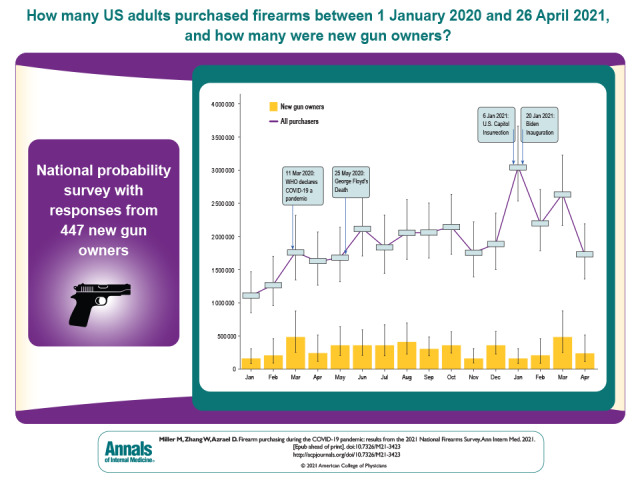
An estimated 2.9% of U.S. adults (7.5 million) became new gun owners from 1 January 2019 to 26 April 2021. Most (5.4 million) had lived in homes without guns, collectively exposing, in addition to themselves, over 11 million persons to household firearms, including more than 5 million children. Approximately half of all new gun owners were female (50% in 2019 and 47% in 2020 to 2021), 20% were Black (21% in 2019 and in 2020-2021), and 20% were Hispanic (20% in 2019 and 19% in 2020-2021). By contrast, other recent purchasers who were not new gun owners were predominantly male (70%) and White (74%), as were gun owners overall (63% male, 73% White).
Retrospective assessment of when respondents purchased firearms. National estimates about new gun owners were based on 447 respondents.
Efforts to reduce firearm injury should consider the recent acceleration in firearm purchasing and the characteristics of new gun owners.
The Joyce Foundation.
2020 年 3 月开始,背景调查数量激增,这表明枪支购买量加速增长。人们对购买这些枪支的人知之甚少。
评估在疫情前后一段时间内购买枪支的人数并描述其特征,描述新枪主的特征,并估计新接触到家庭枪支的人数。
2021 年 4 月进行的基于概率的在线调查。调查权重生成全国代表性估计数。
美国,2019 年 1 月 1 日至 2021 年 4 月 26 日。
1949 名(64%)会说英语的成年人对调查邀请做出了回应;其中 5932 人拥有枪支,包括 2019 年以来购买枪支的 1933 人,其中 447 人成为新枪主。
自 2019 年以来,估计购买枪支的成年人数量及其特征,区分新枪主和非新枪主,并估计新接触枪支的家庭人数。
自 2019 年 1 月 1 日至 2021 年 4 月 26 日,估计有 2.9%的美国成年人(750 万人)成为新枪主。其中大多数(540 万人)以前居住在没有枪支的家中,除了他们自己之外,共有超过 1100 万人接触到家庭枪支,其中包括 500 多万儿童。大约一半的新枪主是女性(2019 年为 50%,2020 年至 2021 年为 47%),20%是黑人(2019 年为 21%,2020 年至 2021 年为 21%),20%是西班牙裔(2019 年为 20%,2020 年至 2021 年为 19%)。相比之下,其他最近购买枪支但不是新枪主的人主要是男性(70%)和白人(74%),枪支拥有者也是如此(63%为男性,73%为白人)。
对受访者购买枪支时间的回顾性评估。关于新枪主的全国估计数是基于 447 名受访者。
减少枪支伤害的努力应考虑到最近枪支购买的加速以及新枪主的特征。
乔伊斯基金会。