Institute of Basic Research In Clinical Medicine, China Academy of Chinese Medical Sciences, Beijing, 100700, China.
Department of Infectious Diseases, Jinyintan hospital, Wuhan, 430024, China.
Phytomedicine. 2022 Jan;95:153868. doi: 10.1016/j.phymed.2021.153868. Epub 2021 Dec 3.
Huashibaidu Formula (HSBD) for the COVID-19 treatment has been supported by the China's Diagnosis and Treatment Protocol for Novel Coronavirus Pneumonia. However, it is not clear whether HSBD can improve blood oxygen saturation and when it should be used with conventional therapies.
To access the effect of HSBD combined with conventional treatment on blood oxygen saturation of COVID-19 patients.
A single-center retrospective cohort study was conducted to collect the confirmed severe COVID-19 patients' information, treated by the National Traditional Chinese Medicine Medical Team at the Jinyintan hospital between January 24 and March 31, 2020. According to whether HSBD was used during hospitalization, participants were separated into the conventional treatment group and the HSBD group (HSBD and conventional treatment). The primary observation indicators included the time for relieving blood oxygen saturation and the improvement ratio of blood oxygen saturation in each group.
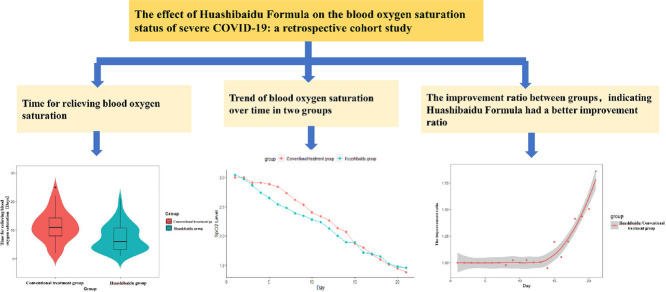
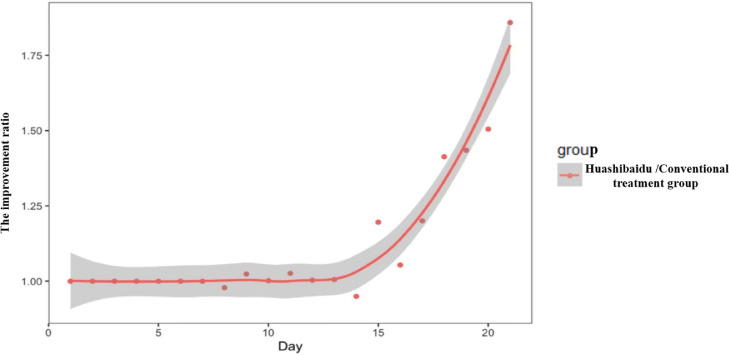
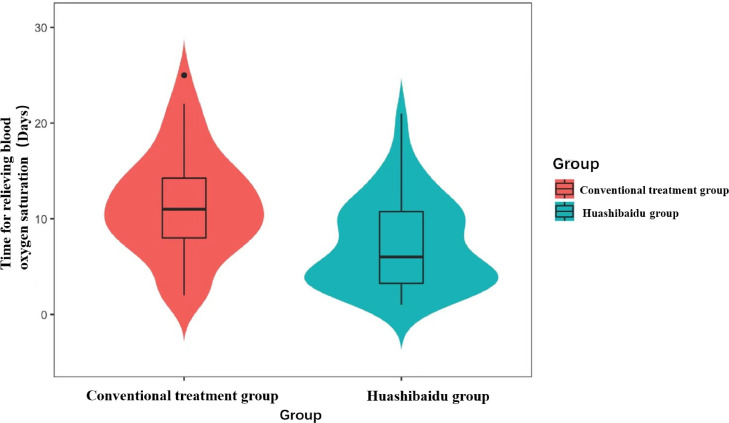
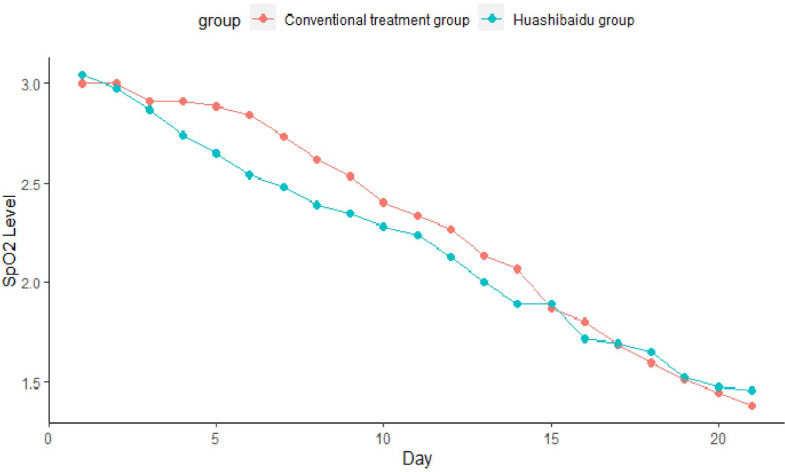
Of 111 patients with severe COVID-19, 53.2% (59/111) received HSBD, and 46.8% (52/111) only received conventional treatment, respectively. No statistically significant difference was found in image, clinical symptoms, and past medical history between the two groups (p > 0.05). Notably, the median time for relieving blood oxygen saturation in the conventional treatment group was 11 days (IQR, 8-14.25), while that in the HSBD group was only 6 days (IQR, 3.25-10.75), which was significantly shortened by 4.09 days (95%CI, 2.07-6.13; p= 0.0001), compared with the conventional treatment group. After repeated measurement design analysis, the main effect within times (p< 0.001) and the main effect were significantly different under the oxygen saturation dimension between two groups (p= 0.004). However, time and group interaction were observed no significant difference (p= 0.094). After 14 days of treatment, the improvement ratio of the HSBD group over the conventional treatment group was 1.20 (95%CI, 0.89-1.61).
For severe COVID-19 patients, the HSBD has a tendency to shorten the time for relieving blood oxygen saturation. After taking a course of HSBD, the effect can be more obvious.
化湿败毒方(HSBD)治疗新冠肺炎已被中国新型冠状病毒肺炎诊疗方案支持。然而,HSBD 是否能提高血氧饱和度以及何时应与常规疗法联合使用尚不清楚。
评估化湿败毒方联合常规疗法对新冠肺炎患者血氧饱和度的影响。
采用单中心回顾性队列研究,收集 2020 年 1 月 24 日至 3 月 31 日期间在金银潭医院接受国家中医药医疗队治疗的确诊重症新冠肺炎患者信息。根据住院期间是否使用 HSBD,将参与者分为常规治疗组和 HSBD 组(HSBD 和常规治疗)。主要观察指标包括缓解血氧饱和度的时间和各组血氧饱和度的改善率。
111 例重症新冠肺炎患者中,53.2%(59/111)接受 HSBD,46.8%(52/111)仅接受常规治疗,两组间影像学、临床症状和既往病史无统计学差异(p>0.05)。值得注意的是,常规治疗组血氧饱和度缓解时间中位数为 11 天(IQR,8-14.25),而 HSBD 组仅为 6 天(IQR,3.25-10.75),与常规治疗组相比明显缩短了 4.09 天(95%CI,2.07-6.13;p=0.0001)。经重复测量设计分析,时间内的主要效应(p<0.001)和两组间血氧饱和度维度的主要效应差异有统计学意义(p=0.004)。然而,观察到时间和组间交互作用无显著差异(p=0.094)。治疗 14 天后,HSBD 组的改善率优于常规治疗组,为 1.20(95%CI,0.89-1.61)。
对于重症新冠肺炎患者,HSBD 有缩短血氧饱和度缓解时间的趋势。服用一疗程 HSBD 后,效果更为明显。