
利用电子健康记录分析莱姆病分期和表现的风险因素。
Risk factors for Lyme disease stage and manifestation using electronic health records.
机构信息
Department of Environmental Health and Engineering, Johns Hopkins Bloomberg School of Public Health, 615 N Wolfe St., W7604, Baltimore, MD, USA.
Department of Population Health Sciences, Geisinger, Danville, PA, USA.
出版信息
BMC Infect Dis. 2021 Dec 20;21(1):1269. doi: 10.1186/s12879-021-06959-y.
BACKGROUND
Little is known about risk factors for early (e.g., erythema migrans) and disseminated Lyme disease manifestations, such as arthritis, neurological complications, and carditis. No study has used both diagnoses and free text to classify Lyme disease by disease stage and manifestation.
METHODS
We identified Lyme disease cases in 2012-2016 in the electronic health record (EHR) of a large, integrated health system in Pennsylvania. We developed a rule-based text-matching algorithm using regular expressions to extract clinical data from free text. Lyme disease cases were then classified by stage and manifestation using data from both diagnoses and free text. Among cases classified by stage, we evaluated individual, community, and health care variables as predictors of disseminated stage (vs. early) disease using Poisson regression models with robust errors. Final models adjusted for sociodemographic factors, receipt of Medical Assistance (i.e., Medicaid, a proxy for low socioeconomic status), primary care contact, setting of diagnosis, season of diagnosis, and urban/rural status.
RESULTS
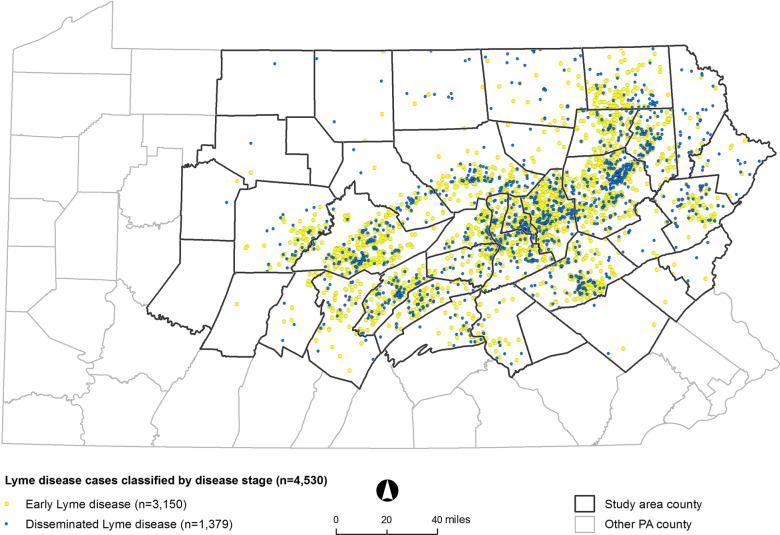
Among 7310 cases of Lyme disease, we classified 62% by stage. Overall, 23% were classified using both diagnoses and text, 26% were classified using diagnoses only, and 13% were classified using text only. Among the staged diagnoses (n = 4530), 30% were disseminated stage (762 arthritis, 426 neurological manifestations, 76 carditis, 95 secondary erythema migrans, and 76 other manifestations). In adjusted models, we found that persons on Medical Assistance at least 50% of time under observation, compared to never users, had a higher risk (risk ratio [95% confidence interval]) of disseminated Lyme disease (1.20 [1.05, 1.37]). Primary care contact (0.59 [0.54, 0.64]) and diagnosis in the urgent care (0.22 [0.17, 0.29]), compared to the outpatient setting, were associated with lower risk of disseminated Lyme disease.
CONCLUSIONS
The associations between insurance payor, primary care status, and diagnostic setting with disseminated Lyme disease suggest that lower socioeconomic status and less health care access could be linked with disseminated stage Lyme disease. Intervening on these factors could reduce the individual and health care burden of disseminated Lyme disease. Our findings demonstrate the value of both diagnostic and narrative text data to identify Lyme disease manifestations in the EHR.
背景
对于莱姆病的早期(例如游走性红斑)和播散性表现(如关节炎、神经并发症和心肌炎)的危险因素知之甚少。尚无研究使用诊断和自由文本来按疾病阶段和表现对莱姆病进行分类。
方法
我们在宾夕法尼亚州一个大型综合医疗系统的电子健康记录(EHR)中确定了 2012-2016 年的莱姆病病例。我们使用正则表达式开发了一种基于规则的文本匹配算法,从自由文本中提取临床数据。然后,使用诊断和自由文本中的数据,根据疾病阶段和表现对莱姆病病例进行分类。在按阶段分类的病例中,我们使用泊松回归模型(具有稳健误差)评估了个体、社区和医疗保健变量作为播散性疾病(与早期疾病相比)的预测因素。最终模型调整了社会人口因素、获得医疗援助(即医疗补助,代表低社会经济地位)、初级保健接触、诊断地点、诊断季节和城乡地位。
结果
在 7310 例莱姆病病例中,我们按阶段对 62%的病例进行了分类。总体而言,23%的病例同时使用诊断和文本进行分类,26%的病例仅使用诊断进行分类,13%的病例仅使用文本进行分类。在分期诊断中(n=4530),30%为播散性疾病(762 例关节炎、426 例神经表现、76 例心肌炎、95 例二次游走性红斑和 76 例其他表现)。在调整模型中,我们发现与从不使用者相比,在观察期至少 50%时间接受医疗援助的人患播散性莱姆病的风险更高(风险比[95%置信区间])(1.20[1.05,1.37])。与门诊相比,初级保健接触(0.59[0.54,0.64])和急诊诊断(0.22[0.17,0.29])与播散性莱姆病的风险降低相关。
结论
保险支付人、初级保健状况和诊断环境与播散性莱姆病之间的关联表明,较低的社会经济地位和较少的医疗保健机会可能与播散性莱姆病阶段有关。干预这些因素可能会降低播散性莱姆病对个人和医疗保健的负担。我们的发现表明,诊断和叙事文本数据对于在 EHR 中识别莱姆病表现具有重要价值。

 Zotero 插件