Institute of Pharmacy and Molecular Biotechnology, Heidelberg University, Heidelberg, Germany.
Department of Chemical Biology, Max Planck Institute for Medical Research, Heidelberg, Germany.
Nat Chem Biol. 2022 Jan;18(1):64-69. doi: 10.1038/s41589-021-00922-3. Epub 2021 Dec 21.
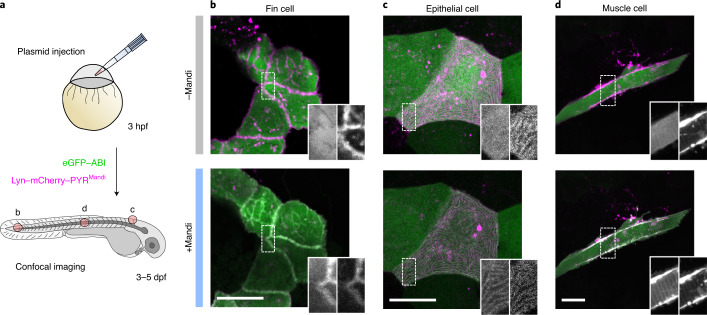
Direct control of protein interactions by chemically induced protein proximity holds great potential for both cell and synthetic biology as well as therapeutic applications. Low toxicity, orthogonality and excellent cell permeability are important criteria for chemical inducers of proximity (CIPs), in particular for in vivo applications. Here, we present the use of the agrochemical mandipropamid (Mandi) as a highly efficient CIP in cell culture systems and living organisms. Mandi specifically induces complex formation between a sixfold mutant of the plant hormone receptor pyrabactin resistance 1 (PYR1) and abscisic acid insensitive (ABI). It is orthogonal to other plant hormone-based CIPs and rapamycin-based CIP systems. We demonstrate the applicability of the Mandi system for rapid and efficient protein translocation in mammalian cells and zebrafish embryos, protein network shuttling and manipulation of endogenous proteins.
化学诱导的蛋白质接近直接控制蛋白质相互作用,对于细胞和合成生物学以及治疗应用都具有巨大的潜力。低毒性、正交性和优异的细胞通透性是化学诱导接近(CIP)的重要标准,特别是对于体内应用。在这里,我们展示了农用化学品 mandipropamid(Mandi)在细胞培养系统和生物体中的高效 CIP 用途。Mandi 特异性诱导植物激素受体 pyrabactin 抗性 1(PYR1)的六倍体突变体与脱落酸不敏感(ABI)之间的复合物形成。它与其他基于植物激素的 CIP 和 rapamycin 为基础的 CIP 系统正交。我们证明了 Mandi 系统在哺乳动物细胞和斑马鱼胚胎中快速有效地进行蛋白质转位、蛋白质网络穿梭和内源性蛋白质操作的适用性。