Niles Meredith T, Beavers Alyssa W, Clay Lauren A, Dougan Marcelle M, Pignotti Giselle A, Rogus Stephanie, Savoie-Roskos Mateja R, Schattman Rachel E, Zack Rachel M, Acciai Francesco, Allegro Deanne, Belarmino Emily H, Bertmann Farryl, Biehl Erin, Birk Nick, Bishop-Royse Jessica, Bozlak Christine, Bradley Brianna, Brenton Barrett P, Buszkiewicz James, Cavaliere Brittney N, Cho Young, Clark Eric M, Coakley Kathryn, Coffin-Schmitt Jeanne, Collier Sarah M, Coombs Casey, Dressel Anne, Drewnowski Adam, Evans Tom, Feingold Beth J, Fiechtner Lauren, Fiorella Kathryn J, Funderburk Katie, Gadhoke Preety, Gonzales-Pacheco Diana, Safi Amelia Greiner, Gu Sen, Hanson Karla L, Harley Amy, Harper Kaitlyn, Hosler Akiko S, Ismach Alan, Josephson Anna, Laestadius Linnea, LeBlanc Heidi, Lewis Laura R, Litton Michelle M, Martin Katie S, Martin Shadai, Martinelli Sarah, Mazzeo John, Merrill Scott C, Neff Roni, Nguyen Esther, Ohri-Vachaspati Punam, Orbe Abigail, Otten Jennifer J, Parmer Sondra, Pemberton Salome, Qusair Zain Al Abdeen, Rivkina Victoria, Robinson Joelle, Rose Chelsea M, Sadeghzadeh Saloumeh, Sivaramakrishnan Brinda, Arroyo Mariana Torres, Voorhees McKenna, Yerxa Kathryn
Department of Nutrition and Food Sciences, Gund Institute for Environment, University of Vermont, Burlington, VT.
Department of Nutrition and Food Science, Wayne State University, Detroit, MI.
Curr Dev Nutr. 2021 Nov 1;5(12):nzab135. doi: 10.1093/cdn/nzab135. eCollection 2021 Dec.
The coronavirus disease 2019 (COVID-19) pandemic profoundly affected food systems including food security. Understanding how the COVID-19 pandemic impacted food security is important to provide support and identify long-term impacts and needs.
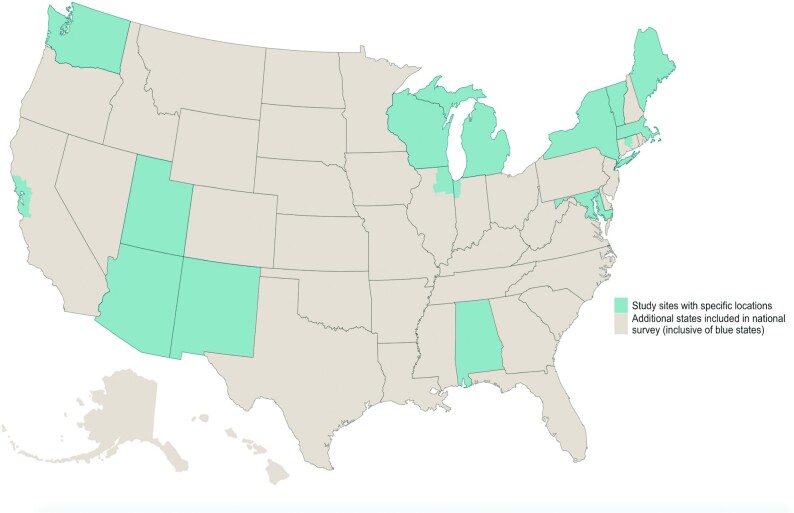
The National Food Access and COVID research Team (NFACT) was formed to assess food security over different US study sites throughout the pandemic, using common instruments and measurements. This study presents results from 18 study sites across 15 states and nationally over the first year of the COVID-19 pandemic.
A validated survey instrument was developed and implemented in whole or part through an online survey of adults across the sites throughout the first year of the pandemic, representing 22 separate surveys. Sampling methods for each study site were convenience, representative, or high-risk targeted. Food security was measured using the USDA 6-item module. Food security prevalence was analyzed using ANOVA by sampling method to assess statistically significant differences.
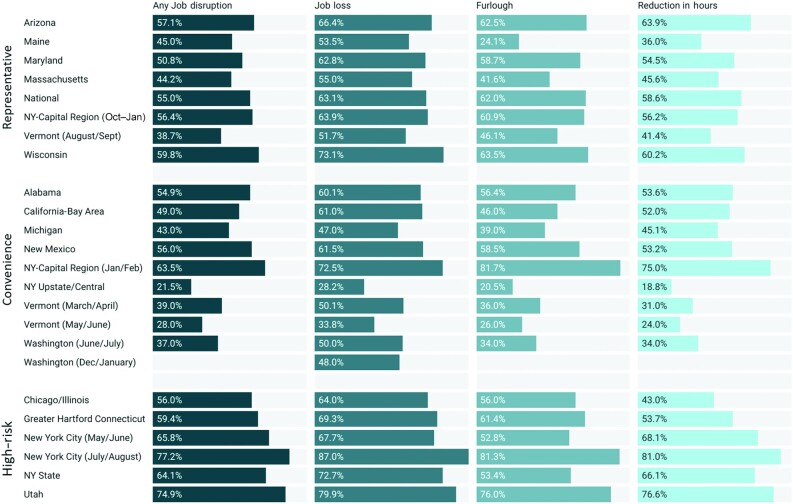
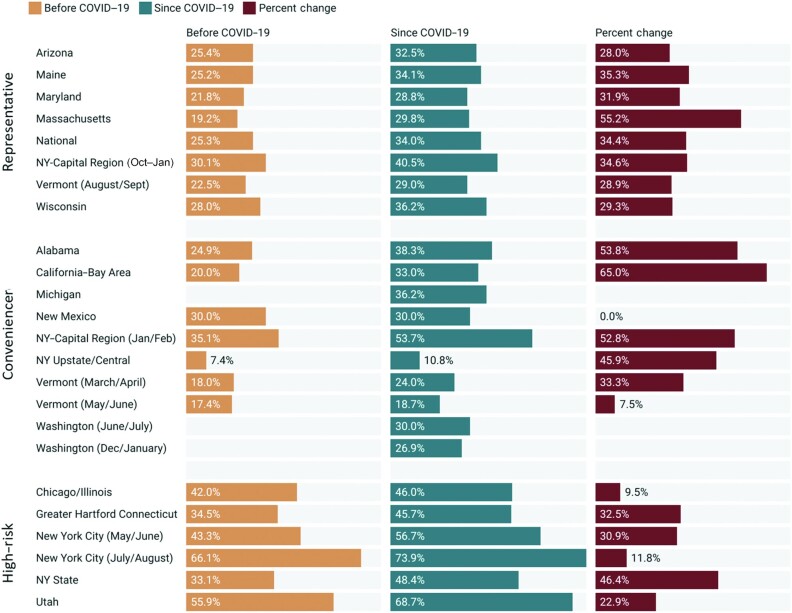
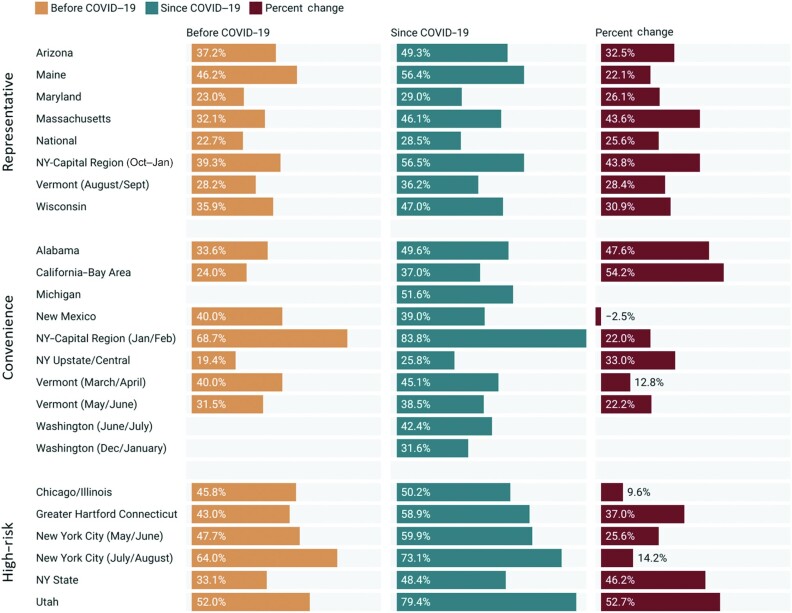
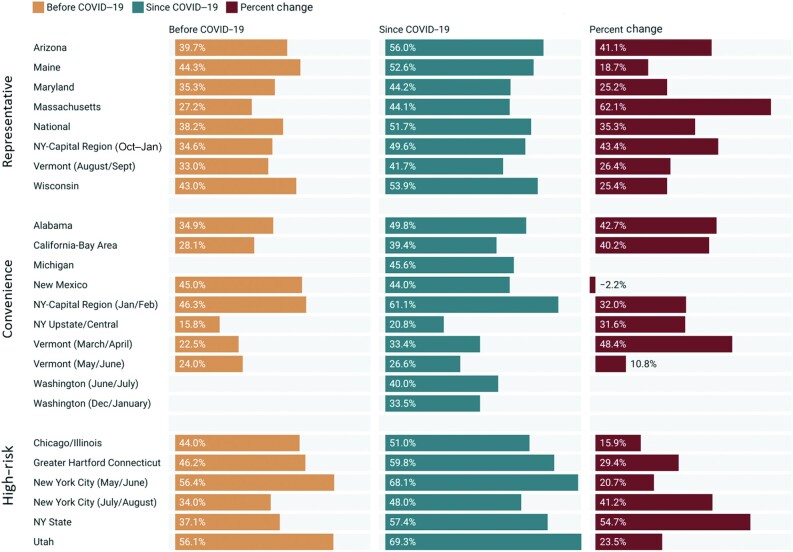
Respondents (= 27,168) indicate higher prevalence of food insecurity (low or very low food security) since the COVID-19 pandemic, compared with before the pandemic. In nearly all study sites, there is a higher prevalence of food insecurity among Black, Indigenous, and People of Color (BIPOC), households with children, and those with job disruptions. The findings demonstrate lingering food insecurity, with high prevalence over time in sites with repeat cross-sectional surveys. There are no statistically significant differences between convenience and representative surveys, but a statistically higher prevalence of food insecurity among high-risk compared with convenience surveys.
This comprehensive study demonstrates a higher prevalence of food insecurity in the first year of the COVID-19 pandemic. These impacts were prevalent for certain demographic groups, and most pronounced for surveys targeting high-risk populations. Results especially document the continued high levels of food insecurity, as well as the variability in estimates due to the survey implementation method.
2019年冠状病毒病(COVID-19)大流行对包括粮食安全在内的粮食系统产生了深远影响。了解COVID-19大流行如何影响粮食安全对于提供支持以及确定长期影响和需求至关重要。
成立了国家粮食获取与COVID研究团队(NFACT),以在整个大流行期间使用通用工具和测量方法评估美国不同研究地点的粮食安全状况。本研究展示了在COVID-19大流行的第一年中,来自15个州的18个研究地点以及全国范围的研究结果。
开发了一种经过验证的调查工具,并在大流行的第一年通过对各地点的成年人进行在线调查全部或部分实施,共进行了22项独立调查。每个研究地点的抽样方法为便利抽样、代表性抽样或高风险目标抽样。使用美国农业部的6项模块来衡量粮食安全状况。通过抽样方法,采用方差分析来分析粮食安全患病率,以评估统计学上的显著差异。
受访者(= 27168人)表示,自COVID-19大流行以来,粮食不安全(粮食安全程度低或极低)的患病率高于大流行之前。在几乎所有研究地点,黑人、原住民和有色人种(BIPOC)、有子女的家庭以及工作受到干扰的人群中,粮食不安全的患病率更高。研究结果表明粮食不安全状况持续存在,在进行重复横断面调查的地点,随着时间推移患病率居高不下。便利抽样调查和代表性抽样调查之间没有统计学上的显著差异,但与便利抽样调查相比,高风险抽样调查中粮食不安全的患病率在统计学上更高。
这项全面的研究表明,在COVID-19大流行的第一年,粮食不安全的患病率更高。这些影响在某些人口群体中普遍存在,在针对高风险人群的调查中最为明显。结果特别记录了持续的高粮食不安全水平,以及由于调查实施方法导致的估计差异。