School of Health Sciences, Western Sydney University, Campbelltown, Australia.
School of Health Sciences, University of Tasmania, Hobart, Tasmania, Australia.
Int J Behav Nutr Phys Act. 2022 Sep 6;19(1):115. doi: 10.1186/s12966-022-01347-4.
Food insecurity during the COVID-19 pandemic has been impacted by necessary public health restrictions. Tasmania, an island state south of the Australian mainland, recorded no community transmission of COVID-19 between May 2020 to November 2021 due to strong border restrictions. This study aimed to determine the changes in prevalence and sociodemographic predictors of food insecurity throughout the COVID-19 pandemic in Tasmania, Australia.
In May 2020 (survey 1: during lockdown), September 2020 (survey 2: eased restrictions) and May 2021 (survey 3: 1-year post-lockdown), cross-sectional, online surveys using convenience sampling methods determined food insecurity in Tasmanian adults using the USDA Household Food Security Survey Module: Six-Item Short Form, in addition to key sociodemographic questions. Crude and age-adjusted prevalence of food insecurity was calculated, and binary logistic regression determined at-risk groups and changes in prevalence over time.
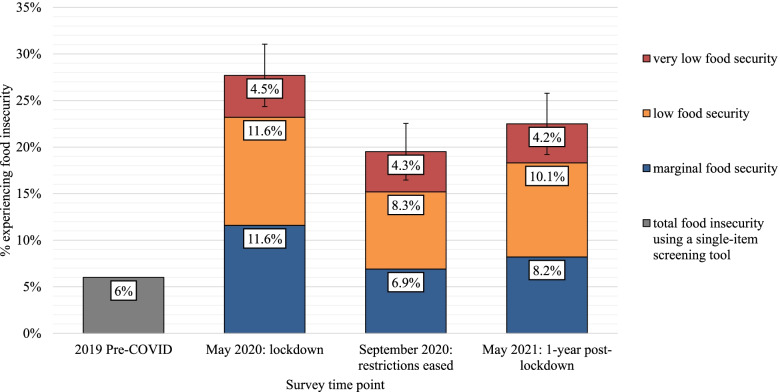
The age-adjusted prevalence of food insecurity was 27.9% during lockdown (n = 1168), 19.5% when restrictions had eased (n = 1097) and 22.6% 1-year post-lockdown (n = 1100). Young adults, Aboriginal and/or Torres Strait Islander people, individuals with disabilities, families with dependents and temporary residents were at highest risk across all time points.
The prevalence of food insecurity was higher than pre-pandemic levels across all three time points. Our results indicate the potential long-term impacts of the COVID-19 pandemic on food security in Australia, where despite easing social distancing restrictions and a lack of COVID-19 transmission, the prevalence of food insecurity reduced, but did not recover to pre-pandemic levels 1-year following a lockdown.
新冠疫情期间,由于必要的公共卫生限制,食物不安全状况受到影响。塔斯马尼亚是澳大利亚大陆南部的一个岛屿州,由于严格的边境限制,2020 年 5 月至 2021 年 11 月期间没有社区传播新冠病毒。本研究旨在确定澳大利亚塔斯马尼亚在整个新冠疫情期间食物不安全状况的流行率变化及其社会人口学预测因素。
在 2020 年 5 月(调查 1:封锁期间)、2020 年 9 月(调查 2:放宽限制)和 2021 年 5 月(调查 3:封锁 1 年后),使用便利抽样方法进行横断面、在线调查,使用美国农业部家庭粮食安全调查模块:六项目简短形式,除了关键的社会人口学问题外,还确定了塔斯马尼亚成年人的粮食不安全情况。计算了粮食不安全的粗患病率和年龄调整患病率,并进行了二元逻辑回归,以确定高危人群和随时间变化的患病率变化。
封锁期间粮食不安全的年龄调整患病率为 27.9%(n=1168),放宽限制时为 19.5%(n=1097),封锁 1 年后为 22.6%(n=1100)。在所有时间点,年轻人、原住民和/或托雷斯海峡岛民、残疾人士、有受抚养家属的家庭和临时居民的风险最高。
在所有三个时间点,粮食不安全的流行率都高于疫情前的水平。我们的结果表明,新冠疫情对澳大利亚粮食安全的潜在长期影响,尽管放宽了社交距离限制,并且没有新冠病毒传播,但粮食不安全的流行率有所下降,但在封锁 1 年后仍未恢复到疫情前水平。