Engageminds HUB - Consumer, Food & Health Engagement Research Center, Università Cattolica del Sacro Cuore, Milan, Italy.
Department of Psychology, Università Cattolica del Sacro Cuore, Milan, Italy.
PLoS One. 2021 Dec 22;16(12):e0261733. doi: 10.1371/journal.pone.0261733. eCollection 2021.
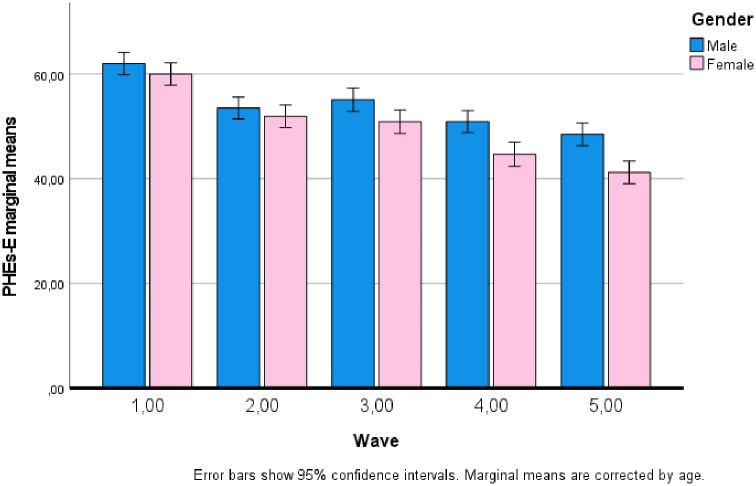
The Covid-19 pandemic has highlighted the importance of citizens' behaviors in the containment of the virus. Individuals might change their intention to adhere to public health prescriptions depending on various personal characteristics, including their own emotional status, which has been recognized to be a crucial psychological factor in orienting people's adherence to public health recommendation during emergency settings. In particular, it is crucial to support citizens' alliance with authorities and feeling of trust: public engagement is a concept that refers to the general involvement of citizens into public affairs which is generally considered an effective approach to enhance citizens' understanding of their crucial role in public affairs. However, so far there is no agreement on the metrics and indexes that should be used to measures public engagement during a health crisis. The aim of this paper is to validate a psychometric scale (PHEs-E), which intends to measure the readiness of individuals to adhere to the prescribed behavioral change to contain the emergency. Data were collected throughout the pandemic in Italy: in particular, five independent samples were recruited starting from March 2020 to March 2021. Results showed that the proposed measure has good psychometric characteristics. A general linear model was computed to assess the differences of public engagement across the different data points and among citizens with different sociodemographic characteristics. Correlations with other psychological constructs (i.e. Anxiety, Depression and Self-Efficacy) were also tested, showing that more engaged citizens have a lower level of anxiety and depression, and a higher self-efficacy. This study's findings indicate that individuals' characteristics may differentiate citizens' motivation to engage in public health behavioral recommendation to prevent the COVID-19 contagion. However the scale could be useful to perform a psychological monitoring of psychological readiness to engage in public health strategies to face critical events and settings.
Covid-19 大流行凸显了公民行为在病毒控制中的重要性。个人可能会根据各种个人特征,包括自己的情绪状态,改变他们遵守公共卫生规定的意愿,情绪状态已被认为是在紧急情况下引导人们遵守公共卫生建议的关键心理因素。特别是,支持公民与当局结盟和信任感至关重要:公众参与是指公民普遍参与公共事务的概念,通常被认为是增强公民对自己在公共事务中关键作用的理解的有效方法。然而,迄今为止,对于在卫生危机期间应该使用哪些指标来衡量公众参与,还没有达成共识。本文的目的是验证一个心理计量学量表(PHEs-E),该量表旨在衡量个人遵守规定的行为改变以遏制紧急情况的准备程度。数据是在意大利大流行期间收集的:特别是,从 2020 年 3 月到 2021 年 3 月,招募了五个独立的样本。结果表明,所提出的测量方法具有良好的心理计量学特性。计算了一个一般线性模型,以评估在不同数据点和具有不同社会人口特征的公民之间的公众参与差异。还测试了与其他心理结构(即焦虑、抑郁和自我效能感)的相关性,结果表明,参与度更高的公民焦虑和抑郁水平更低,自我效能感更高。这项研究的结果表明,个人特征可能会区分公民参与公共卫生行为建议以预防 COVID-19 感染的动机。然而,该量表可用于对参与公共卫生战略的心理准备情况进行心理监测,以应对关键事件和环境。