Department of Infection Control and Prevention, The University of Tokyo Hospital, Hongo, Bunkyo-ku, Tokyo, Japan.
Department of Infectious Diseases, Fujita Health Universitygrid.256115.4 School of Medicine, Toyoake, Aichi, Japan.
Microbiol Spectr. 2021 Dec 22;9(3):e0182721. doi: 10.1128/spectrum.01827-21.
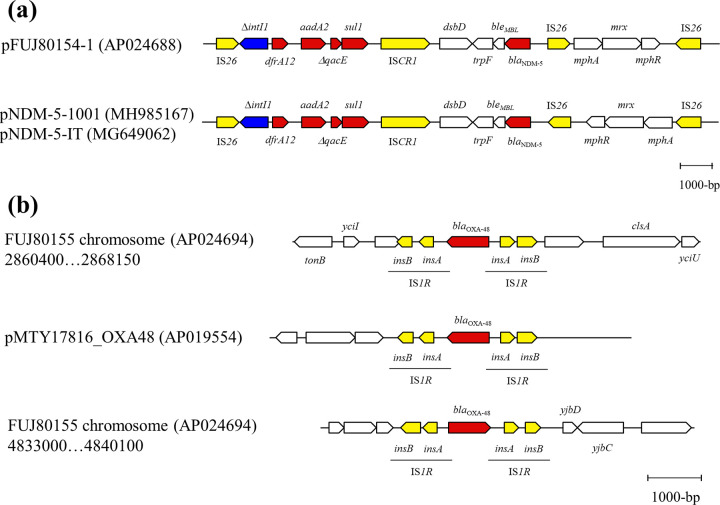
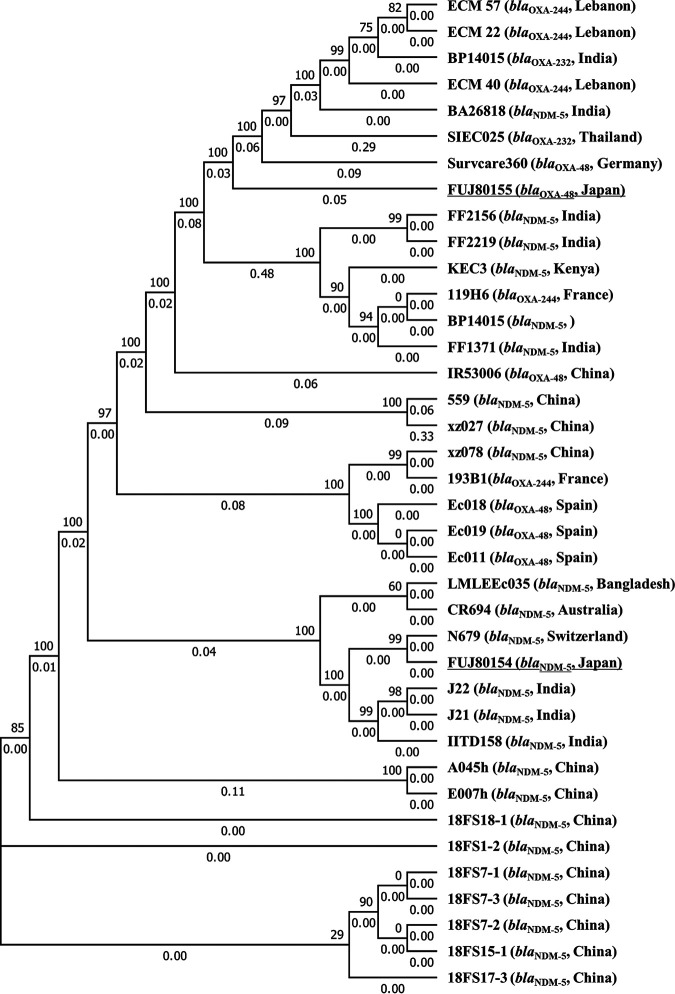
Carbapenemase-producing Escherichia coli sequence type (ST) 648 strains were isolated from two international visitors without previous medical exposure from Southeast Asian countries in a hospital in Japan. One isolate, FUJ80154, carried in a complex class 1 integron on an IncFIB/FII plasmid; the other isolate, FUJ80155, carried two copies of on the chromosome flanked by IS on both sides. The core-genome based-phylogenetic analysis with publicly available genome data of E. coli ST648 carrying or demonstrated high genetic similarity between FUJ80154 and NDM-5-prooducing E. coli ST648 strains isolated in South and Southeast Asian countries. On the other hand, no closely related isolates of FUJ80155 were identified. In the absence of prior hospitalization overseas, neither patient had qualified for routine screening of multidrug-resistant organisms, and the isolates were incidentally identified in cultures ordered at the discretion of the treating physician. Although patients with history of international hospitalization are often subject to screening for multidrug-resistant organisms, it is unclear whether patients who reside in countries where carbapenemase-producing (CPE) is endemic but have no history of local hospitalization contribute to the transmission of CPE. In this study, NDM-5-producing and OXA-48-producing Escherichia coli sequence type (ST) 648, a recently recognized high-risk, multidrug-resistant clone, were detected from two overseas visitors without previous medical exposure. The findings of this study suggest that active surveillance culture on admission to hospital may be considered for travelers from countries with endemicity of carbapenem-resistant organisms even without history of local hospitalization and underscore the need to monitor cross-border transmission of high-risk clones, such as carbapenemase-producing E. coli ST648.
从日本一家医院的两名来自东南亚国家、无既往医疗接触的国际旅行者中分离出产碳青霉烯酶大肠埃希菌序列型(ST)648 菌株。一个分离株 FUJ80154 携带位于 IncFIB/FII 质粒上的复杂 I 类整合子中的 ;另一个分离株 FUJ80155 在染色体两侧的 IS 侧翼携带两个 拷贝。对带有 或 的可公开获得的大肠埃希氏菌 ST648 基因组数据进行基于核心基因组的系统发育分析表明,FUJ80154 与在南亚和东南亚国家分离的产 NDM-5 大肠埃希氏菌 ST648 菌株具有很高的遗传相似性。另一方面,未鉴定到 FUJ80155 的密切相关分离株。由于这两名患者均无海外住院史,不符合常规多药耐药菌筛查条件,而且这些分离株是在主治医生决定进行培养时偶然发现的。尽管有国际住院史的患者通常需要进行多药耐药菌筛查,但尚不清楚居住在产碳青霉烯酶肠杆菌(CPE)流行国家、但无本地住院史的患者是否有助于 CPE 的传播。在这项研究中,从两名无既往医疗接触的海外旅行者中发现了产 NDM-5 和产 OXA-48 的大肠埃希菌序列型(ST)648,这是一种新发现的高风险、多药耐药克隆。本研究结果表明,即使无本地住院史,来自产碳青霉烯类耐药菌流行国家的旅行者在入院时也可能需要进行主动监测培养,并强调需要监测高风险克隆(如产碳青霉烯酶大肠埃希菌 ST648)的跨境传播。