de la Torre-Luque Alejandro, Ozeylem Fatos, Essau Cecilia A
Department of Legal Medicine, Psychiatry and Pathology, Universidad Complutense de Madrid, Centre for Biomedical Research in Mental Health (CIBERSAM), Spain.
University of Roehampton, Department of Psychology, London, UK.
Addict Behav Rep. 2021 Oct 7;14:100387. doi: 10.1016/j.abrep.2021.100387. eCollection 2021 Dec.
Adolescence is a critical developmental stage for the initiation of substance use worldwide. However, the prevalence of various types of substances consumed by adolescents living in low- and middle- income countries (LMICs) across different continents is not fully understood.The aims of the present study were to estimate the prevalence of regular and problematic substance use among adolescents in 73 LMICs across different continents and to explore the role of country-specific factors on this prevalence.
Data of 314,187 adolescents (52.79% girls; median age = 15 years old) who participated in the Global School-based Student Health Survey (GSHS) were analysed. After estimating the weighted prevalence for each country, multilevel models were used to examine the influence of country-specific factors on the prevalence of substance use across 73 LMICs.
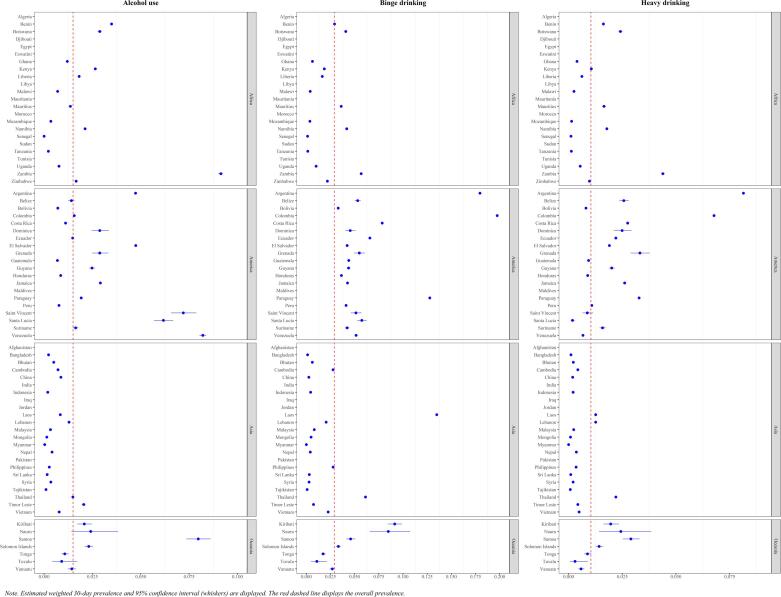
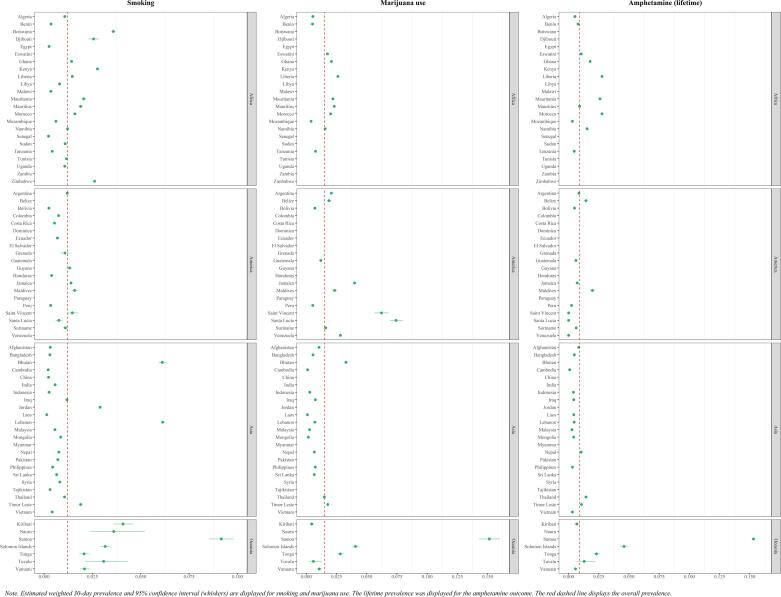
The results indicated that problematic alcohol use was more prevalent in LMICs with higher income levels. The prevalence of regular alcohol use was the highest in Zambia. Regular and problematic alcohol use was the least prevalent in Senegal and Myanmar. The findings also revealed that smoking and the consumption of marijuana and amphetamine were the most common among adolescents in Samoa, whereas the prevalences for these substances were the lowest in Laos.
Economic wealth, religion and geographical factors seem to have a role in determining the prevalence of substance use among adolescents in LMICs.
在全球范围内,青春期是开始使用毒品的关键发育阶段。然而,不同大陆低收入和中等收入国家(LMICs)青少年消费的各类毒品的流行情况尚未完全了解。本研究的目的是估计不同大陆73个低收入和中等收入国家青少年中经常和有问题地使用毒品的流行率,并探讨特定国家因素对这一流行率的作用。
分析了参与全球学校学生健康调查(GSHS)的314187名青少年(52.79%为女孩;中位年龄 = 15岁)的数据。在估计每个国家的加权流行率后,使用多层次模型来检验特定国家因素对73个低收入和中等收入国家毒品使用流行率的影响。
结果表明,有问题的酒精使用在收入水平较高的低收入和中等收入国家更为普遍。经常饮酒的流行率在赞比亚最高。经常和有问题地饮酒在塞内加尔和缅甸最不普遍。研究结果还显示,吸烟以及大麻和安非他命的消费在萨摩亚青少年中最为常见,而这些毒品在老挝的流行率最低。
经济财富、宗教和地理因素似乎在决定低收入和中等收入国家青少年毒品使用流行率方面发挥作用。