Institute of Engineering Medicine, Beijing Institute of Technology, No. 5, South Street, Zhongguancun, Haidian District, Beijing 100081, China.
School of Biomedical Convergence Engineering, Pusan National University, Yangsan 626841, Kyungnam, Korea.
Mar Drugs. 2021 Dec 15;19(12):708. doi: 10.3390/md19120708.
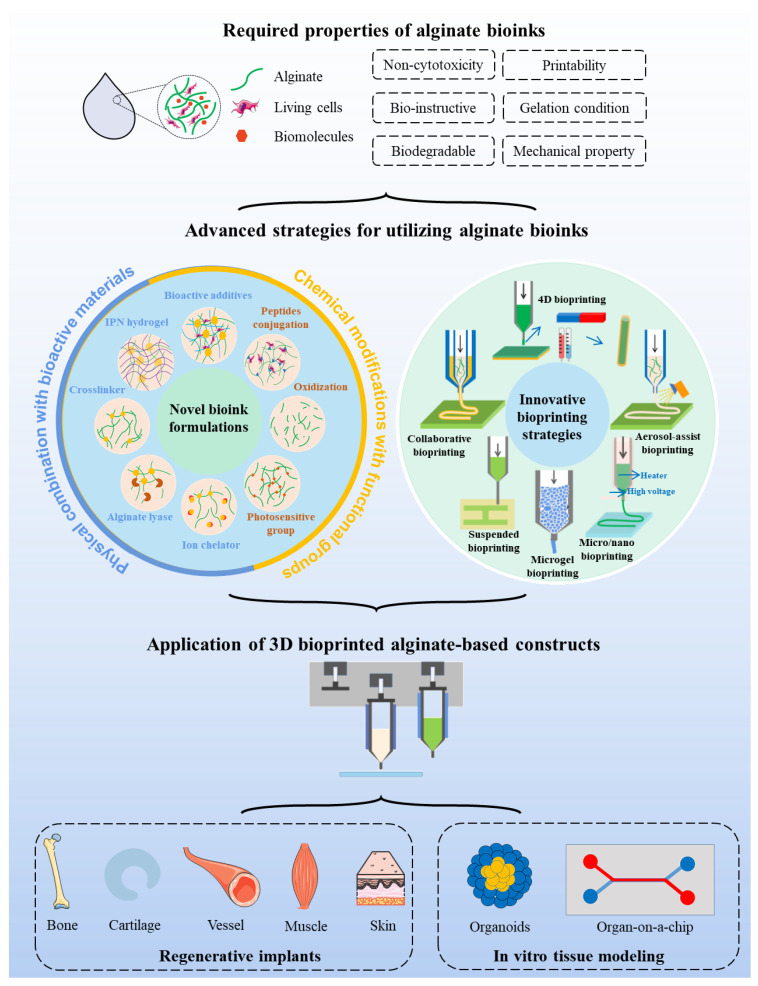
Alginate is a natural polysaccharide that typically originates from various species of algae. Due to its low cost, good biocompatibility, and rapid ionic gelation, the alginate hydrogel has become a good option of bioink source for 3D bioprinting. However, the lack of cell adhesive moieties, erratic biodegradability, and poor printability are the critical limitations of alginate hydrogel bioink. This review discusses the pivotal properties of alginate hydrogel as a bioink for 3D bioprinting technologies. Afterward, a variety of advanced material formulations and biofabrication strategies that have recently been developed to overcome the drawbacks of alginate hydrogel bioink will be focused on. In addition, the applications of these advanced solutions for 3D bioprinting of tissue/organ mimicries such as regenerative implants and in vitro tissue models using alginate-based bioink will be systematically summarized.
藻酸盐是一种天然多糖,通常来源于各种藻类。由于其成本低、生物相容性好、离子快速凝胶化,藻酸盐水凝胶已成为 3D 生物打印生物墨水的良好选择。然而,藻酸盐水凝胶生物墨水缺乏细胞黏附部分、降解性不稳定和较差的可打印性等是其关键限制因素。本综述讨论了藻酸盐水凝胶作为 3D 生物打印技术生物墨水的关键特性。之后,将重点介绍为了克服藻酸盐水凝胶生物墨水的缺点而最近开发的各种先进材料配方和生物制造策略。此外,还将系统总结这些先进解决方案在基于藻酸盐的生物墨水用于再生植入物和体外组织模型等组织/器官模拟物的 3D 生物打印中的应用。