Silvestre-Ferreira Ana, Pastor Josep
Department of Veterinary Sciences, University of Trás-os-Montes and Alto Douro (UTAD), Quinta de Prados, 5000-801 Vila Real, Portugal.
Animal and Veterinary Research Centre (CECAV), University of Trás-os-Montes and Alto Douro (UTAD), Quinta de Prados, 5000-801 Vila Real, Portugal.
Animals (Basel). 2021 Dec 11;11(12):3533. doi: 10.3390/ani11123533.
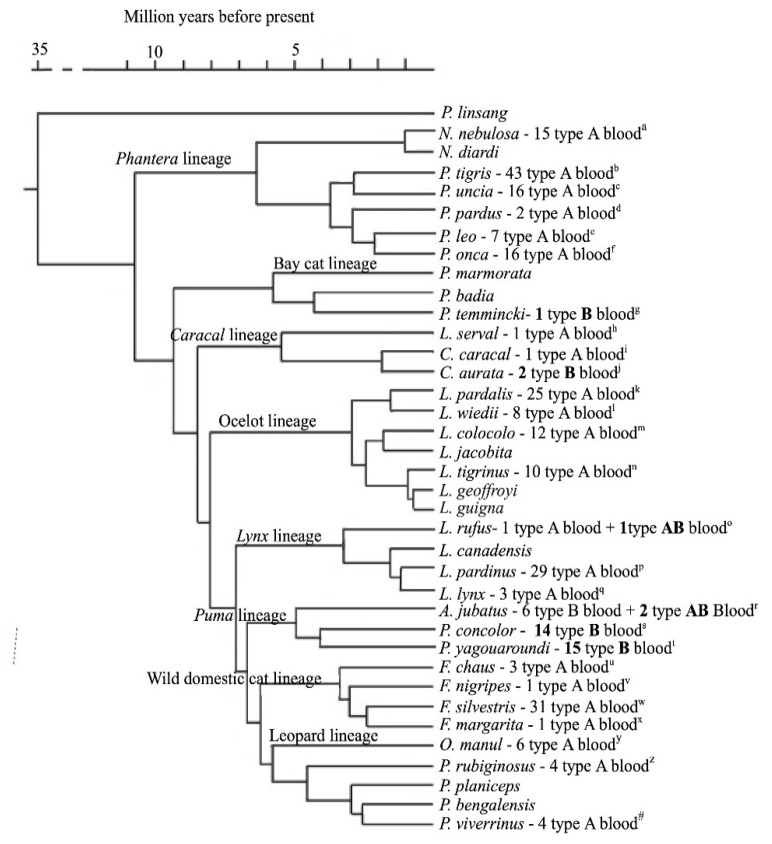
Wild felids and domestic cats share the AB blood group. However, there have been few studies regarding the characterization and prevalence of the different blood types in wild animals. The erythrocyte membrane glycolipids of the wild cats correspond to the major disialoganglioside patterns observed in domestic cats. Like in domestic cats, type A blood seems to be the most common, although wild felid species seem to exhibit one single blood type. Of the species studied, the wild domestic cats, and the Panthera and ocelot lineages, all had type A blood; the Puma lineage showed almost exclusively type B blood. The prevalence of wild felids blood types show that there seems to be variation between species, but not within species, and no evidence of geographical variation has yet been found, showing apparently no genetic variability. The presence of alloantibodies has also been demonstrated, so the risk of life-threatening transfusion reactions due to mismatched transfusions and neonatal isoerythrolysis is a possibility. Like in other species, the recognition of wild felids blood groups is clinically relevant, as it can also be important in establishing phylogenetic relationships within the Felidae family. We will review the current knowledge on this topic and give insights into the wild felids blood groups potential for zoo transfusion medicine and phylogenetic studies in order to help support reintroduction projects and to preserve genetic diversity.
野生猫科动物和家猫拥有相同的AB血型系统。然而,关于野生动物不同血型的特征和流行情况的研究却很少。野生猫科动物的红细胞膜糖脂与家猫中观察到的主要二唾液酸神经节苷脂模式相对应。与家猫一样,A型血似乎最为常见,尽管野生猫科动物物种似乎只表现出一种血型。在所研究的物种中,野生家猫、豹属和豹猫谱系均为A型血;美洲狮谱系几乎全为B型血。野生猫科动物血型的流行情况表明,不同物种之间似乎存在差异,但同一物种内不存在差异,而且尚未发现地理差异的证据,这显然表明不存在遗传变异性。同种抗体的存在也已得到证实,因此,因输血不匹配和新生幼崽溶血病而导致危及生命的输血反应的风险是存在的。与其他物种一样,对野生猫科动物血型的识别在临床上具有相关性,因为这对于确定猫科动物家族内部的系统发育关系也很重要。我们将回顾关于这一主题的现有知识,并深入探讨野生猫科动物血型在动物园输血医学和系统发育研究中的潜力,以帮助支持重新引入项目并保护遗传多样性。