Yu Guanghui, Beauchemin Karen A, Dong Ruilan
College of Animal Science and Technology, Qingdao Agricultural University, No. 700 Changcheng Road, Chengyang District, Qingdao 266109, China.
Lethbridge Research and Development Centre, Agriculture and Agri-Food Canada, 5403 1st Avenue South, Lethbridge, AB T1J 4B1, Canada.
Animals (Basel). 2021 Dec 13;11(12):3540. doi: 10.3390/ani11123540.
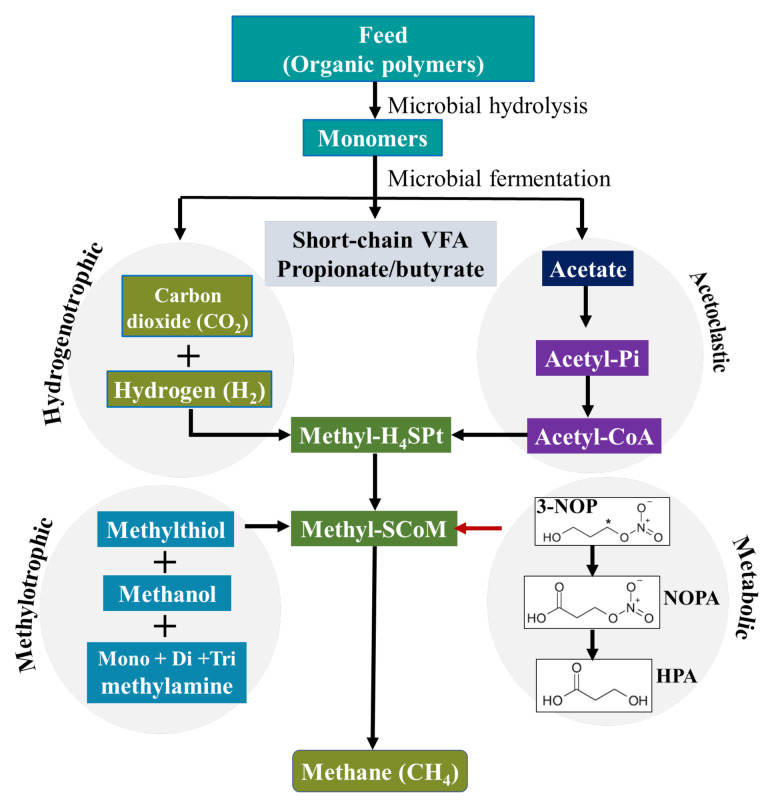
Methane (CH) from enteric fermentation accounts for 3 to 5% of global anthropogenic greenhouse gas emissions, which contribute to climate change. Cost-effective strategies are needed to reduce feed energy losses as enteric CH while improving ruminant production efficiency. Mitigation strategies need to be environmentally friendly, easily adopted by producers and accepted by consumers. However, few sustainable CH mitigation approaches are available. Recent studies show that the chemically synthesized CH inhibitor 3-nitrooxypropanol is one of the most effective approaches for enteric CH abatement. 3-nitrooxypropanol specifically targets the methyl-coenzyme M reductase and inhibits the final catalytic step in methanogenesis in rumen archaea. Providing 3-nitrooxypropanol to dairy and beef cattle in research studies has consistently decreased enteric CH production by 30% on average, with reductions as high as 82% in some cases. Efficacy is positively related to 3-NOP dose and negatively affected by neutral detergent fiber concentration of the diet, with greater responses in dairy compared with beef cattle when compared at the same dose. This review collates the current literature on 3-nitrooxypropanol and examines the overall findings of meta-analyses and individual studies to provide a synthesis of science-based information on the use of 3-nitrooxypropanol for CH abatement. The intent is to help guide commercial adoption at the farm level in the future. There is a significant body of peer-reviewed scientific literature to indicate that 3-nitrooxypropanol is effective and safe when incorporated into total mixed rations, but further research is required to fully understand the long-term effects and the interactions with other CH mitigating compounds.
反刍动物肠道发酵产生的甲烷(CH₄)占全球人为温室气体排放的3%至5%,这对气候变化有影响。需要具有成本效益的策略来减少作为肠道CH₄的饲料能量损失,同时提高反刍动物的生产效率。缓解策略需要对环境友好,易于生产者采用并为消费者所接受。然而,几乎没有可持续的CH₄减排方法。最近的研究表明,化学合成的CH₄抑制剂3-硝基氧丙醇是减少肠道CH₄排放最有效的方法之一。3-硝基氧丙醇专门作用于甲基辅酶M还原酶,抑制瘤胃古菌甲烷生成的最后催化步骤。在研究中给奶牛和肉牛提供3-硝基氧丙醇,平均可使肠道CH₄产量持续降低30%,在某些情况下降幅高达82%。效果与3-硝基氧丙醇的剂量呈正相关,且受日粮中性洗涤纤维浓度的负面影响,在相同剂量下,奶牛的反应比肉牛更大。这篇综述整理了有关3-硝基氧丙醇的现有文献,并审视了荟萃分析和个别研究的总体结果,以综合提供关于使用3-硝基氧丙醇减少CH₄排放的科学依据信息。目的是帮助指导未来农场层面的商业应用。有大量经过同行评审的科学文献表明,3-硝基氧丙醇添加到全混合日粮中时是有效且安全的,但需要进一步研究以充分了解其长期影响以及与其他CH₄减排化合物的相互作用。