Department of Animal Science, University of California, Davis, California, United States of America.
Commonwealth Scientific and Industrial Research Organisation, Agriculture and Food, Townsville, Queensland, Australia.
PLoS One. 2021 Mar 17;16(3):e0247820. doi: 10.1371/journal.pone.0247820. eCollection 2021.
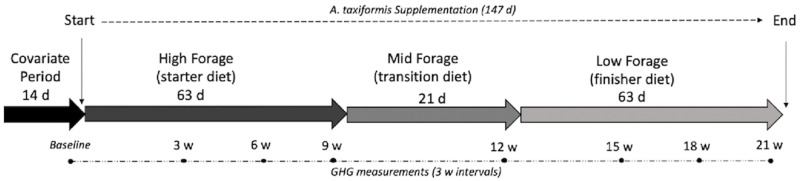
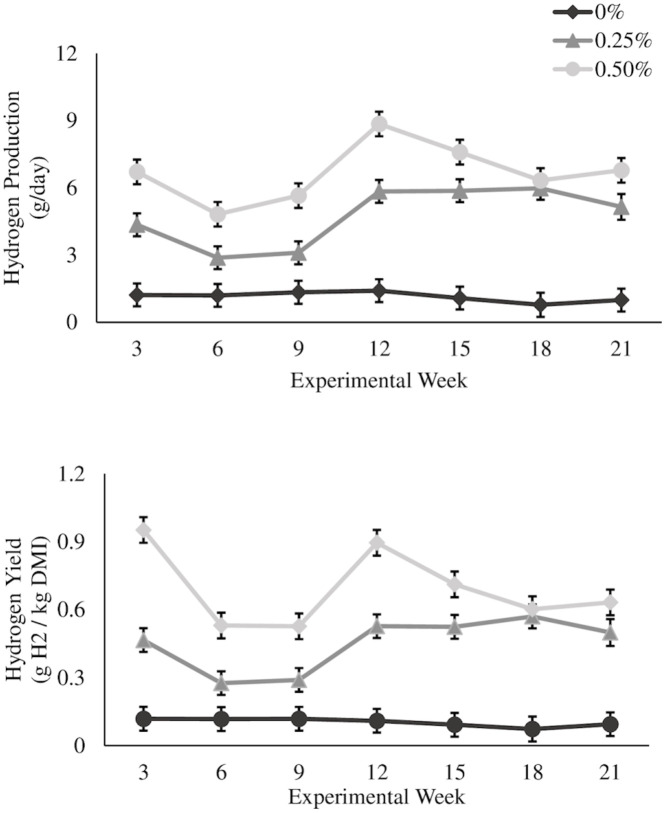
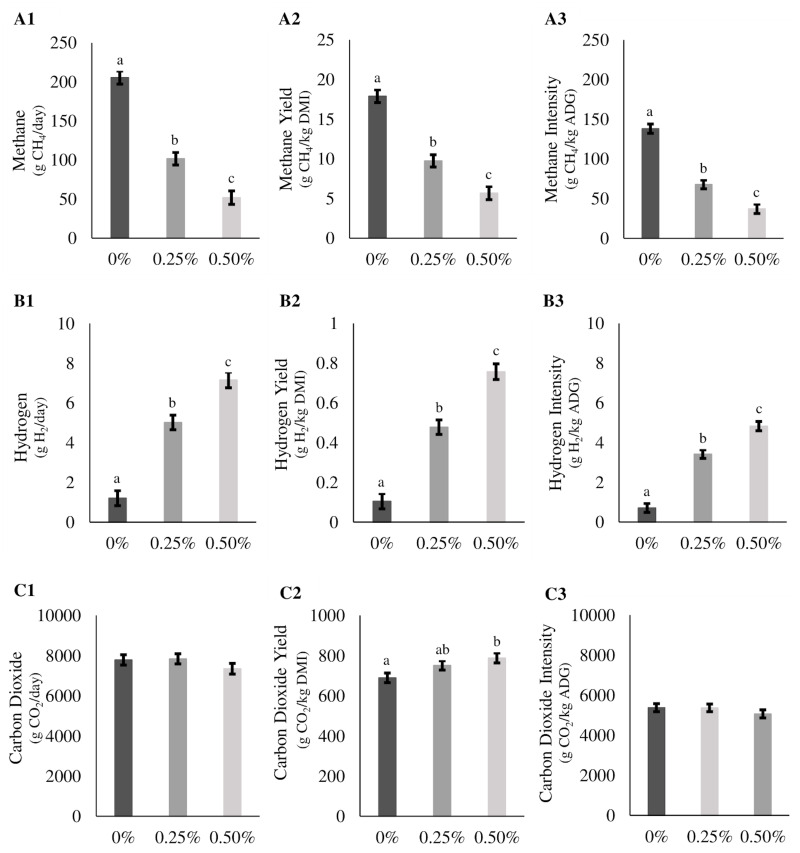
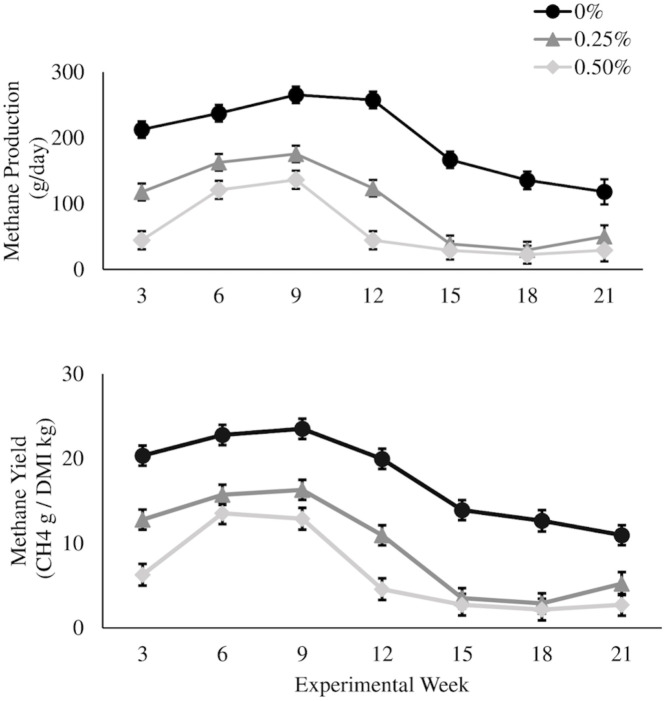
The red macroalgae (seaweed) Asparagopsis spp. has shown to reduce ruminant enteric methane (CH4) production up to 99% in vitro. The objective of this study was to determine the effect of Asparagopsis taxiformis on CH4 production (g/day per animal), yield (g CH4/kg dry matter intake (DMI)), and intensity (g CH4/kg ADG); average daily gain (ADG; kg gain/day), feed conversion efficiency (FCE; kg ADG/kg DMI), and carcass and meat quality in growing beef steers. Twenty-one Angus-Hereford beef steers were randomly allocated to one of three treatment groups: 0% (Control), 0.25% (Low), and 0.5% (High) A. taxiformis inclusion based on organic matter intake. Steers were fed 3 diets: high, medium, and low forage total mixed ration (TMR) representing life-stage diets of growing beef steers. The Low and High treatments over 147 days reduced enteric CH4 yield 45 and 68%, respectively. However, there was an interaction between TMR type and the magnitude of CH4 yield reduction. Supplementing low forage TMR reduced CH4 yield 69.8% (P <0.01) for Low and 80% (P <0.01) for High treatments. Hydrogen (H2) yield (g H2/DMI) increased (P <0.01) 336 and 590% compared to Control for the Low and High treatments, respectively. Carbon dioxide (CO2) yield (g CO2/DMI) increased 13.7% between Control and High treatments (P = 0.03). No differences were found in ADG, carcass quality, strip loin proximate analysis and shear force, or consumer taste preferences. DMI tended to decrease 8% (P = 0.08) in the Low treatment and DMI decreased 14% (P <0.01) in the High treatment. Conversely, FCE tended to increase 7% in Low (P = 0.06) and increased 14% in High (P <0.01) treatment compared to Control. The persistent reduction of CH4 by A. taxiformis supplementation suggests that this is a viable feed additive to significantly decrease the carbon footprint of ruminant livestock and potentially increase production efficiency.
红藻(海藻)泡叶藻已被证明可以在体外将反刍动物肠道甲烷(CH4)的产生减少 99%。本研究的目的是确定泡叶藻对 CH4 产生(每天每头动物产生的 CH4 量,g/d)、产量(g CH4/kg 干物质摄入量(DMI))和强度(g CH4/kg ADG);平均日增重(ADG;每天的增重,kg)、饲料转化率(FCE;kg ADG/kg DMI)以及生长育肥牛的胴体和肉质的影响。21 头安格斯-赫里福德育肥牛被随机分配到三个处理组之一:0%(对照)、0.25%(低)和 0.5%(高)基于有机物摄入量的泡叶藻添加。牛被喂食 3 种日粮:高、中、低三种全混合日粮(TMR),代表生长育肥牛的生活阶段日粮。在 147 天内,低和高处理分别减少了 45%和 68%的肠道 CH4 产量。然而,TMR 类型和 CH4 产量减少的幅度之间存在相互作用。补充低饲料 TMR 使低处理的 CH4 产量减少 69.8%(P<0.01),高处理的 CH4 产量减少 80%(P<0.01)。与对照相比,低和高处理的氢气(H2)产量(g H2/DMI)分别增加了 336%和 590%(P<0.01)。二氧化碳(CO2)产量(g CO2/DMI)在对照和高处理之间增加了 13.7%(P=0.03)。在 ADG、胴体质量、里脊切块的近似分析和剪切力或消费者的口味偏好方面没有差异。低处理的 DMI 趋于减少 8%(P=0.08),高处理的 DMI 减少 14%(P<0.01)。相反,低处理的 FCE 趋于增加 7%(P=0.06),高处理的 FCE 增加 14%(P<0.01),与对照相比。泡叶藻补充剂持续减少 CH4 的产生表明,这是一种可行的饲料添加剂,可以显著降低反刍动物的碳足迹,并有潜力提高生产效率。