Australian National University, Canberra, Australia.
New Zealand Agricultural Greenhouse Gas Research Centre (NZAGRC), Palmerston North, New Zealand.
Philos Trans A Math Phys Eng Sci. 2021 Nov 15;379(2210):20200452. doi: 10.1098/rsta.2020.0452. Epub 2021 Sep 27.
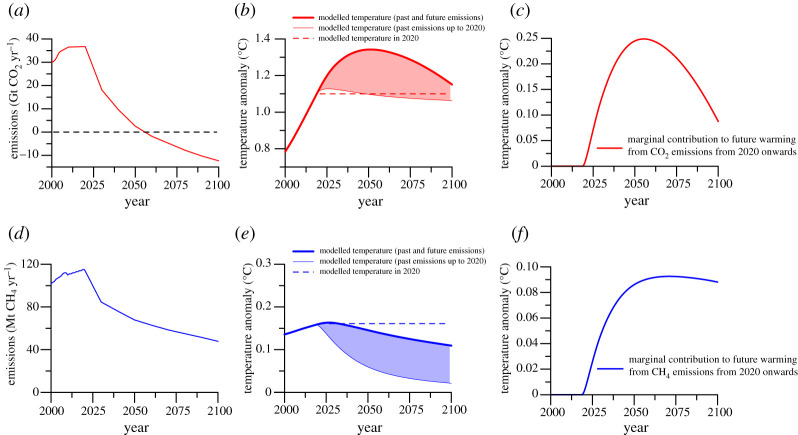
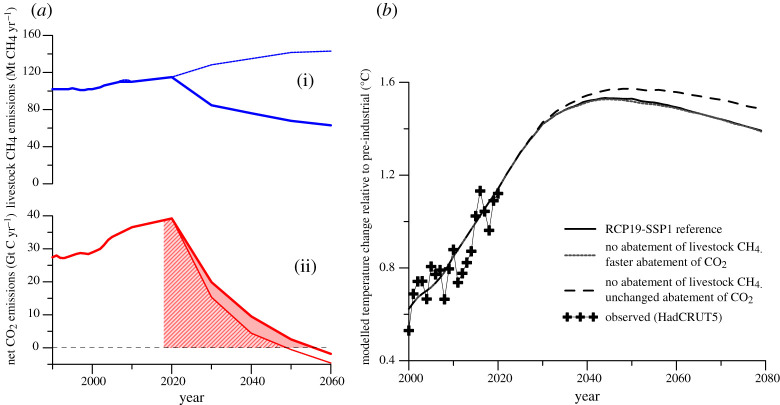
Agriculture is the largest single source of global anthropogenic methane (CH) emissions, with ruminants the dominant contributor. Livestock CH emissions are projected to grow another 30% by 2050 under current policies, yet few countries have set targets or are implementing policies to reduce emissions in absolute terms. The reason for this limited ambition may be linked not only to the underpinning role of livestock for nutrition and livelihoods in many countries but also diverging perspectives on the importance of mitigating these emissions, given the short atmospheric lifetime of CH. Here, we show that in mitigation pathways that limit warming to 1.5°C, which include cost-effective reductions from all emission sources, the contribution of future livestock CH emissions to global warming in 2050 is about one-third of that from future net carbon dioxide emissions. Future livestock CH emissions, therefore, significantly constrain the remaining carbon budget and the ability to meet stringent temperature limits. We review options to address livestock CH emissions through more efficient production, technological advances and demand-side changes, and their interactions with land-based carbon sequestration. We conclude that bringing livestock into mainstream mitigation policies, while recognizing their unique social, cultural and economic roles, would make an important contribution towards reaching the temperature goal of the Paris Agreement and is vital for a limit of 1.5°C. This article is part of a discussion meeting issue 'Rising methane: is warming feeding warming? (part 1)'.
农业是人为甲烷(CH)排放的最大单一来源,反刍动物是主要贡献者。在当前政策下,到 2050 年,牲畜 CH 排放量预计将再增长 30%,但很少有国家设定目标或正在实施减少绝对排放量的政策。这种有限的雄心壮志的原因可能不仅与牲畜在许多国家的营养和生计的基础作用有关,还与对缓解这些排放的重要性的不同看法有关,因为 CH 在大气中的寿命很短。在这里,我们表明,在将升温限制在 1.5°C 的缓解途径中,包括所有排放源的具有成本效益的减排,未来牲畜 CH 排放对 2050 年全球变暖的贡献约为未来净二氧化碳排放的三分之一。因此,未来牲畜 CH 排放极大地限制了剩余的碳预算和满足严格温度限制的能力。我们审查了通过更高效生产、技术进步和需求方变化来解决牲畜 CH 排放的各种选择,以及它们与基于土地的碳封存的相互作用。我们的结论是,将牲畜纳入主流缓解政策,同时认识到其独特的社会、文化和经济作用,将为实现《巴黎协定》的温度目标做出重要贡献,对于 1.5°C 的限制至关重要。本文是关于“甲烷上升:变暖助长变暖?(第 1 部分)”讨论会议的一部分。