Muin Dana Anaïs, Helmer Hanns, Leitner Hermann, Neururer Sabrina
Department of Obstetrics and Gynecology, Division of Fetomaternal Medicine, Comprehensive Center for Pediatrics, Medical University of Vienna, Waehringer Guertel 18-20, 1090 Vienna, Austria.
Department of Clinical Epidemiology, Tyrolean Federal Institute for Integrated Care, Tirol Kliniken GmbH, Anichstraße 35, 6020 Innsbruck, Austria.
J Clin Med. 2021 Dec 13;10(24):5828. doi: 10.3390/jcm10245828.
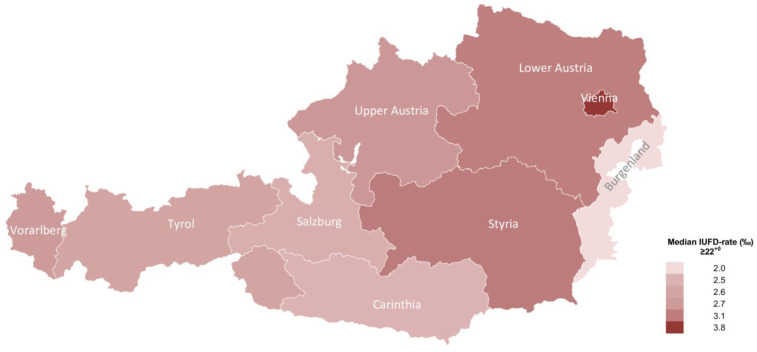
(1) Background: Across Europe, the incidence of antepartum stillbirth varies greatly, partly because of heterogeneous definitions regarding gestational weeks and differences in legislation. With this study, we sought to provide a comprehensive overview on the demographics of antepartum stillbirth in Austria, defined as non-iatrogenic fetal demise ≥22 gestational weeks (/40). (2) Methods: We conducted a population-based study on epidemiological characteristics of singleton antepartum stillbirth in Austria between January 2008 and December 2020. Data were derived from the validated Austrian Birth Registry. (3) Results: From January 2008 through December 2020, the antepartum stillbirth rate ≥20/40 was 3.10, ≥22/40 3.14, and ≥24/40 2.83 per 1000 births in Austria. The highest incidence was recorded in the federal states of Vienna, Styria, and Lower and Upper Austria, contributing to 71.9% of all stillbirths in the country. In the last decade, significant fluctuations in incidence were noted: from 2011 to 2012, the rate significantly declined from 3.40 to 3.07‰, whilst it significantly increased from 2.76 to 3.49‰ between 2019 and 2020. The median gestational age of antepartum stillbirth in Austria was 33 (27-37) weeks. Stillbirth rates ≤26/40 ranged from 164.98 to 334.18‰, whilst the lowest rates of 0.58-8.4‰ were observed ≥36/40. The main demographic risk factors were maternal obesity and low parity. (4) Conclusions: In Austria, the antepartum stillbirth rate has remained relatively stable at 2.83-3.10 per 1000 births for the last decade, despite a significant decline in 2012 and an increase in 2020.
(1) 背景:在欧洲,产前死产的发生率差异很大,部分原因是孕周定义不统一以及立法存在差异。通过本研究,我们试图全面概述奥地利产前死产的人口统计学情况,将其定义为孕22周及以上(/40)的非医源性胎儿死亡。(2) 方法:我们对2008年1月至2020年12月期间奥地利单胎产前死产的流行病学特征进行了一项基于人群的研究。数据来自经过验证的奥地利出生登记处。(3) 结果:2008年1月至2020年12月期间,奥地利每1000例出生中,孕20周及以上(/40)的产前死产率为3.10,孕22周及以上(/40)为3.14,孕24周及以上(/40)为2.83。发病率最高的是维也纳、施蒂利亚以及下奥地利州和上奥地利州,占该国所有死产的71.9%。在过去十年中,发病率出现了显著波动:2011年至2012年,发病率从3.40‰显著下降至3.07‰,而在2019年至2020年期间,发病率从2.76‰显著上升至3.49‰。奥地利产前死产的中位孕周为33(27 - 37)周。孕26周及以下(/40)的死产率在164.98‰至334.18‰之间,而孕36周及以上(/40)的死产率最低,为0.58‰至8.4‰。主要的人口统计学风险因素是母亲肥胖和低生育次数。(4) 结论:在奥地利,尽管2012年显著下降且2020年有所上升,但在过去十年中,每1000例出生的产前死产率相对稳定,为2.83 - 3.10。