Gammal Roseann S, Berenbrok Lucas A, Empey Philip E, Massart Mylynda B
Department of Pharmacy Practice, Massachusetts College of Pharmacy and Health Sciences, Boston, MA 02115, USA.
Department of Pharmacy and Therapeutics, University of Pittsburgh School of Pharmacy, Pittsburgh, PA 15261, USA.
J Pers Med. 2021 Dec 4;11(12):1296. doi: 10.3390/jpm11121296.
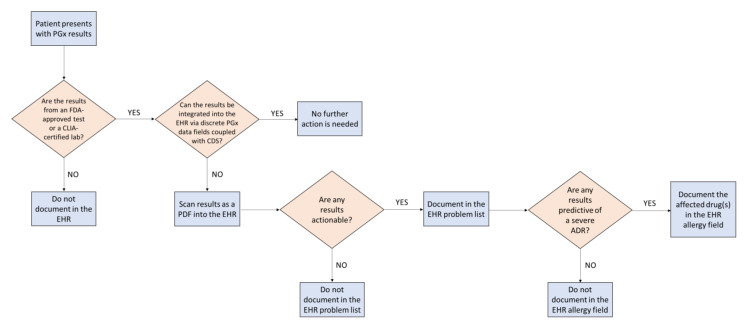
With increasing patient interest in and access to pharmacogenomic testing, clinicians practicing in primary care are more likely than ever to encounter a patient seeking or presenting with pharmacogenomic test results. Gene-based prescribing recommendations are available to healthcare providers through Food and Drug Administration-approved drug labeling and Clinical Pharmacogenetics Implementation Consortium guidelines. Given the lifelong utility of pharmacogenomic test results to optimize pharmacotherapy for commonly prescribed medications, appropriate documentation of these results in a patient's electronic health record (EHR) is essential. The current "gold standard" for pharmacogenomics implementation includes entering pharmacogenomic test results into EHRs as discrete results with associated clinical decision support (CDS) alerts that will fire at the point of prescribing, similar to drug allergy alerts. However, such infrastructure is limited to the few institutions that have invested in the resources and personnel to develop and maintain it. For the majority of clinicians who do not practice at an institution with a dedicated clinical pharmacogenomics team and integrated pharmacogenomics CDS in the EHR, this report provides practical tips for documenting pharmacogenomic test results in the problem list and allergy field to maximize the visibility and utility of results over time, especially when such results could prevent the occurrence of serious adverse drug reactions or predict therapeutic failure.
随着患者对药物基因组学检测的兴趣增加以及获得检测的机会增多,从事初级保健的临床医生比以往任何时候都更有可能遇到寻求或呈现药物基因组学检测结果的患者。医疗保健提供者可通过美国食品药品监督管理局批准的药品标签和临床药物遗传学实施联盟指南获得基于基因的处方建议。鉴于药物基因组学检测结果对于优化常用药物的药物治疗具有终身效用,在患者的电子健康记录(EHR)中对这些结果进行适当记录至关重要。当前药物基因组学实施的“金标准”包括将药物基因组学检测结果作为离散结果输入EHR,并带有相关的临床决策支持(CDS)警报,这些警报将在开处方时触发,类似于药物过敏警报。然而,这样的基础设施仅限于少数投资于资源和人员以开发和维护它的机构。对于大多数不在拥有专门临床药物基因组学团队和EHR中集成的药物基因组学CDS的机构执业的临床医生,本报告提供了在问题列表和过敏字段中记录药物基因组学检测结果的实用技巧,以随着时间的推移最大限度地提高结果的可见性和效用,特别是当这些结果可以预防严重药物不良反应的发生或预测治疗失败时。