Berjano Pedro, Langella Francesco, Ventriglia Luca, Compagnone Domenico, Barletta Paolo, Huber David, Mangili Francesca, Licandro Ginevra, Galbusera Fabio, Cina Andrea, Bassani Tito, Lamartina Claudio, Scaramuzzo Laura, Bassani Roberto, Brayda-Bruno Marco, Villafañe Jorge Hugo, Monti Lorenzo, Azzimonti Laura
IRCCS Istituto Ortopedico Galeazzi, 20161 Milan, Italy.
Istituto Dalle Molle di Studi sull'Intelligenza Artificiale (IDSIA), USI-SUPSI, 6900 Lugano, Switzerland.
J Pers Med. 2021 Dec 16;11(12):1377. doi: 10.3390/jpm11121377.
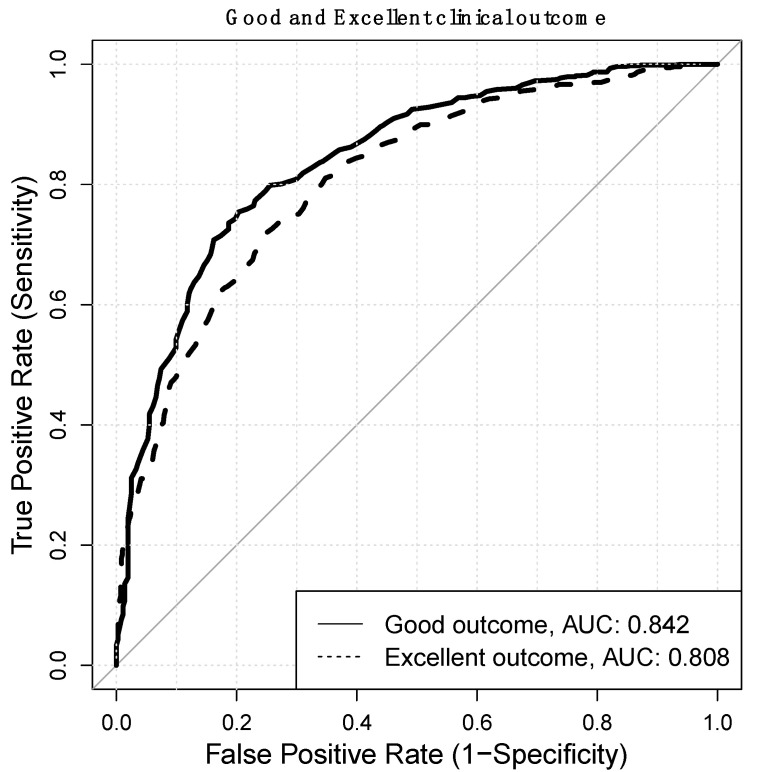
The study aims to create a preoperative model from baseline demographic and health-related quality of life scores (HRQOL) to predict a good to excellent early clinical outcome using a machine learning (ML) approach. A single spine surgery center retrospective review of prospectively collected data from January 2016 to December 2020 from the institutional registry (SpineREG) was performed. The inclusion criteria were age ≥ 18 years, both sexes, lumbar arthrodesis procedure, a complete follow up assessment (Oswestry Disability Index-ODI, SF-36 and COMI back) and the capability to read and understand the Italian language. A delta of improvement of the ODI higher than 12.7/100 was considered a "good early outcome". A combined target model of ODI (Δ ≥ 12.7/100), SF-36 PCS (Δ ≥ 6/100) and COMI back (Δ ≥ 2.2/10) was considered an "excellent early outcome". The performance of the ML models was evaluated in terms of sensitivity, i.e., True Positive Rate (TPR), specificity, i.e., True Negative Rate (TNR), accuracy and area under the receiver operating characteristic curve (AUC ROC). A total of 1243 patients were included in this study. The model for predicting ODI at 6 months' follow up showed a good balance between sensitivity (74.3%) and specificity (79.4%), while providing a good accuracy (75.8%) with ROC AUC = 0.842. The combined target model showed a sensitivity of 74.2% and specificity of 71.8%, with an accuracy of 72.8%, and an ROC AUC = 0.808. The results of our study suggest that a machine learning approach showed high performance in predicting early good to excellent clinical results.
该研究旨在利用机器学习(ML)方法,从基线人口统计学和健康相关生活质量评分(HRQOL)创建一个术前模型,以预测良好至优异的早期临床结果。对一个单一脊柱手术中心2016年1月至2020年12月从机构登记处(SpineREG)前瞻性收集的数据进行回顾性分析。纳入标准为年龄≥18岁、男女不限、腰椎融合手术、完整的随访评估(Oswestry功能障碍指数-ODI、SF-36和COMI背部评分)以及具备阅读和理解意大利语的能力。ODI改善差值高于12.7/100被视为“良好早期结果”。ODI(Δ≥12.7/100)、SF-36身体成分评分(Δ≥6/100)和COMI背部评分(Δ≥2.2/10)的联合目标模型被视为“优异早期结果”。ML模型的性能通过敏感性(即真阳性率,TPR)、特异性(即真阴性率,TNR)、准确性和受试者工作特征曲线下面积(AUC ROC)进行评估。本研究共纳入1243例患者。预测6个月随访时ODI的模型在敏感性(74.3%)和特异性(79.4%)之间显示出良好的平衡,同时具有良好的准确性(75.8%),ROC AUC = 0.842。联合目标模型的敏感性为74.2%,特异性为71.8%,准确性为72.8%,ROC AUC = 0.808。我们的研究结果表明,机器学习方法在预测早期良好至优异临床结果方面表现出高性能。