Vicente Tânia F L, Lemos Marco F L, Félix Rafael, Valentão Patrícia, Félix Carina
MARE-Marine and Environmental Sciences Centre, ESTM, Politécnico de Leiria, 2520-641 Peniche, Portugal.
REQUIMTE/LAQV, Laboratório de Farmacognosia, Faculdade de Farmácia, Universidade do Porto, 4050-313 Porto, Portugal.
J Fungi (Basel). 2021 Nov 25;7(12):1006. doi: 10.3390/jof7121006.
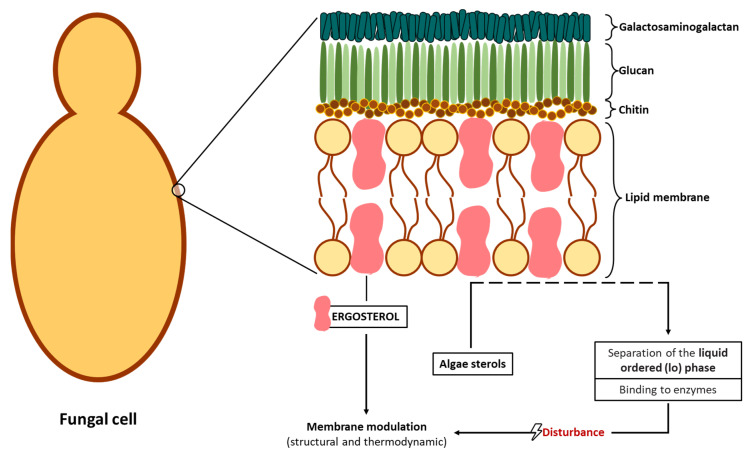
Fungal phytopathogens are a growing problem all over the world; their propagation causes significant crop losses, affecting the quality of fruits and vegetables, diminishing the availability of food, leading to the loss of billions of euros every year. To control fungal diseases, the use of synthetic chemical fungicides is widely applied; these substances are, however, environmentally damaging. Marine algae, one of the richest marine sources of compounds possessing a wide range of bioactivities, present an eco-friendly alternative in the search for diverse compounds with industrial applications. The synthesis of such bioactive compounds has been recognized as part of microalgal responsiveness to stress conditions, resulting in the production of polyphenols, polysaccharides, lipophilic compounds, and terpenoids, including halogenated compounds, already described as antimicrobial agents. Furthermore, many studies, in vitro or in planta, have demonstrated the inhibitory activity of these compounds with respect to fungal phytopathogens. This review aims to gather the maximum of information addressing macroalgae extracts with potential inhibition against fungal phytopathogens, including the best inhibitory results, while presenting some already reported mechanisms of action.
真菌性植物病原体在全球范围内都是一个日益严重的问题;它们的传播导致了巨大的作物损失,影响水果和蔬菜的质量,减少了食物的可获得性,每年造成数十亿欧元的损失。为了控制真菌病害,合成化学杀菌剂被广泛使用;然而,这些物质对环境有破坏作用。海藻是海洋中化合物最丰富的来源之一,具有广泛的生物活性,在寻找具有工业应用价值的多种化合物方面提供了一种环保的选择。这类生物活性化合物的合成已被认为是微藻对应激条件的反应的一部分,导致了多酚、多糖、亲脂性化合物和萜类化合物的产生,包括已被描述为抗菌剂的卤代化合物。此外,许多体外或植物体内的研究已经证明了这些化合物对真菌性植物病原体的抑制活性。这篇综述旨在收集关于大型海藻提取物对真菌性植物病原体具有潜在抑制作用的最多信息,包括最佳抑制结果,同时介绍一些已报道的作用机制。