Department of Structural Biology of Signaling Proteins, Division BIOCEV, Institute of Physiology of the Czech Academy of Sciences, 25250 Vestec, Czech Republic.
Department of Physical and Macromolecular Chemistry, Faculty of Science, Charles University, 12843 Prague, Czech Republic.
Int J Mol Sci. 2021 Dec 13;22(24):13395. doi: 10.3390/ijms222413395.
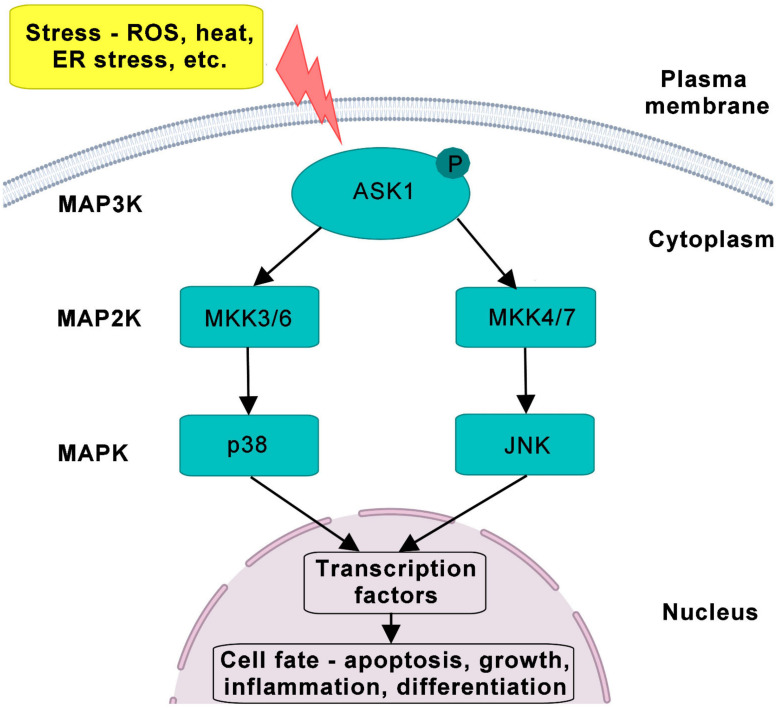
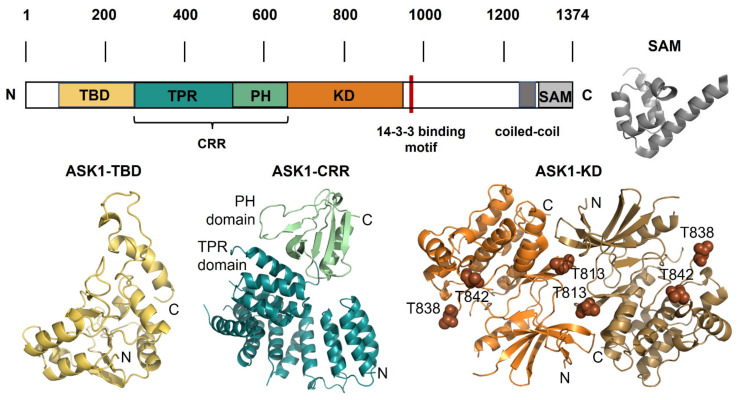
Apoptosis signal-regulating kinase (ASK) 1, a member of the mitogen-activated protein kinase kinase kinase (MAP3K) family, modulates diverse responses to oxidative and endoplasmic reticulum (ER) stress and calcium influx. As a crucial cellular stress sensor, ASK1 activates c-Jun N-terminal kinases (JNKs) and p38 MAPKs. Their excessive and sustained activation leads to cell death, inflammation and fibrosis in various tissues and is implicated in the development of many neurological disorders, such as Alzheimer's, Parkinson's and Huntington disease and amyotrophic lateral sclerosis, in addition to cardiovascular diseases, diabetes and cancer. However, currently available inhibitors of JNK and p38 kinases either lack efficacy or have undesirable side effects. Therefore, targeted inhibition of their upstream activator, ASK1, stands out as a promising therapeutic strategy for treating such severe pathological conditions. This review summarizes recent structural findings on ASK1 regulation and its role in various diseases, highlighting prospects for ASK1 inhibition in the treatment of these pathologies.
凋亡信号调节激酶 1(ASK1),丝裂原活化蛋白激酶激酶激酶(MAP3K)家族的一员,调节氧化应激和内质网(ER)应激以及钙内流的多种反应。作为一种关键的细胞应激传感器,ASK1 激活 c-Jun N 端激酶(JNKs)和 p38 MAPKs。它们的过度和持续激活导致各种组织中的细胞死亡、炎症和纤维化,并与许多神经退行性疾病的发展有关,如阿尔茨海默病、帕金森病和亨廷顿病以及肌萎缩侧索硬化症,此外还与心血管疾病、糖尿病和癌症有关。然而,目前可用的 JNK 和 p38 激酶抑制剂要么缺乏疗效,要么有不良的副作用。因此,靶向抑制其上游激活剂 ASK1 是治疗这些严重病理状况的一种有前途的治疗策略。这篇综述总结了 ASK1 调节的最新结构发现及其在各种疾病中的作用,强调了 ASK1 抑制在这些病理疾病治疗中的前景。