Huang Kevin W, Wang Ian H, Fu Ping, Krum Henry, Bach Leon A, Wang Bing H
Biomarker Discovery Laboratory, Baker Heart and Diabetes Institute, Melbourne, Australia.
Monash Centre of Cardiovascular Research and Education in Therapeutics, School of Public Health and Preventive Medicine, Monash University, Melbourne, Australia.
Int J Cardiol Heart Vasc. 2021 Aug 2;36:100852. doi: 10.1016/j.ijcha.2021.100852. eCollection 2021 Oct.
Studies of insulin-like growth factor 1 (IGF-1) as a novel therapy for the treatment of cardiovascular diseases have proven promising. However, elevated IGF-1 levels have also been associated with poor patient outcomes in heart failure with reduced ejection fraction. IGF-1 therapy has additionally been shown to not be beneficial in the percutaneous coronary intervention setting. Although IGF-1 activation of the PI3K/Akt and ERK1/2 pathways have been demonstrated as cardioprotective, other cellular mechanisms have not been fully investigated.
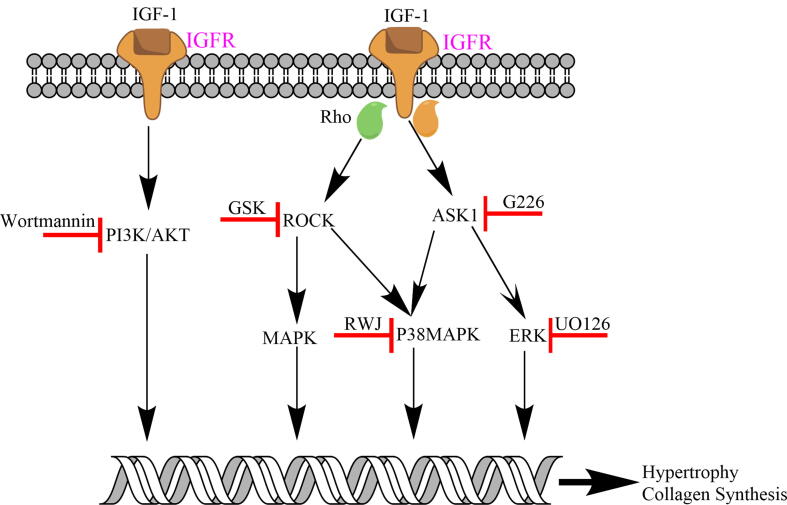
Neonatal rat cardiac myocytes (NCMs) and fibroblasts (NCFs) were isolated from 1 to 2-day old pups using enzymatic digestion. NCMs and NCFs were pre-treated with IGF binding protein 6, inhibitors for the PI3K/Akt Wortmannin, ERK1/2 U0126, Rho Associated Protein Kinase (ROCK) GSK576371, Apoptosis Signal-regulating Kinase-1 (ASK-1) G2261818A, and p38MAPK RWJ67657 pathways before stimulation with IGF-1 for 62 and 50 h, respectively. Cardiac myocyte hypertrophy and fibroblast collagen synthesis were determined by H-leucine and H-proline incorporation, respectively.
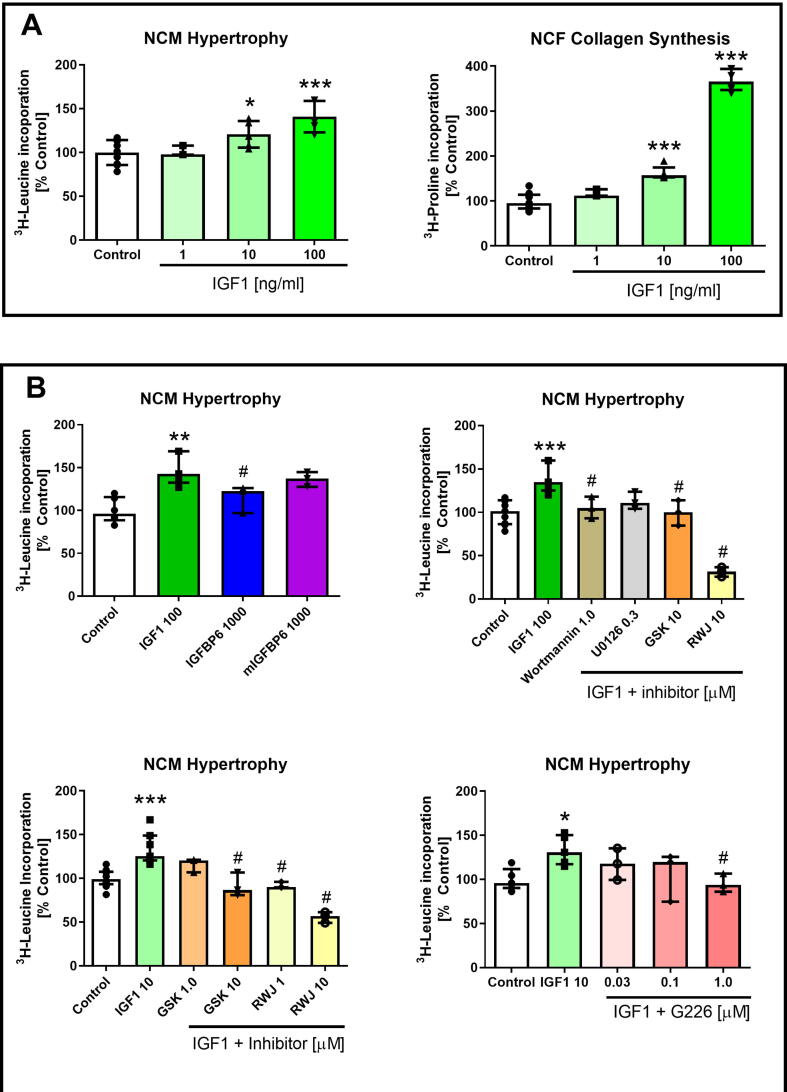
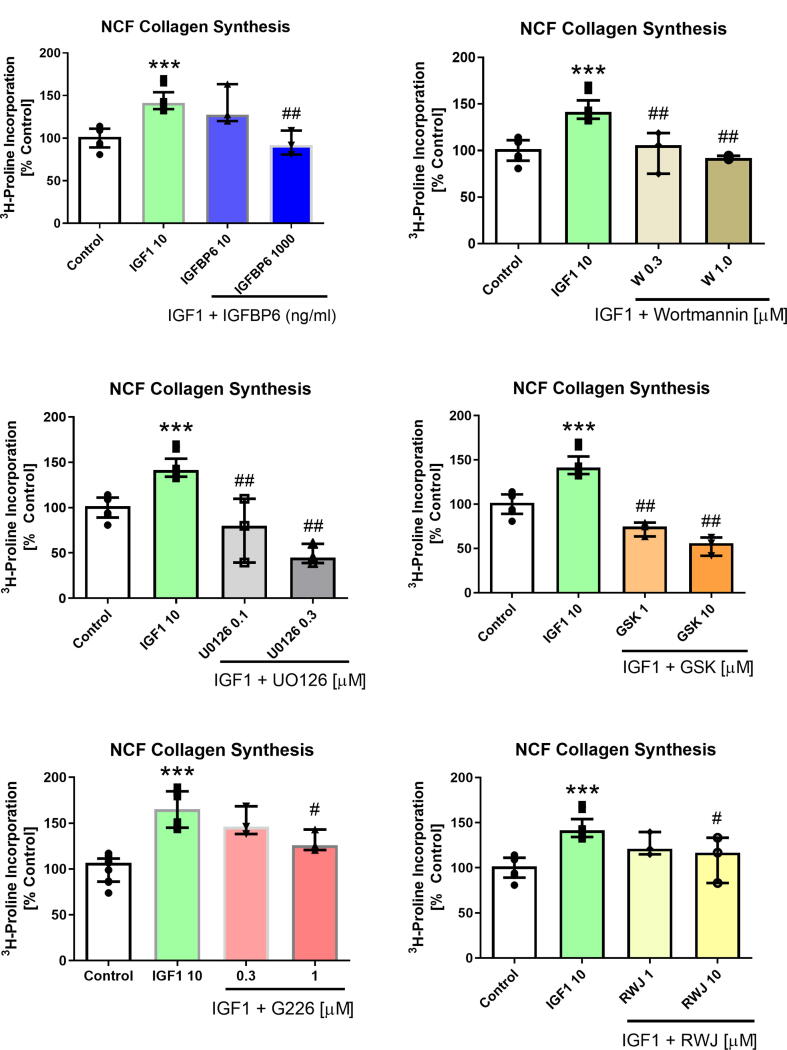
IGF-1 dose-dependently stimulated NCM hypertrophy and NCF collagen synthesis.Treatment with IGFBP6 and the kinase inhibitors, Wortmannin, U0126, GSK576371, G2261818A and RWJ67657 significantly inhibited IGF-1 stimulated NCM hypertrophy and NCF collagen synthesis.
This study is the first to demonstrate that IGF-1 treatment in NCMs and NCFs activates the ROCK, ASK-1 and p38MAPK pathways. Future research may be guided by consideration of the PI3K/Akt and ERK1/2 pathways potentially increasing collagen synthesis, and the utilisation of a biased agonist to reduce activation of the ROCK, ASK-1 and p38MAPK pathways to maximise cardioprotective benefit whilst mitigating risks.
胰岛素样生长因子1(IGF-1)作为治疗心血管疾病的一种新型疗法的研究已被证明具有前景。然而,在射血分数降低的心力衰竭患者中,IGF-1水平升高也与不良预后相关。此外,IGF-1治疗在经皮冠状动脉介入治疗中未显示出有益效果。尽管IGF-1对PI3K/Akt和ERK1/2信号通路的激活已被证明具有心脏保护作用,但其他细胞机制尚未得到充分研究。
采用酶消化法从1至2日龄幼鼠中分离出新生大鼠心肌细胞(NCMs)和成纤维细胞(NCFs)。在分别用IGF-1刺激62小时和50小时之前,先用IGF结合蛋白6、PI3K/Akt抑制剂渥曼青霉素、ERK1/2抑制剂U0126、Rho相关蛋白激酶(ROCK)抑制剂GSK576371、凋亡信号调节激酶-1(ASK-1)抑制剂G2261818A和p38丝裂原活化蛋白激酶(p38MAPK)抑制剂RWJ67657对NCMs和NCFs进行预处理。分别通过H-亮氨酸掺入和H-脯氨酸掺入来测定心肌细胞肥大和成纤维细胞胶原合成。
IGF-1以剂量依赖的方式刺激NCM肥大和NCF胶原合成。用IGFBP6和激酶抑制剂渥曼青霉素、U0126、GSK576371、G2261818A和RWJ67657处理可显著抑制IGF-1刺激的NCM肥大和NCF胶原合成。
本研究首次证明,在NCMs和NCFs中进行IGF-1治疗可激活ROCK、ASK-1和p38MAPK信号通路。未来的研究可能会考虑PI3K/Akt和ERK1/2信号通路可能增加胶原合成这一因素,并利用偏向性激动剂来减少ROCK、ASK-1和p38MAPK信号通路的激活,以在降低风险的同时最大化心脏保护益处。