Namutebi Fiona, Kayima James, Kaddumukasa Mark
Department of Medicine, School of Medicine, College of Health Sciences, Makerere University, P. O Box 7062, Kampala, Uganda.
Uganda Heart Institute, Kampala, Uganda.
BMC Rheumatol. 2021 Dec 27;5(1):56. doi: 10.1186/s41927-021-00228-w.
Vitamin D deficiency is highly prevalent among patients with osteoarthritis. It is associated with joint pain, stiffness and worse physical function. Whether vitamin D deficiency is associated with osteoarthritis is controversial. We investigated serum vitamin D levels and its association with symptom severity in patients with knee osteoarthritis.
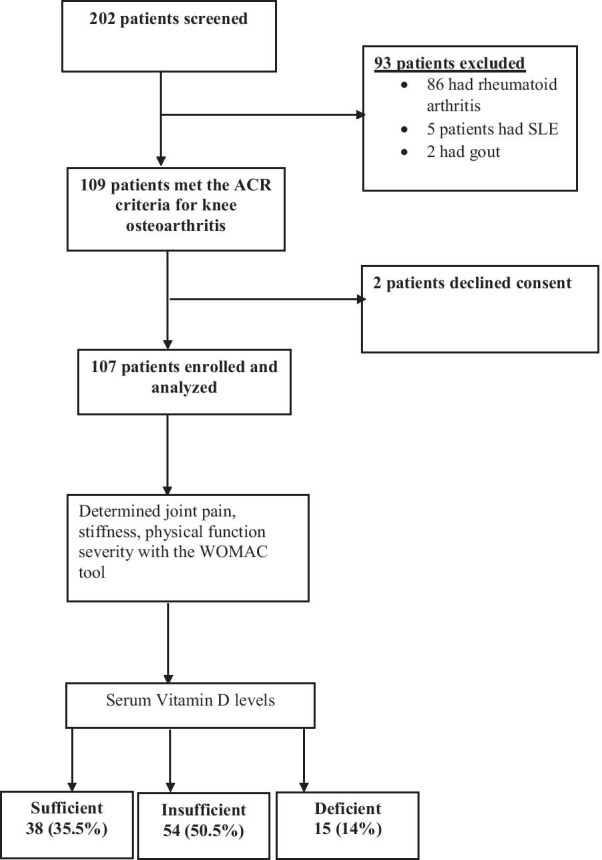
Between January 2020 to March and May 2020, we conducted a cross sectional study at a national referral hospital in Uganda. Using the American College of Rheumatology clinical criteria, 107 consenting adults were diagnosed with knee osteoarthritis. A questionnaire captured patient demographics and clinical characteristics. Joint pain, stiffness and physical function severity were assessed and graded based on the Western Ontario and McMaster Universities Arthritis Index (WOMAC). We determined serum vitamin D levels by electrochemilumniscence immunoassay. The data were analysed and adjusted for age, sex, education, occupation, family history, body mass index (BMI) and calcium supplementation.
Of the 107 patients, 92 (86%) patients were females, mean (SD) age was 58.1 (12.6) years. Nearly 65% of the patients had suboptimal serum vitamin D levels < 30 ng/ml. The median (Q1, Q3) WOMAC joint scores were as follows: pain 8.0 (5, 11), stiffness 1 (0, 2), physical function 29.0 (16, 41) and total WOMAC 39.0 (21, 54). Spearman correlations between serum vitamin D levels with symptom severity were as follows: joint pain (r = 0.18, p = 0.06), stiffness (r = 0.13, p = 0.17), physical function (r = 0.09, p = 0.36) and total WOMAC (r = 0.13, p = 0.19).
Serum vitamin D levels are not associated with joint pain, stiffness and physical function severity. Older age and higher BMI are associated with vitamin D deficiency in patients with knee osteoarthritis attending a national referral hospital rheumatology clinic in Uganda. Suboptimal vitamin D is an independent risk factor for total mortality in the general population. Clinical guidelines and further studies to determine age and BMI ranges required for vitamin D screening are needed in patients with osteoarthritis in Uganda. Patients are advised to keep a normal BMI.
维生素D缺乏在骨关节炎患者中极为普遍。它与关节疼痛、僵硬及更差的身体功能相关。维生素D缺乏是否与骨关节炎相关存在争议。我们调查了膝骨关节炎患者的血清维生素D水平及其与症状严重程度的关联。
在2020年1月至2020年3月及5月期间,我们在乌干达一家国家级转诊医院开展了一项横断面研究。依据美国风湿病学会临床标准,107名同意参与的成年人被诊断为膝骨关节炎。通过问卷调查收集患者的人口统计学和临床特征。基于西安大略和麦克马斯特大学骨关节炎指数(WOMAC)对关节疼痛、僵硬及身体功能严重程度进行评估和分级。我们采用电化学发光免疫分析法测定血清维生素D水平。对数据进行分析,并针对年龄、性别、教育程度、职业、家族史、体重指数(BMI)和补钙情况进行调整。
107名患者中,92名(86%)为女性,平均(标准差)年龄为58.1(12.6)岁。近65%的患者血清维生素D水平低于30 ng/ml,处于不理想状态。WOMAC关节评分的中位数(四分位间距)如下:疼痛8.0(5,11),僵硬1(0,2),身体功能29.0(16,41),WOMAC总分39.0(21,54)。血清维生素D水平与症状严重程度之间的Spearman相关性如下:关节疼痛(r = 0.18,p = 0.06),僵硬(r = 0.13,p = 0.17),身体功能(r = 0.09,p = 0.36),WOMAC总分(r = 0.13,p = 0.19)。
血清维生素D水平与关节疼痛、僵硬及身体功能严重程度无关。在乌干达一家国家级转诊医院风湿病诊所就诊的膝骨关节炎患者中,年龄较大和BMI较高与维生素D缺乏相关。维生素D水平不理想是普通人群全因死亡的独立危险因素。乌干达骨关节炎患者需要临床指南以及进一步研究来确定维生素D筛查所需的年龄和BMI范围。建议患者保持正常的BMI。