Karami Manoochehr, Mirzaei Mohammad, Shahbazi Fatemeh, Keramat Fariba, Jalili Ebrahim, Bashirian Saeid, Heidarimoghadam Rashid, Bathaei Jalal, Khazaei Salman
Department of Epidemiology, School of Public Health, Hamadan University of Medical Sciences, Hamadan, Iran.
Modeling of Noncommunicable Disease Research Center, School of Public Health, Hamadan University of Medical Sciences, Hamadan, Iran.
Med J Islam Repub Iran. 2021 Aug 11;35:103. doi: 10.47176/mjiri.35.103. eCollection 2021.
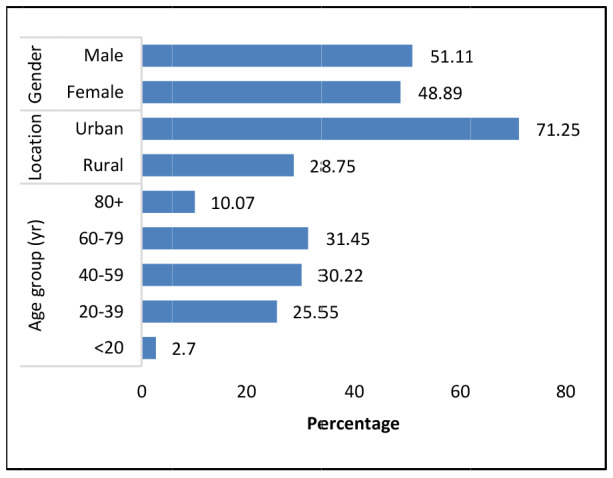
Coronavirus disease 2019 (COVID-19) is a contagious disease caused by a newly identified coronavirus. Our knowledge about the survival rate and prognostic factors of the disease is not established well. The purpose of this study was to evaluate the predictors of COVID-19 mortality in Hamadan province in western Iran. In this study, we included all laboratory-confirmed COVID-19 cases with known treatment outcomes in Hamadan province, Iran, between 20, 2020, to May 10, 2020. Demographic, clinical, laboratory data, and treatment outcomes were obtained from computerized medical records and compared between survived cases and patients with death outcomes. Univariable and multivariable logistic regression models were used to determine the predictors of death. From 749 investigated patients, 77 patients (10.28%) died during the treatment. The Mean age of patients was 53.97±19.04 years. Multivariable logistic regression showed that males had 2.07 (95% CI: 1.73, 2.54) fold higher odds of death. Those with 60 years old and more had 6.49 (95% CI: 4.53, 7.93) fold higher odds of death. Patients with an underlying disease had 7.14 (95% CI: 6.94, 7.38) fold higher odds of death, and patients who were hospitalized in the ICU ward had 2.24 (95% CI: 1.75, 2.90) times higher odds of COVID-19 related mortality. The potential predictors of death in COVID-19 cases, including the male gender, older age, and having an underlying disease could help physicians to identify patients with poor prognoses at an early stage and better management of them.
2019冠状病毒病(COVID-19)是一种由新发现的冠状病毒引起的传染病。我们对该疾病的生存率和预后因素的了解尚不充分。本研究的目的是评估伊朗西部哈马丹省COVID-19死亡率的预测因素。在本研究中,我们纳入了2020年2月20日至2020年5月10日期间伊朗哈马丹省所有实验室确诊且已知治疗结果的COVID-19病例。从计算机化医疗记录中获取人口统计学、临床、实验室数据及治疗结果,并在存活病例和死亡病例之间进行比较。采用单变量和多变量逻辑回归模型来确定死亡的预测因素。在749名接受调查的患者中,77名患者(10.28%)在治疗期间死亡。患者的平均年龄为53.97±19.04岁。多变量逻辑回归显示,男性死亡几率高2.07倍(95%置信区间:1.73,2.54)。60岁及以上者死亡几率高6.49倍(95%置信区间:4.53,7.93)。有基础疾病的患者死亡几率高7.14倍(95%置信区间:6.94,7.38),在重症监护病房住院的患者COVID-19相关死亡几率高2.24倍(95%置信区间:1.75,2.90)。COVID-19病例死亡的潜在预测因素,包括男性、老年和有基础疾病,有助于医生在早期识别预后不良的患者并对其进行更好的管理。