Faculty of Rehabilitation, Kobe Gakuin University Graduate School, Kobe, Hyogo, Japan.
Department of Rehabilitation, Maehara Orthopedics Rehabilitation Clinic, Obu, Aichi, Japan.
Pain Res Manag. 2022 Aug 29;2022:4323045. doi: 10.1155/2022/4323045. eCollection 2022.
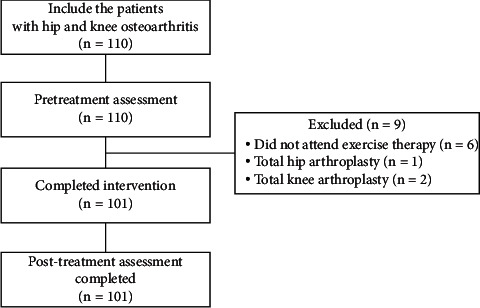
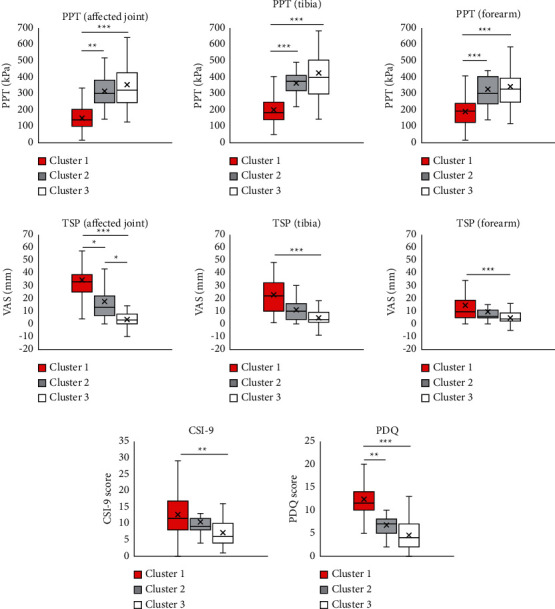
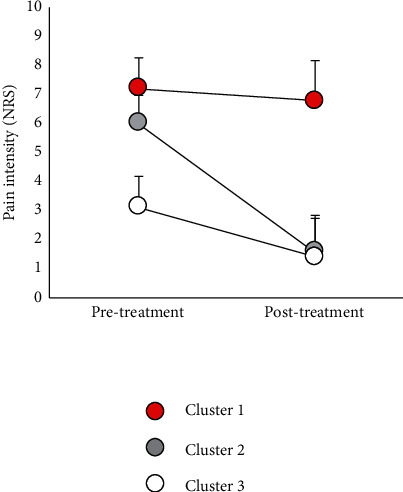
Pain sensitization and neuropathic pain-like symptoms are some of the common pain symptoms in patients with lower limbs, including hip and knee, osteoarthritis (HOA/KOA). Exercise therapy has been the first-line treatment; however, the effects differ for each patient. This prospective cohort study investigated the relationship between the effectiveness of exercise therapy and pretreatment characteristics (radiologic severity, pain sensitization, and neuropathic pain-like symptoms) of patients with HOA/KOA. We assessed the pain intensity using a numerical rating scale (NRS) before and after 12 weeks of exercise therapy in patients with HOA/KOA ( = 101). Before treatment, the Kellgren-Lawrence (K-L) grade; minimum joint space width (mJSW); pressure pain threshold (PPT) and temporal summation of pain (TSP) at the affected joint, tibia, and forearm; Central Sensitization Inventory-9; and painDETECT questionnaire (PDQ) were assessed. Cluster analysis was based on the pretreatment NRS and change in NRS with exercise therapy to identify the subgroups of pain reduction. The pretreatment characteristics of each cluster were compared. According to the results of the cluster analyses, patients in cluster 1 had severe pain that did not improve after exercise therapy, patients in cluster 2 had severe pain that improved, and those in cluster 3 had mild pain that improved. The patients in cluster 1 exhibited lower PPT at all measurement sites, higher TSP at the affected joint, and higher PDQ scores than those in other clusters. There was no difference in the K-L grade and mJSW among the clusters. The subgroup with severe pain and pain sensitization or neuropathic pain-like symptoms at pretreatment, even with mild joint deformity, may have difficulty in achieving improvement in pain after 12 weeks of exercise therapy. These findings could be useful for prognosis prediction and for planning exercise therapy and combining with other treatment.
疼痛敏感和神经病理性疼痛样症状是下肢包括髋关节和膝关节骨关节炎(HOA/KOA)患者常见的疼痛症状之一。运动疗法一直是一线治疗方法;然而,每位患者的效果不同。这项前瞻性队列研究调查了 HOA/KOA 患者运动疗法的疗效与治疗前特征(放射学严重程度、疼痛敏感和神经病理性疼痛样症状)之间的关系。我们使用数字评分量表(NRS)评估了 HOA/KOA 患者运动疗法前后 12 周的疼痛强度(n=101)。治疗前评估了 Kellgren-Lawrence(K-L)分级、最小关节间隙宽度(mJSW)、受累关节、胫骨和前臂的压痛阈(PPT)和疼痛时间总和(TSP)、中枢敏化量表-9(CSS-9)和疼痛 DETECT 问卷(PDQ)。基于治疗前 NRS 和运动疗法后 NRS 的变化进行聚类分析,以确定疼痛减轻的亚组。比较了每个聚类的预处理特征。根据聚类分析的结果,聚类 1 的患者疼痛严重,运动疗法后无改善,聚类 2 的患者疼痛严重,但运动疗法后有所改善,聚类 3 的患者疼痛轻微,且运动疗法后有所改善。聚类 1 患者在所有测量部位的 PPT 较低,受累关节的 TSP 较高,PDQ 评分较高。聚类之间的 K-L 分级和 mJSW 没有差异。治疗前疼痛敏感和神经病理性疼痛样症状严重或疼痛严重且伴有轻度关节畸形的患者,在接受 12 周运动疗法后,疼痛改善可能存在困难。这些发现可能有助于预测预后,并有助于规划运动疗法和与其他治疗方法结合使用。