Purvis Rachel S, Hallgren Emily, Moore Ramey A, Willis Don E, Hall Spencer, Gurel-Headley Morgan, McElfish Pearl A
College of Medicine, University of Arkansas for Medical Sciences Northwest, 1125 N. College Avenue, Fayetteville, AR 72703, USA.
Office of Community Health and Research, University of Arkansas for Medical Sciences Northwest, 1125 N. College Avenue, Fayetteville, AR 72703, USA.
Vaccines (Basel). 2021 Dec 1;9(12):1418. doi: 10.3390/vaccines9121418.
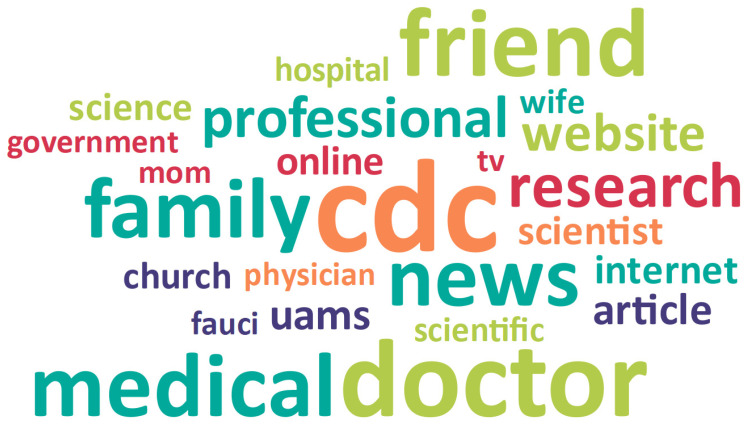
The World Health Organization has identified vaccine hesitancy as a top health concern. Emerging research shows that those who are hesitant may still get vaccinated; however, little is known about those who say they are hesitant but still get vaccinated. Most people have high trust in several sources of COVID-19 information, and trust in certain information sources such as the Centers for Disease Control and Prevention and health care providers was associated with being vaccinated. This study explored trusted information sources among hesitant adopters in the United States with a survey respondents completed while waiting after receiving a COVID-19 vaccine dose. The study included ( = 867) respondents. The majority of respondents were female (60.21%); were between the ages of 18 and 44 years old (71.97%); and were diverse, with most identifying as White (44.54%) or Hispanic/Latinx (32.55%). Hesitant adopters reported multiple trusted sources of COVID-19 vaccine information, which can be grouped into four emergent subthemes: (1) Health care/Medical science, (2) Personal relationships, (3) News and social media, and (4) Individual/Myself. Some respondents expressed a distrust of all sources of COVID-19 vaccine information, despite receiving the vaccine, describing a lack of trust in traditional sources of information such as the mainstream media or government. This study contributes to the literature by documenting trusted sources of COVID-19 vaccine information among hesitant adopters in the United States. Findings provide important insights about respondents' trusted sources of COVID-19 vaccine information that can inform future public health messaging campaigns intended to increase vaccine uptake among hesitant adopters.
世界卫生组织已将疫苗犹豫确定为首要的健康问题。新出现的研究表明,那些持犹豫态度的人仍可能接种疫苗;然而,对于那些表示自己持犹豫态度但仍接种了疫苗的人,我们知之甚少。大多数人对几种新冠病毒信息来源高度信任,对某些信息来源(如疾病控制与预防中心和医疗服务提供者)的信任与接种疫苗有关。本研究通过一项调查,对在美国接种新冠疫苗一剂后等待期间的受访者进行了询问,以探究犹豫接种者所信任的信息来源。该研究纳入了867名受访者。大多数受访者为女性(60.21%);年龄在18至44岁之间(71.97%);且具有多样性,大多数人认定为白人(44.54%)或西班牙裔/拉丁裔(32.55%)。犹豫接种者报告了多种新冠疫苗信息的可信来源,这些来源可归为四个新出现的子主题:(1)医疗保健/医学科学,(2)人际关系,(3)新闻和社交媒体,以及(4)个人/自己。一些受访者表示,尽管接种了疫苗,但他们不信任任何新冠疫苗信息来源,称对主流媒体或政府等传统信息来源缺乏信任。本研究通过记录美国犹豫接种者中新冠疫苗信息的可信来源,为相关文献做出了贡献。研究结果提供了关于受访者所信任的新冠疫苗信息来源的重要见解,可为未来旨在提高犹豫接种者疫苗接种率的公共卫生宣传活动提供参考。