Department of Computer Science, School of Engineering and Sciences, Campus Monterrey, Tecnologico de Monterrey, Monterrey 64849, Mexico.
Department of Computer Science, School of Engineering and Sciences, Campus Estado de México, Tecnologico de Monterrey, Atizapán 52926, Mexico.
Sensors (Basel). 2021 Dec 11;21(24):8293. doi: 10.3390/s21248293.
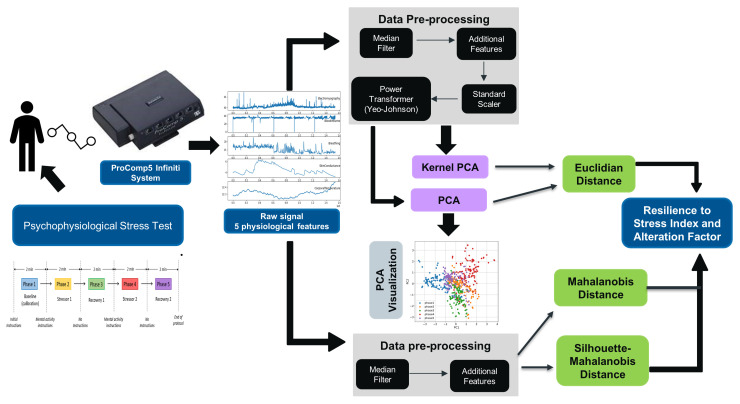
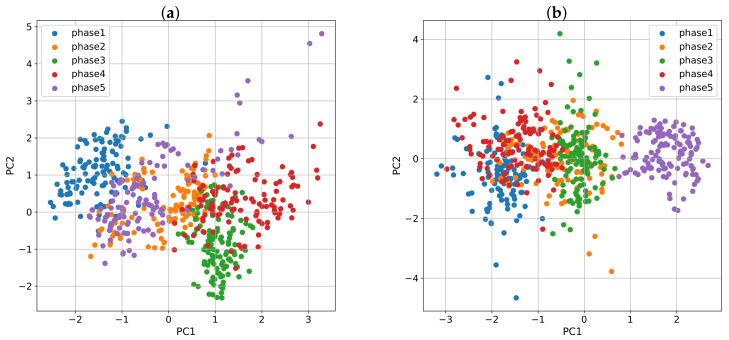
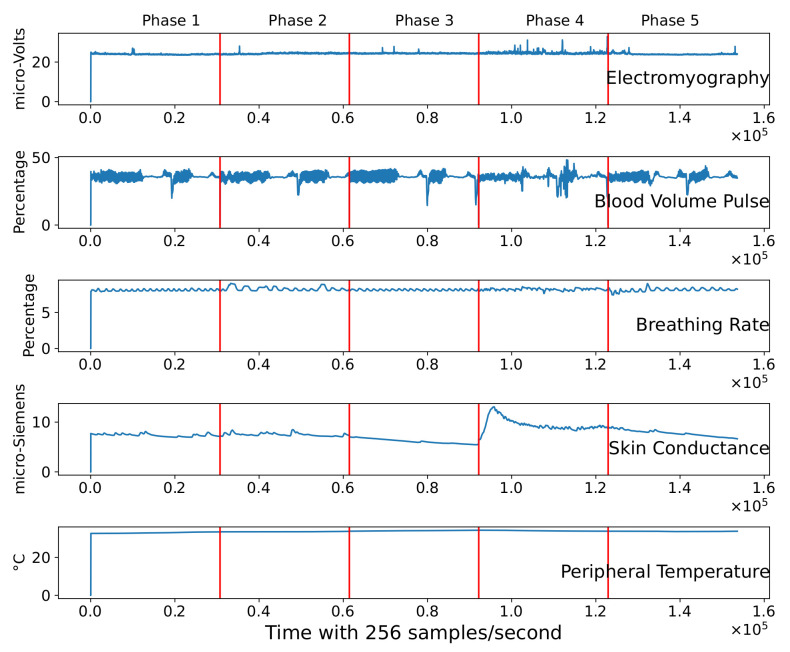
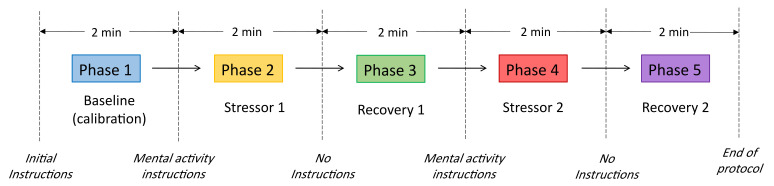
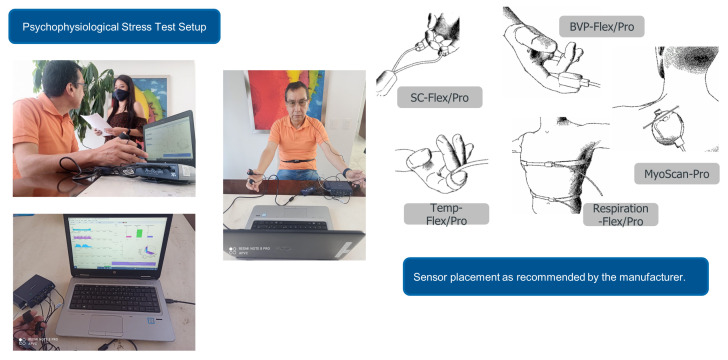
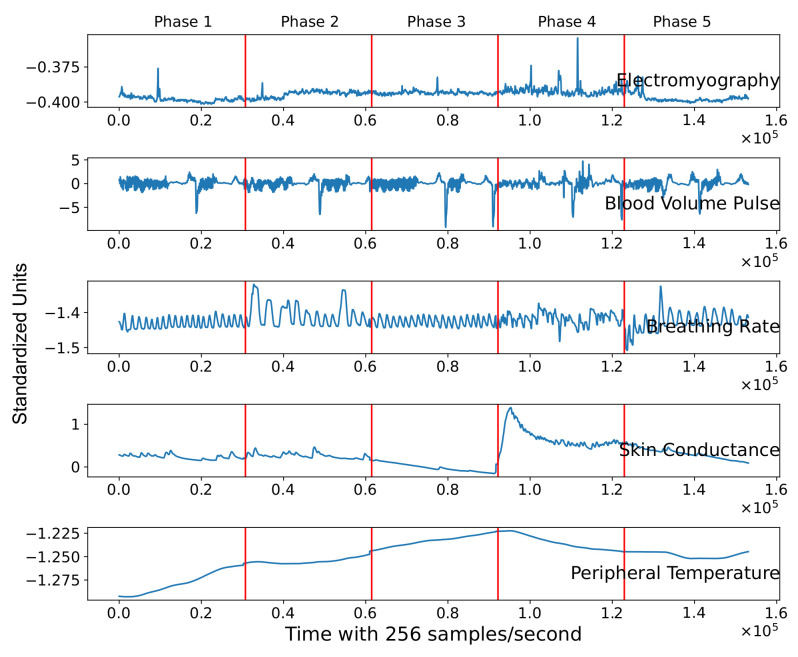
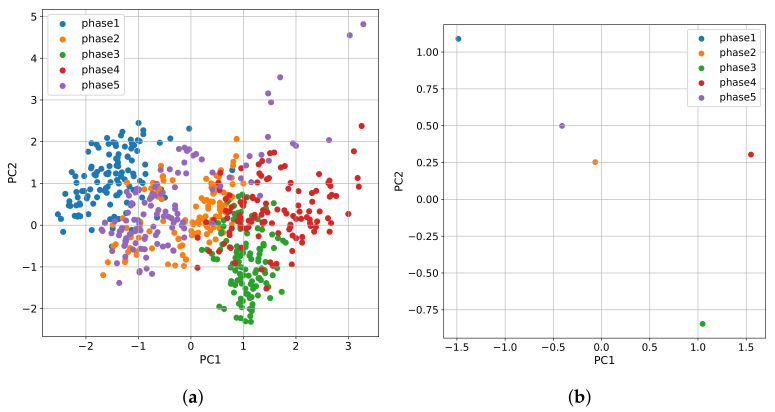
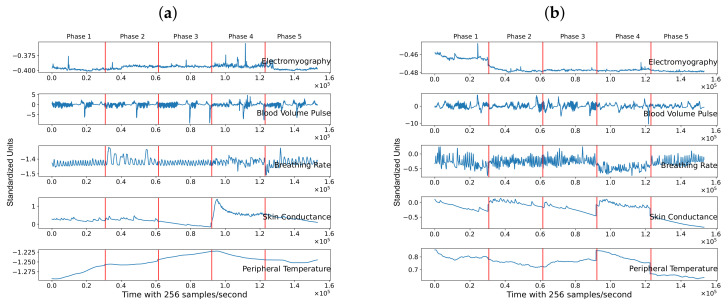
This study proposes a new index to measure the resilience of an individual to stress, based on the changes of specific physiological variables. These variables include electromyography, which is the muscle response, blood volume pulse, breathing rate, peripheral temperature, and skin conductance. We measured the data with a biofeedback device from 71 individuals subjected to a 10-min psychophysiological stress test. The data exploration revealed that features' variability among test phases could be observed in a two-dimensional space with Principal Components Analysis (PCA). In this work, we demonstrate that the values of each feature within a phase are well organized in clusters. The new index we propose, Resilience to Stress Index (RSI), is based on this observation. To compute the index, we used non-supervised machine learning methods to calculate the inter-cluster distances, specifically using the following four methods: Euclidean Distance of PCA, Mahalanobis Distance, Cluster Validity Index Distance, and Euclidean Distance of Kernel PCA. While there was no statistically significant difference (p>0.01) among the methods, we recommend using Mahalanobis, since this method provides higher monotonic association with the Resilience in Mexicans (RESI-M) scale. Results are encouraging since we demonstrated that the computation of a reliable RSI is possible. To validate the new index, we undertook two tasks: a comparison of the RSI against the RESI-M, and a Spearman correlation between phases one and five to determine if the behavior is resilient or not. The computation of the RSI of an individual has a broader scope in mind, and it is to understand and to support mental health. The benefits of having a metric that measures resilience to stress are multiple; for instance, to the extent that individuals can track their resilience to stress, they can improve their everyday life.
本研究提出了一种新的个体应激弹性指数,该指数基于特定生理变量的变化来衡量。这些变量包括肌电图(肌肉反应)、血流脉冲、呼吸频率、外周温度和皮肤电导。我们使用生物反馈设备对 71 名个体进行了 10 分钟的心理生理应激测试,测量了这些数据。数据探索表明,主成分分析(PCA)可以在二维空间中观察到测试阶段中特征之间的可变性。在这项工作中,我们证明了在一个阶段内每个特征的值都很好地聚类在一起。我们提出的新指数,应激弹性指数(RSI),就是基于这一观察结果。为了计算指数,我们使用无监督机器学习方法计算了聚类间的距离,具体使用了以下四种方法:PCA 的欧几里得距离、马氏距离、聚类有效性指数距离和核 PCA 的欧几里得距离。虽然这些方法之间没有统计学上的显著差异(p>0.01),但我们建议使用马氏距离,因为这种方法与墨西哥人应激弹性量表(RESI-M)具有更高的单调关联。结果令人鼓舞,因为我们证明了计算可靠的 RSI 是可能的。为了验证新指数,我们进行了两项任务:将 RSI 与 RESI-M 进行比较,以及对第一阶段和第五阶段之间的 Spearman 相关性进行比较,以确定行为是否具有弹性。计算个体的 RSI 有更广泛的考虑,旨在理解和支持心理健康。衡量应激弹性的指标有多种好处;例如,个体能够跟踪自己的应激弹性,就可以改善他们的日常生活。